macro / ch 13
13.6Supply-side policies
Goals of supply-side policies
- Promote long-term growth by increasing the productive capacity of the economy
- the main objective is to increase potential output
- rightward shift of LRAS curve
- Improve competition and efficiency
- make the economy more responsive to the market forces of demand and supply
- to increase efficiency in production
- Reduce costs of labour and reduce unemployment through greater labour market flexibility
- greater labour market flexibility means making the labour market more responsive to the market forces of demand and supply
- to reduce unemployment as well as labour costs
- Increase incentives of firms to invest in innovation by lowering costs of production
- Higher after tax profits through lower costs of production as well as lower taxes provide firms with incentives to engage in research and development
- increases the productive capacity of the economy resulting in greater increases in productive capacity and growth in potential output.
- Reduce inflation to improve international competitiveness
- Increases in potential output reduce inflationary pressures in the economy
- making exports more competitive in global markets
Market-based supply-side policies
- In this view, the economy’s real GDP tends automatically towards long-run full employment equilibrium and potential GDP (see Chapter 9). The focus of government policies should therefore be to create conditions that allow market forces to work well.
- three headings
- Encouraging competition
- Labour market reforms/Increasing labour market flexibilities
- Incentive-related policies
- Encouraging competition
- greater competition among firms forces them to reduce costs of production, contributing to greater efficiency in production and improve resource allocation, with the possible added benefit of improving the quality of goods and services
- Privatisation
- involving a transfer of ownership of a firm from the public to the private sector, can increase efficiency due to improved management and operation of the privatised firm.
- This is based on the argument that government enterprises are often inefficient due to bureaucratic procedures, high administrative costs and unproductive workers, because they do not face incentives to lower costs and maximise profits.
- Deregulation
- Deregulation involves elimination or reduction of government regulation of private sector activities.
- Economic regulation involves government control of prices, output, and other activities of firms, offering them protection against competition
- Many countries have moved toward removal of government regulations, and hence economic deregulation. A main form of deregulation has been to allow new, private firms to enter into monopolistic or oligopolistic industries, thus forcing existing firms to face competition. The objective has been to increase efficiency, lower costs and improve quality.
- ‘Social regulation’ involves protecting consumers against undesirable effects of private sector activities (many of these involve negative externalities)
- In contrast to economic regulation, social regulation is being strengthened in many countries in the interests of public safety. Some economists, however, argue that social regulation is excessive, giving rise to costly and inefficient bureaucratic procedures, paperwork and unnecessary government interference, and should therefore be reduced.
- Contracting out to the private sector
- a policy option whereby governments make a contractual agreement with private firms to provide goods and services for the government.
- Examples include public goods, information technology, human resources management and accounting services
- These result in increased competition as private firms compete with each other to get contracts with the government
- Anti-monopoly regulation
- Increased competition can result from restricting market power of firms by enforcing anti-monopoly legislation, by breaking up large firms that have been found to engage in monopolistic practices into smaller units that will behave more competitively, and by preventing mergers between firms that might result in too much market power.
- Greater scope for the forces of supply and demand may result in increased efficiency, lower costs and improved quality (innovation, in order to compete with similar firms)
- Trade liberalisation
- International trade between countries has become freer (liberalised) in recent decades due to reductions in trade barriers
- Free or freer trade increases competition between firms both domestically and globally, which can result in greater efficiency in production and an improved allocation of resources.
- Labour market reforms
-
= increasing labour market flexibility
-
= reducing labour market rigidities
-
to get rid of rigidities by making labour markets more competitive, making wages respond to the forces of supply and demand, lowering labour costs and increasing employment by lowering the natural rate of unemployment
-
Lower costs of production can lead to increased profits, which in turn may result in greater investment by firms, increased R&D, increased capital goods production, and therefore increases in potential output (potential/long-term economic growth)
-
Abolishing minimum wage legislation
- Elimination or reduction of the legal minimum wage it is argued reduces unemployment by allowing the equilibrium wage to fall
- lower unemployment
- greater firm profits, as wage costs would be lowered
- more investment and economic growth
- Elimination or reduction of the legal minimum wage it is argued reduces unemployment by allowing the equilibrium wage to fall
-
Weakening the power of labour (trade) unions
- Unionised labour frequently succeeds in securing high wage increase
- if labour unions are weakened, wages will be more responsive to the forces of supply and demand, and will therefore be more likely to fall in if there is unemployment
- lower unemploymeht
- greater firm profits, as wage costs would be lowered
- more investment and economic growth
-
Reducing unemployment benefits
- unemployment benefits have the unintended effect of reducing the incentive to search for a new job, causing some unemployed workers to remain unemployed
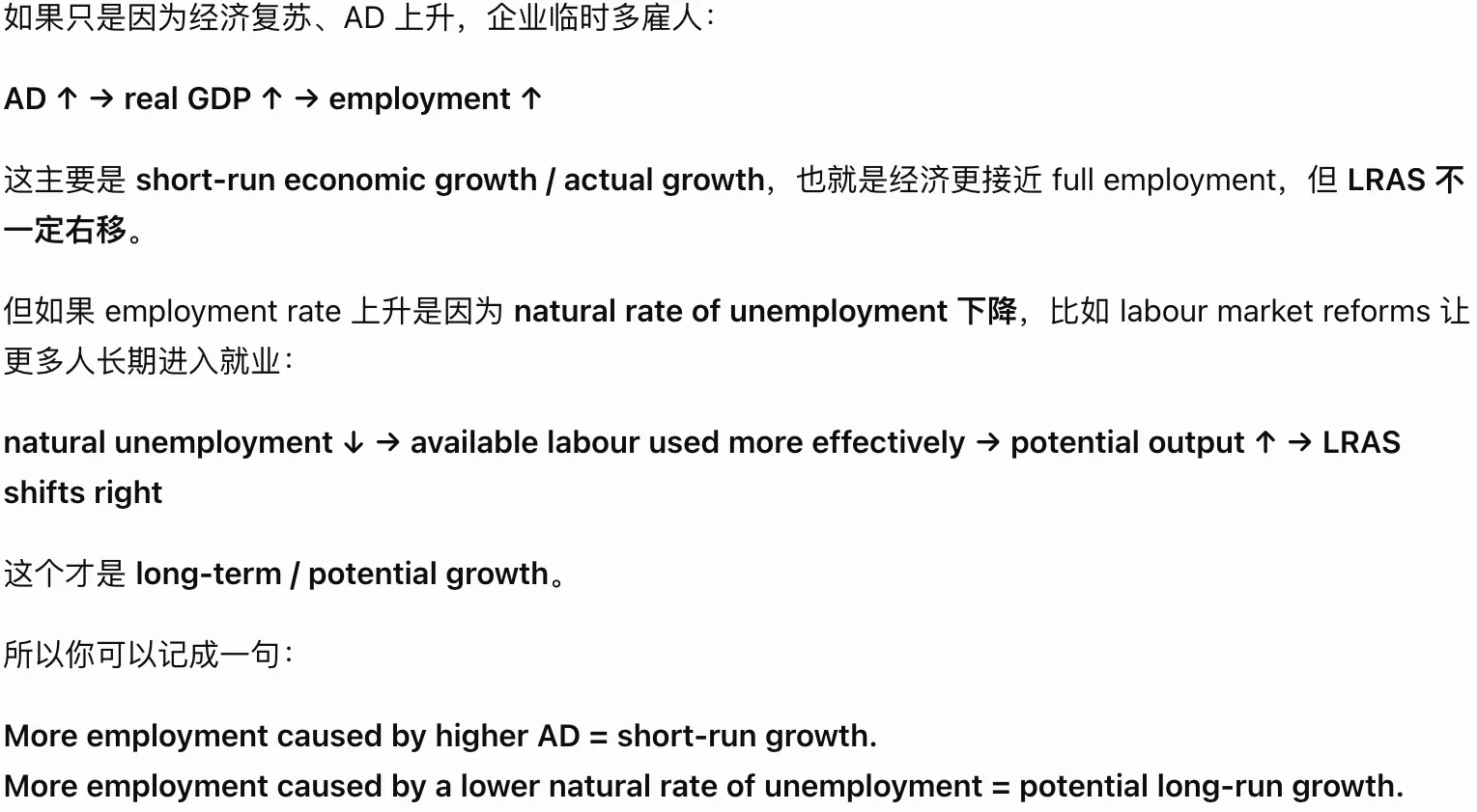
- reducing unemployment benefits is expected to lower unemployment, as it would encourage the unemployed to look for work. This could work to reduce the natural rate of unemployment.
- lower natural unemployment → more people are employed productively → greater productive capacity (quantity of factors of production, specifically labours, increases)
-
重点!!!
-
-
Reducing job security
- Many countries have laws protecting workers against being fired, making it costly for firms to fire workers because of high levels of compensation that must be paid to the worker being laid off
- reducing workers’ job security by making it easier and less costly for firms to let go of workers has the effect of increasing employment, because firms are more likely to hire new workers if they know they can fire them easily and without cost if they are no longer needed
- more available workers are used effectively (efficiently), lower natural rate of unemloyment, higher quantity of factors of production
- reducing job security would decrease firms’ labour costs because of the lower costs of firing, and would therefore increase profits, investment and economic growth.
-
- Incentive-related policies
- cutting various types of taxes
- change the incentives faced by taxpayers (firms and consumers)
- Lowering personal income taxes
- Supply-side economists argue that changes in personal income taxes have an even greater impact on aggregate supply, comparing with impact on AD
- They lead to higher after-tax incomes, creating an incentive for people to provide more work
- This can happen through an increase in the number of hours worked per week; an increase in the number of people interested in finding work (who were formerly not interested in working); an increase in the number of years worked, as people may decide to retire later; a decrease in unemployment as unemployed workers choose to shorten the duration of their unemployment.
- All these factors may work to shift the LRAS curve to the right, increasing potential output.
- Lowering taxes on capital gains and interest income
- Taxes on capital gains are taxes on profits from financial investments (such as stocks and bonds) or from buying and selling real estate
- If the taxes on capital gains and on income from interest on savings deposits are reduced, people may be more motivated to save, thus increasing the amount of savings available for investment (savings are deposits in the bank, firms need to borrow money from the bank to invest)
- More investment means a greater production of capital goods (quantity and quality of factors of production) and an increase in potential output