macro / ch 13
13.2Demand management and monetary policy
The role of central banks
- monetary policy is carried out by the central bank of each country
- commercial banks
- are private or public financial institutions whose main functions are to hold deposits for their customers (customers and fimrs), to make loans to their customers, to transfer funds by check electronically from one bank to another, and to buy government bonds.
- central bank
- Banker to the government
- it holds the government’s cash (as deposits), receives payments for the government and makes payments for the government, and manages the government’s borrowing by selling bonds to commercial banks and the public.
- Banker to commercial banks
- acts as a banker to commercial banks by holding deposits for them and can also make loans to them in times of need.
- it is not a banker to consumers and firms
- Regulator of commercial banks
- regulates and supervises commercial banks
- making sure they operate with appropriate levels of cash (reserve ratio), according to rules that ensure the safety of the financial system
- Conduct monetary policy
- the central bank is responsible for monetary policy
- based on its control of the supply of money and interest rates
- Banker to the government
The goals of monetary policy
- Low and stable rate of inflation
- usually around 2%
- Low unemployment
- try to maintain unemployment at relatively low levels
- including cyclical unemployment, arising in a deflationary gap due to insufficient AD
- Reduce business cycle fluctuations
- fluctuations around potential output are disruptive to the normal functioning of the economy, causing inflation when output is above potential output, and cyclical unemployment when it is below the potential
- make the fluctuations as small as possible
- Promote a stable economic environment for long term growth
- External balance
- refers to a situation where a country’s revenues from exports are balanced by spending on imports over an extended period of time
- the central bank can influence exchange rates because of the close relationship between interest rates and exchange rates
Inflation targeting
- aims at maintaining a particular targeted rate of inflation
- inflation targeting
- the public announcement of medium-term numerical targets of inflation with an institutional commitment by the monetary authority to achieve these targets
- advantages
- achievement of a low and stable rate of inflation
- improved ability of economic decision-makers to anticipate the future rate of inflation and therefore plan their economic activities
- greater co-ordination between monetary and fiscal policy since knowlede about inflation targets allows the government to plan its fiscal policy to complement the central bank’s monetary policy
- disadvantages
- reduced ability of the central bank to pursue other macroeconomic objectives, the goal of full employment
- conflict between low unemployment and low rate of inflation
Determination of the rate of interest ( HL only)
- the money market and the rate of interest
- Interest Rate Basics
- Borrowing money requires paying back the principal + interest
- Interest = a percentage of the principal paid per year (e.g. 10% on $1000 = $100/year)
- Factors Affecting Interest Rates (real world)
- Risk level of the loan → higher risk = higher rate
- Maturity (loan duration) → longer = higher rate
- Loan size → larger loan = lower rate
- Lender’s market power → more power = higher rate
- Economists simplify by assuming a single “rate of interest” in models
- Money Market
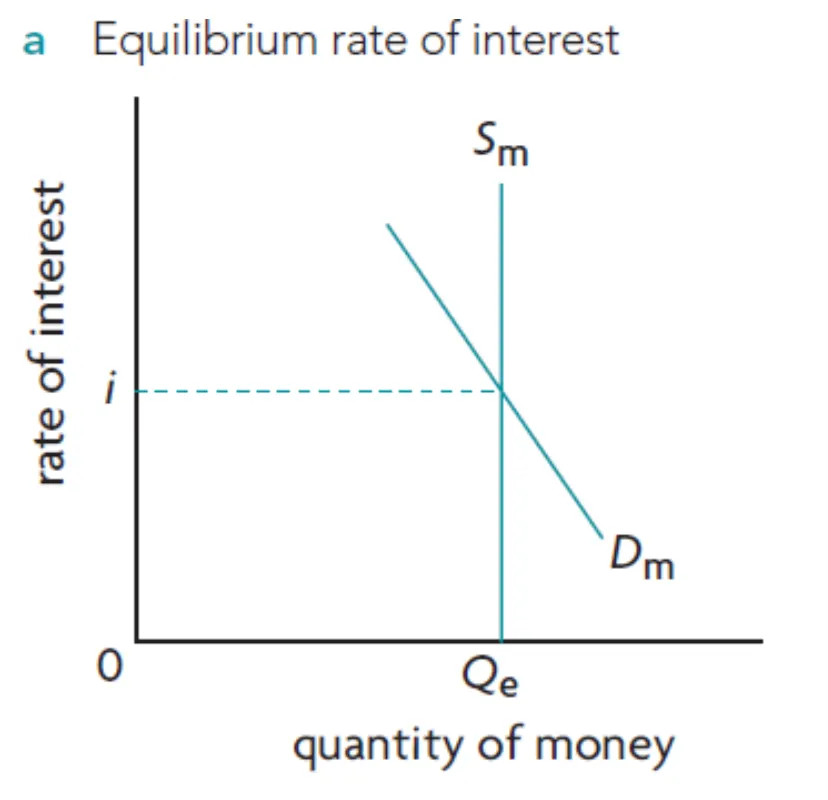
- Interest rate is determined by supply and demand for money
- Money = anything accepted as payment (currency + cheque/checking accounts)
- Horizontal axis = quantity of money; Vertical axis = rate of interest
- Supply of Money (Sₘ)
- Fixed by the central bank → shown as a vertical line (interest-inelastic)
- Demand for Money (Dₘ)
- Downward-sloping curve
- As interest rates fall → quantity of money demanded rises
- Key reason: money (currency/cheques) earns no interest, so the opportunity cost of holding money falls when interest rates fall
-
-
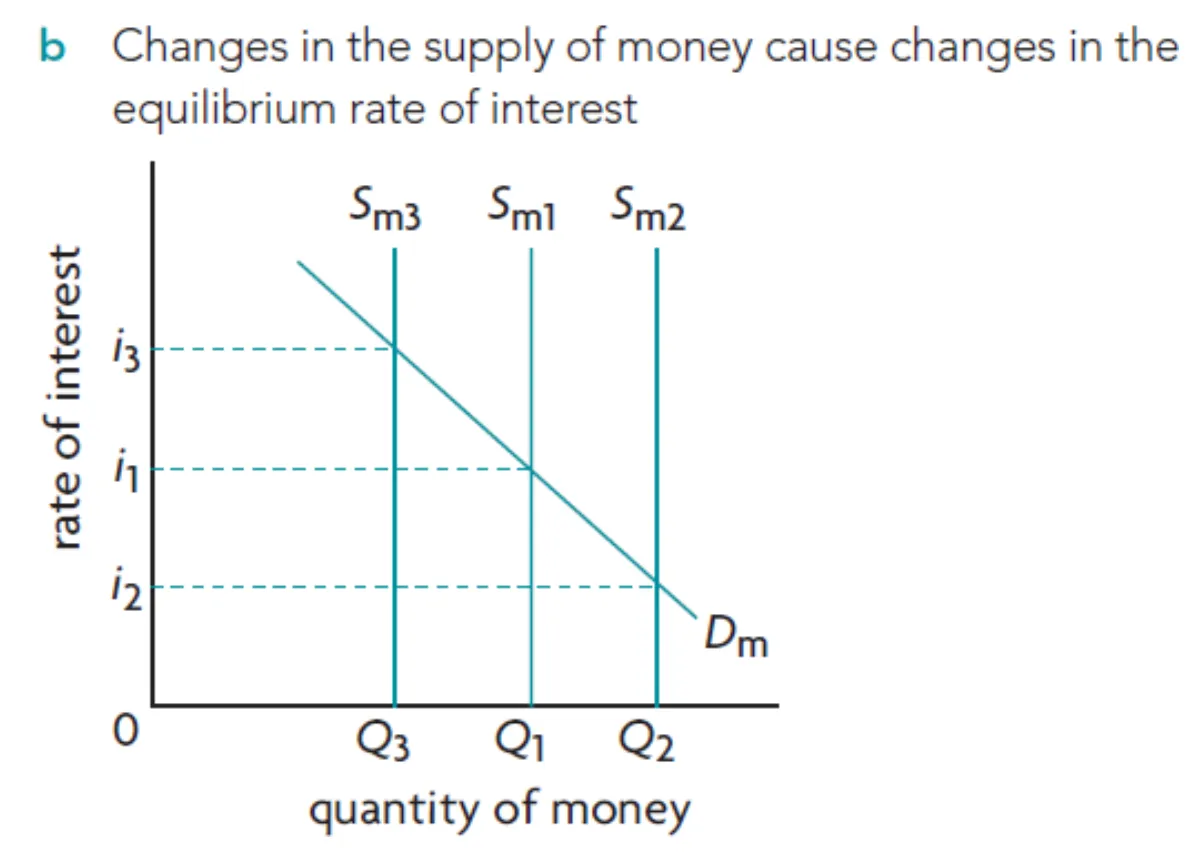
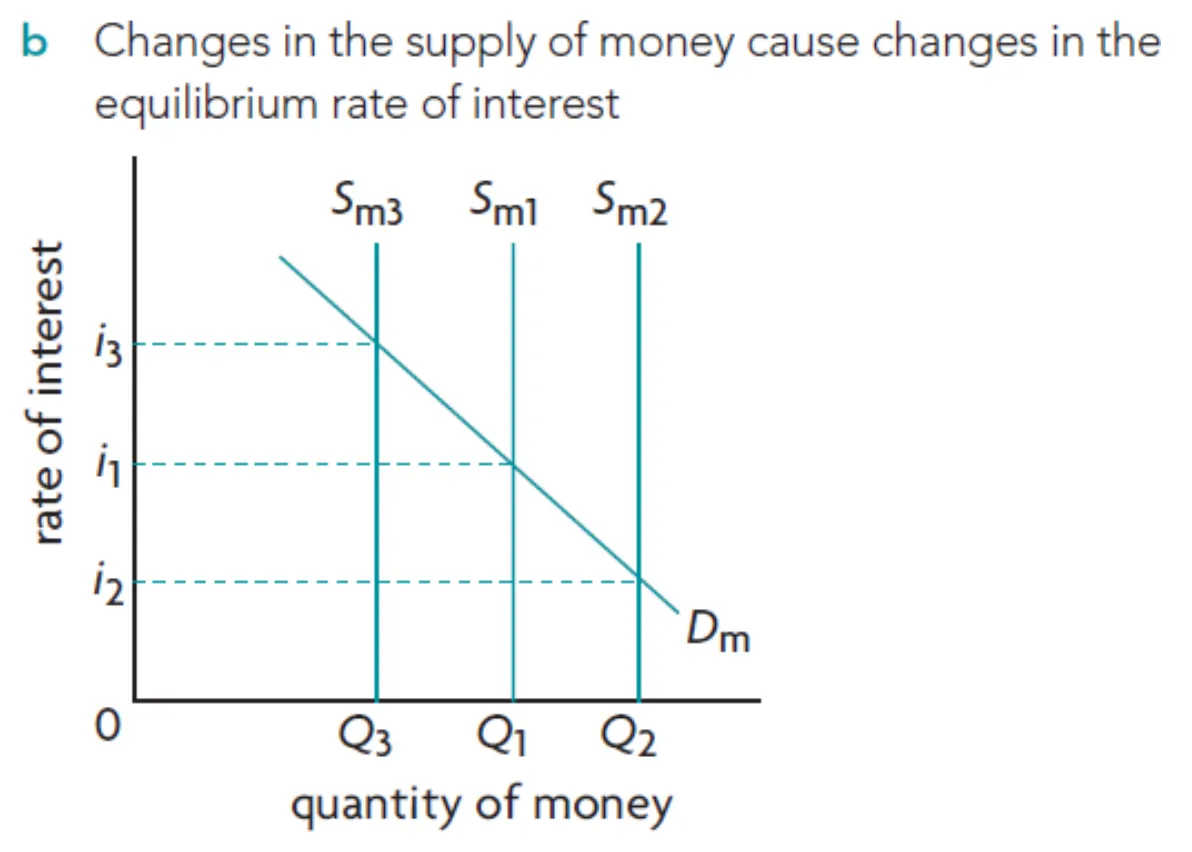
- setting a target interest rate
- Central bank sets a target interest rate, then adjusts the money supply until the equilibrium rate matches the target
- Central banks don’t directly fix interest rates — they let the market determine it by shifting Sₘ
- To raise rates (i₁ → i₃): central bank reduces money supply → Sₘ shifts left → equilibrium rate rises
- If market rate deviates from target, the central bank keeps adjusting Sₘ until target is achieved
-
- Interest Rate Basics
How the central bank changes the money supply (HL only)
- money creation process
- Customer deposits £1000 → bank keeps 20% (£200) as required reserves → lends out £800 (excess reserves)
- Borrower spends £800 → recipient deposits it → that bank keeps 20% (£160) → lends out £640
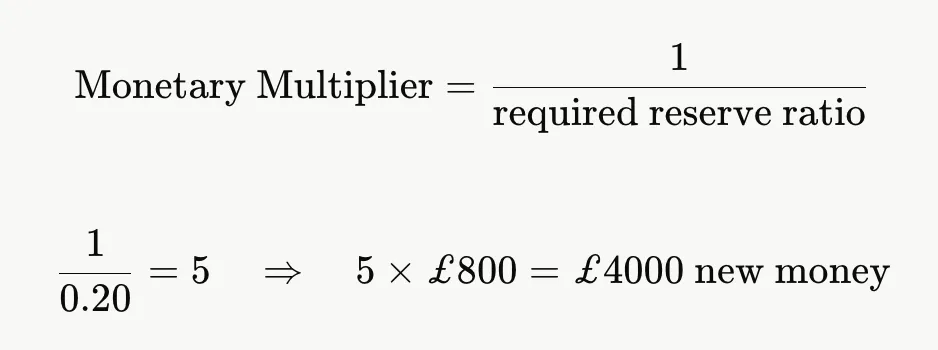
- This repeats infinitely → total new money created = £4000
- How commercial banks create money
- Required reserves = the legally required fraction of deposits banks must keep in vaults
- Minimum reserve requirement (required reserve ratio) = the % set by the central bank
- Excess reserves = deposits beyond required reserves → can be lent out
- Fractional reserve system = only a fraction of deposits are kept; the rest are lent out
- The Monetary Multiplier
-
- Key Takeaways
- New loans are new money — borrowers use loans for transactions just like regular money
- The money created is a maximum — banks may lend less in practice
- Lower reserve requirement → more excess reserves → more money created
- Tools of monetary policy
- Open market operations
- Involves buying/selling pre-existing government bonds in the bond market
- Bond = a debt certificate that promises periodic interest payments until repaid at maturity
- Bond holder = lender; Bond issuer = borrower
- To Lower Interest Rates → Central bank BUYS bonds
- Pays commercial banks for bonds → increases their excess reserves
- More excess reserves → more loans → money supply increases → Sₘ shifts right → interest rate falls ↓
- To Raise Interest Rates → Central bank SELLS bonds
- Commercial banks pay for bonds → reduces their excess reserves
- Less excess reserves → fewer loans → money supply decreases → Sₘ shifts left → interest rate rises ↑
- Minimum reserve requirements
- Central bank tool: changing the minimum reserve requirement to influence money supply
-
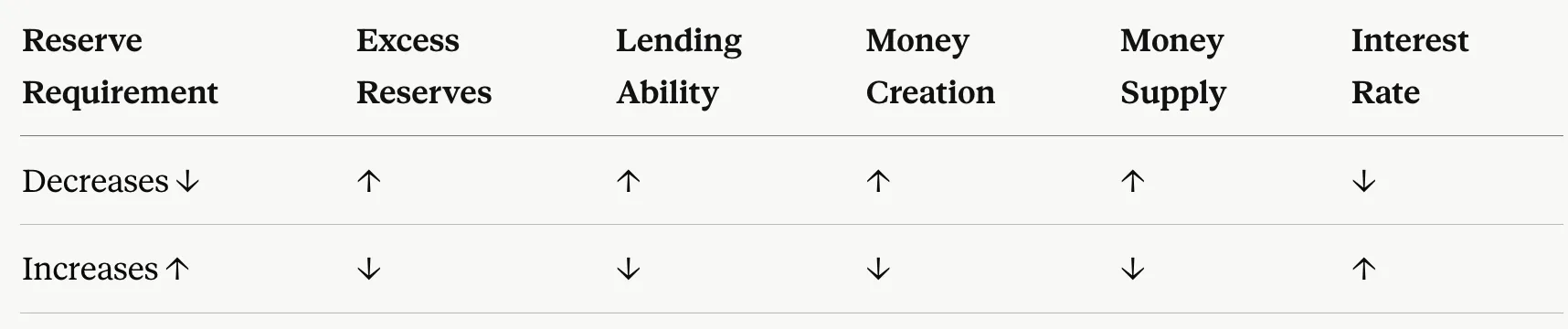
- Lower reserve requirement → banks keep less, lend more → money supply increases
- Higher reserve requirement → banks keep more, lend less → money supply decreases
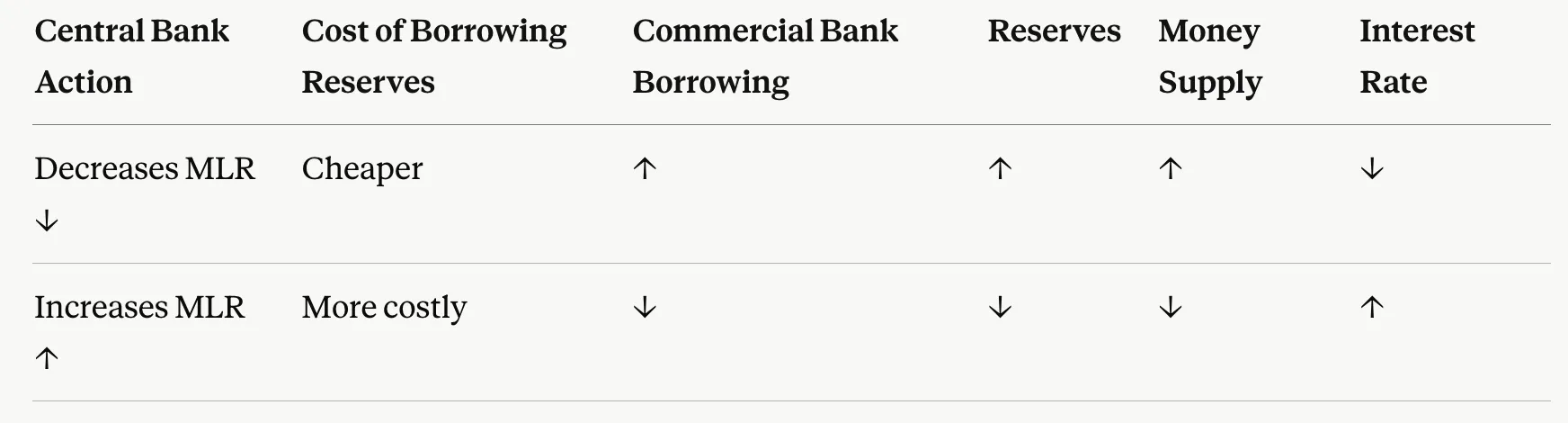
- Changes in the central bank’s minimum lending rate
- The interest rate the central bank charges commercial banks when lending to them
- Reflects the cost of acquiring reserves for commercial banks
- How It Works
-
- Lower MLR → cheaper for commercial banks to borrow reserves → more lending → money supply increases
- Higher MLR → more expensive to borrow reserves → less lending → money supply decreases
- Quantitative easing
- An unconventional monetary policy tool — similar to OMO bond-buying but on a much larger scale, involving more types of financial assets in larger quantities
- Why It’s Used
- Conventional monetary policy works by lowering interest rates to encourage borrowing & boost AD
- When rates approach zero, conventional policy becomes ineffective
- QE is used as an alternative to further stimulate the economy
- How It Works
- Central bank buys large quantities of financial assets from commercial banks
- Central bank pays commercial bank by electronically creating reserves for commercial banks
- Commercial banks gain more reserves → more lending capacity, more willing and able to offer loans → money supply increases → AD increases
-
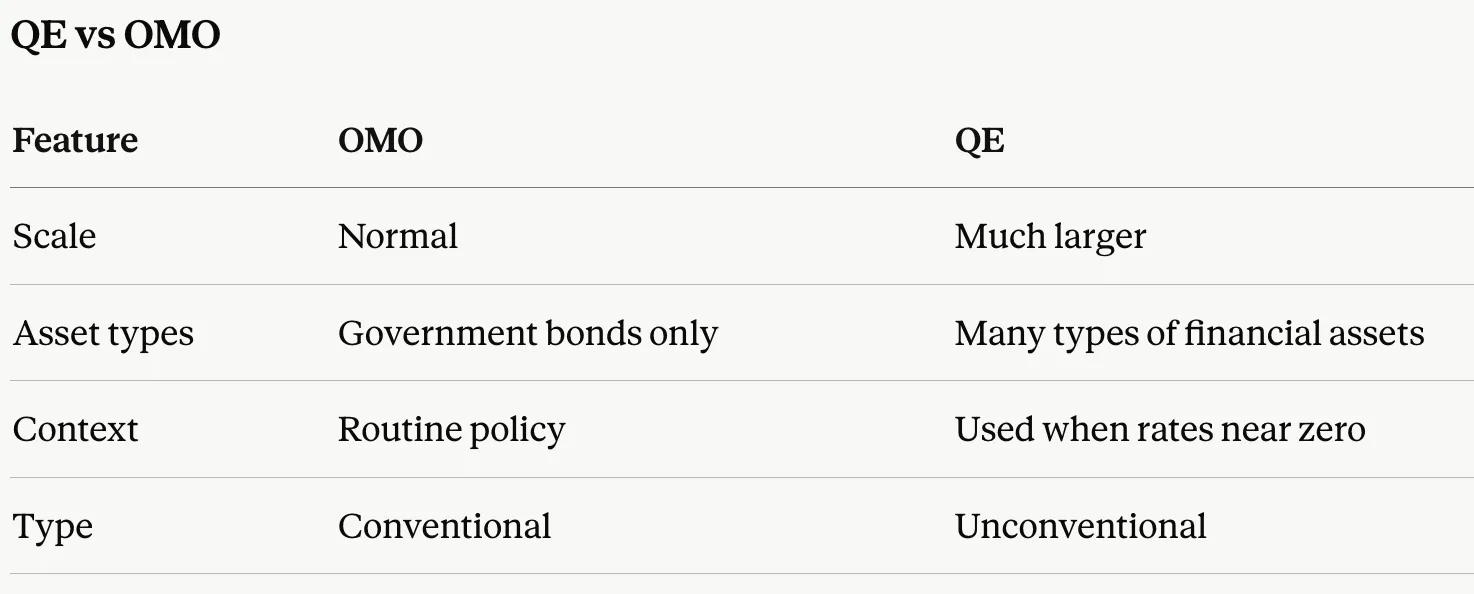
- QE = last resort tool when interest rates can’t go lower → central bank “prints” electronic money to inject reserves directly into commercial banks → goal is to raise AD
- Open market operations
Real versus nominal interest rates
- Nominal interest rate = the market rate you actually see (e.g. bank tells you “5% on savings”)
- Real interest rate = nominal rate adjusted for inflation → measures actual purchasing power gained
- Real interest rate=Nominal interest rate−Rate of inflation
- To protect savings from inflation, nominal rate must be ≥ rate of inflation
- If real rate is negative → savers are actually losing wealth in real terms
- This is why inflation erodes savings — even if the bank pays interest, it may not be enough to keep up
The role of monetary policy: deflationary/recessionary and inflationary gaps
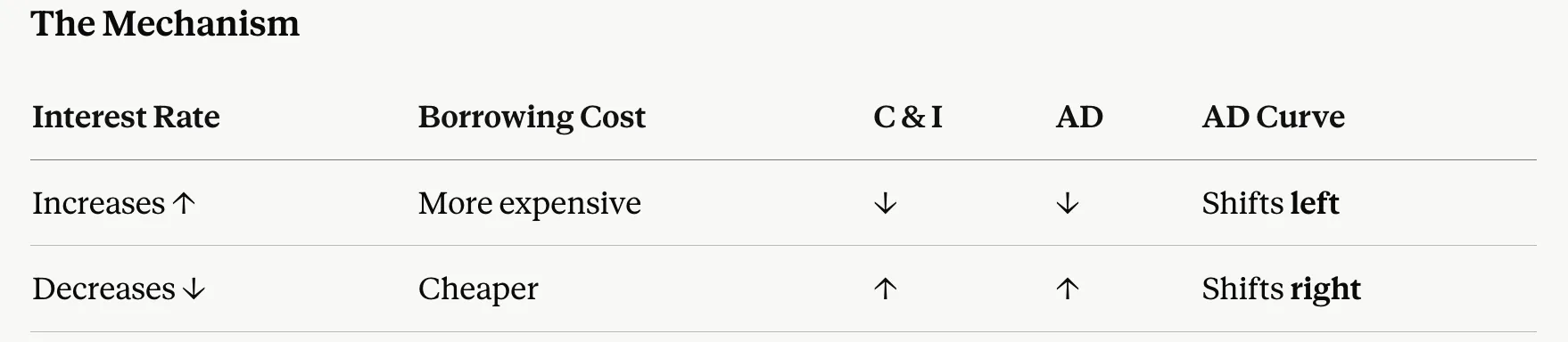
- Changes in interest rates and AD
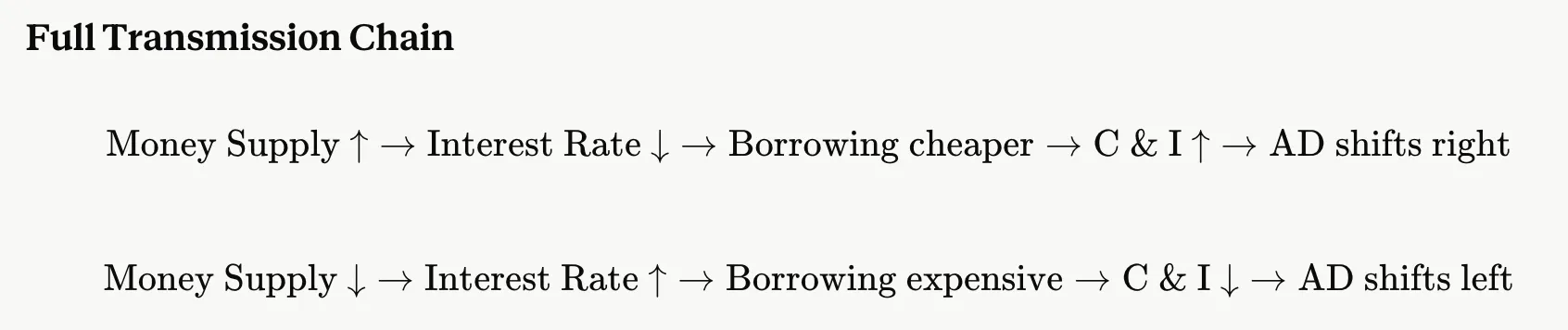
- Changing money supply → changes interest rates → ultimately affects AD
- Interest rates affect 2 of the 4 components of AD: C (consumption) and I (investment)
- Why? Because consumer and firm spending is partly funded by borrowing
-
- the chain
-
- Expansionary monetary policy
-
-
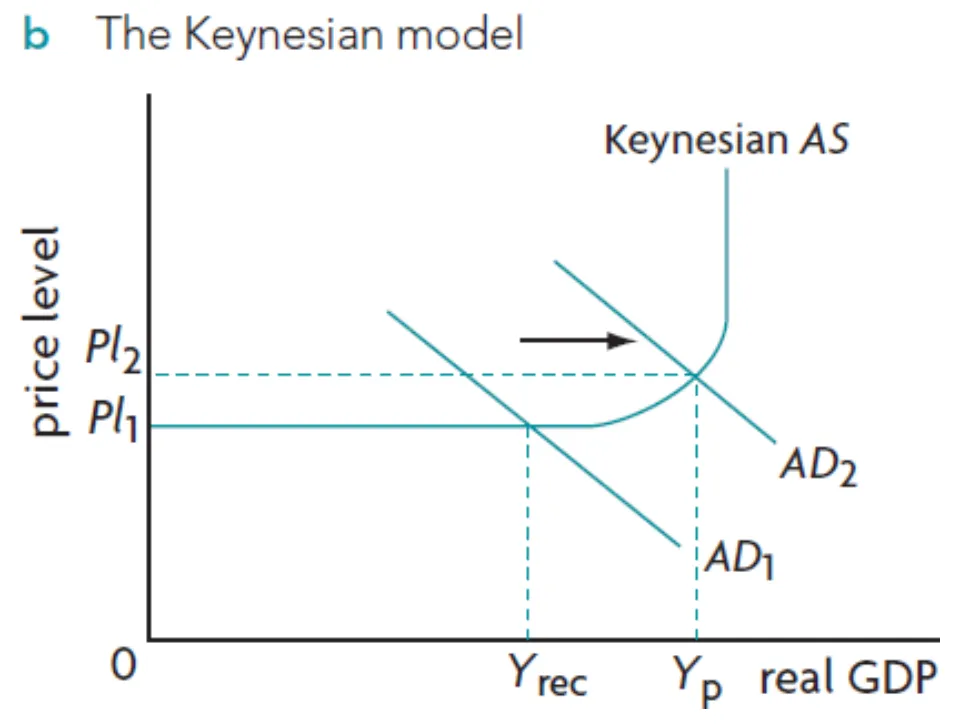
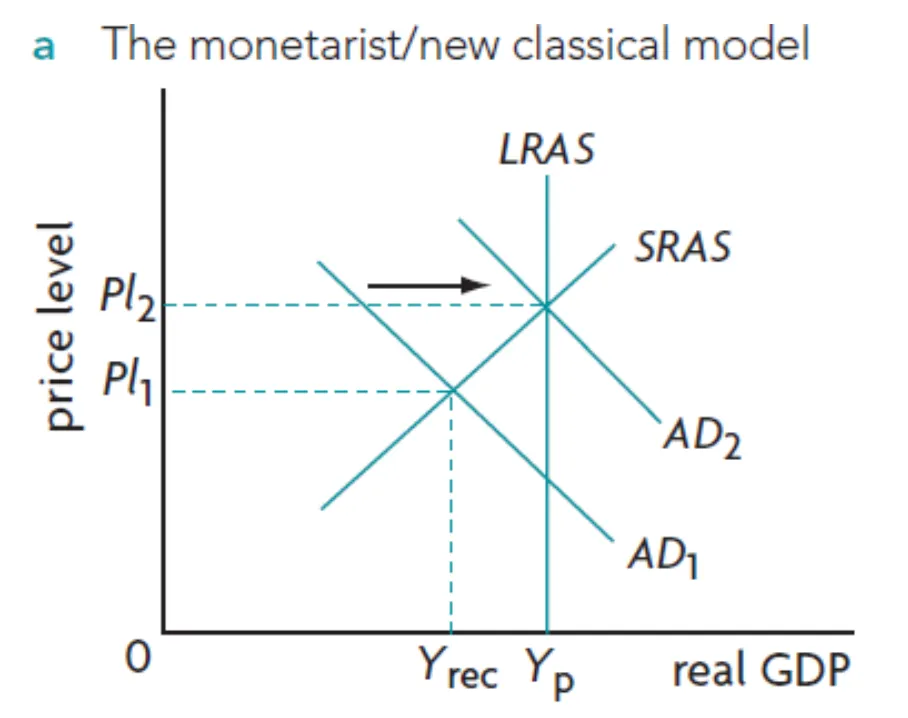
- When economy has a deflationary/recessionary gap (insufficient AD)
- The Transmission Mechanism
-

- Expansionary monetary policy = increasing money supply to expand AD and economic activity
- Also called “easy money policy” — money supply is increased, making borrowing easier/cheaper
-
- Both models agree AD and real GDP rise — but disagree on the size of GDP increase and whether prices rise
- Keynesian model is more optimistic about output gains with less inflation risk (when there’s a large output gap)
-
- Contractionary (tight) monetary policy
-
-
-
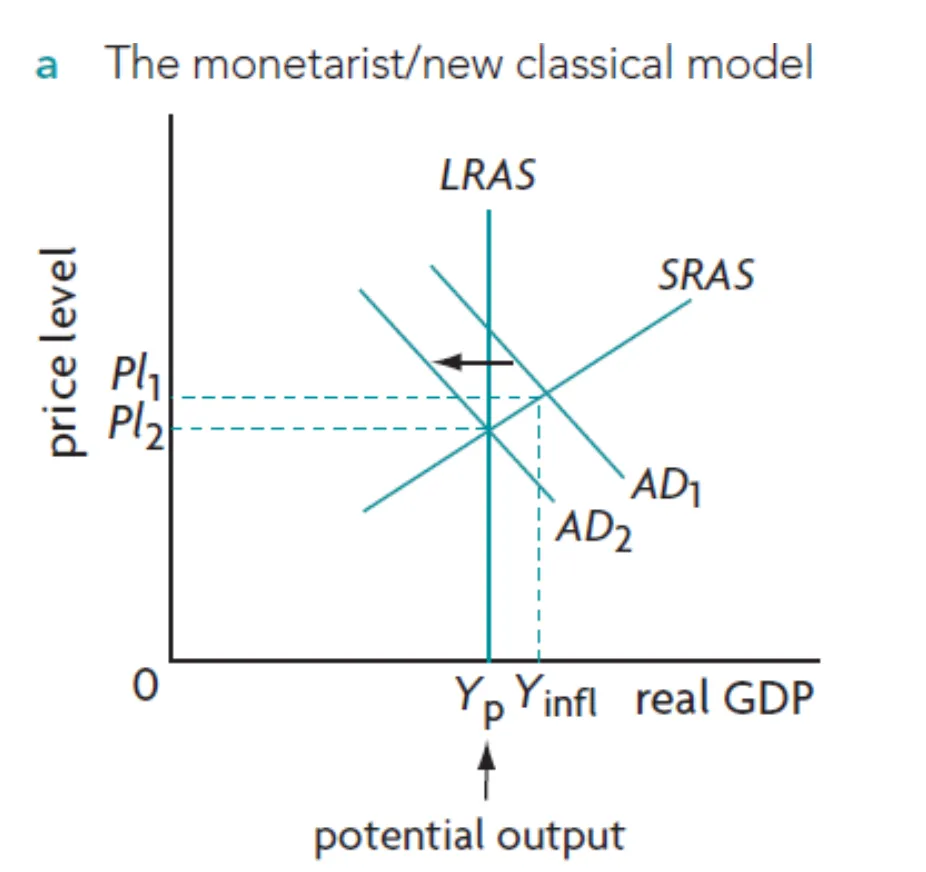
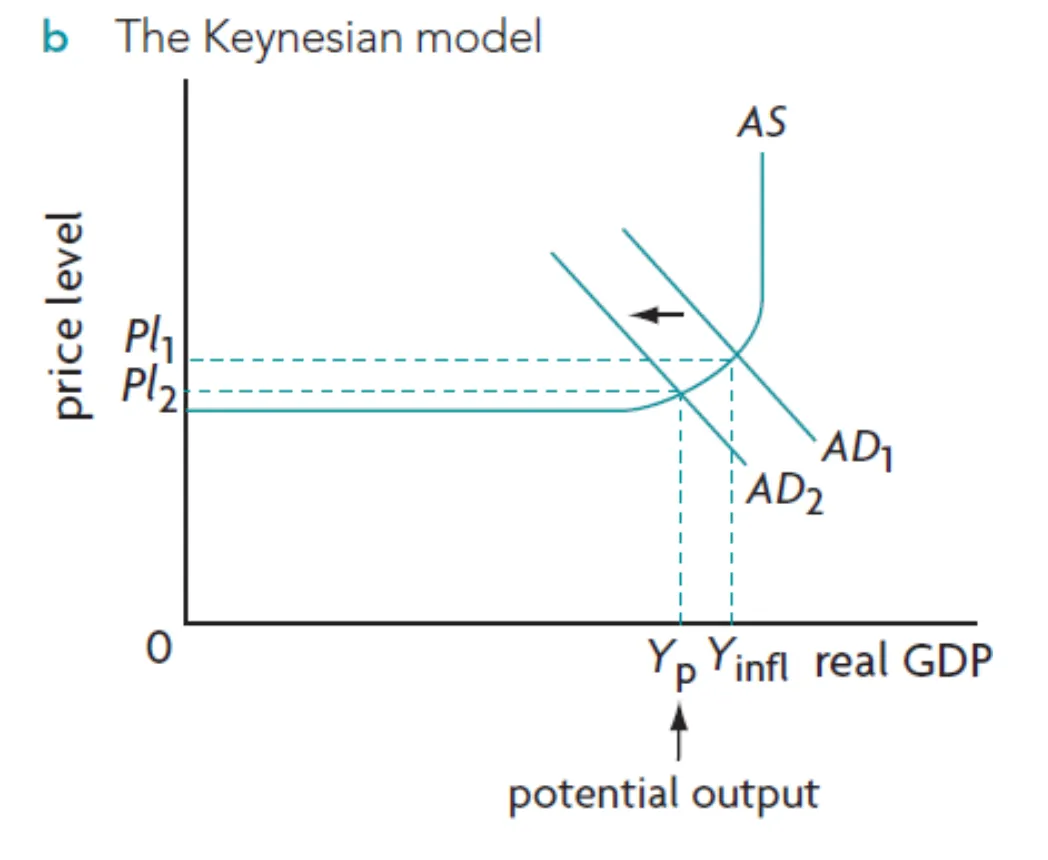
- When economy has an inflationary gap (excess AD, real GDP > Yp)
- The Transmission Mechanism
-
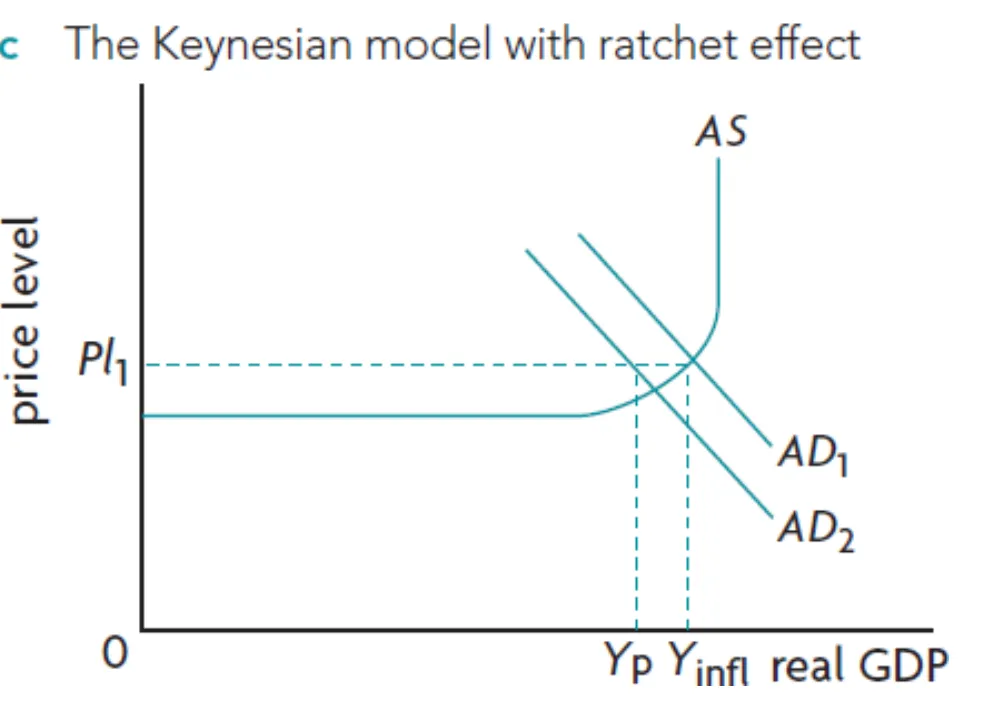
- The Ratchet Effect (Keynesian)
- In Keynesian model, prices rise easily but don’t fall easily when AD decreases
- So showing a price level decrease with contractionary policy is unrealistic
- Ratchet effect: price level rises with AD increases, but stays constant when AD falls
- Result: AD₁ → AD₂ causes real GDP to fall to Yp, but price level remains at pl₁
- This is considered a more realistic representation of real-world behaviour
- Also: the AD decrease needed to close the gap is smaller with the ratchet effect than without
-

Evaluating monetary policy
- Constraints on monetary policy
- Ineffective in deep recession
- Zero lower bound — rates can’t go below 0%, so no further stimulus possible
- Low confidence — pessimistic firms/consumers won’t borrow even if rates are low
- Banks fear lending — banks unwilling to lend in severe recession (fear of default, borrower can’t repay)
- Keep their reserves safe than risk lending and never getting the money back
- conflict between objectives
- interest rate changes affect exchange rates too → domestic goals may conflict with external balance goals
- may be inflationary
- if expansionary policy lasts too long, AD may overshoot → inflation
- ineffective against stagflation/cost-push inflation
- monetary policy is a demand-side tool → cannot address supply-side causes of instability
- Ineffective in deep recession
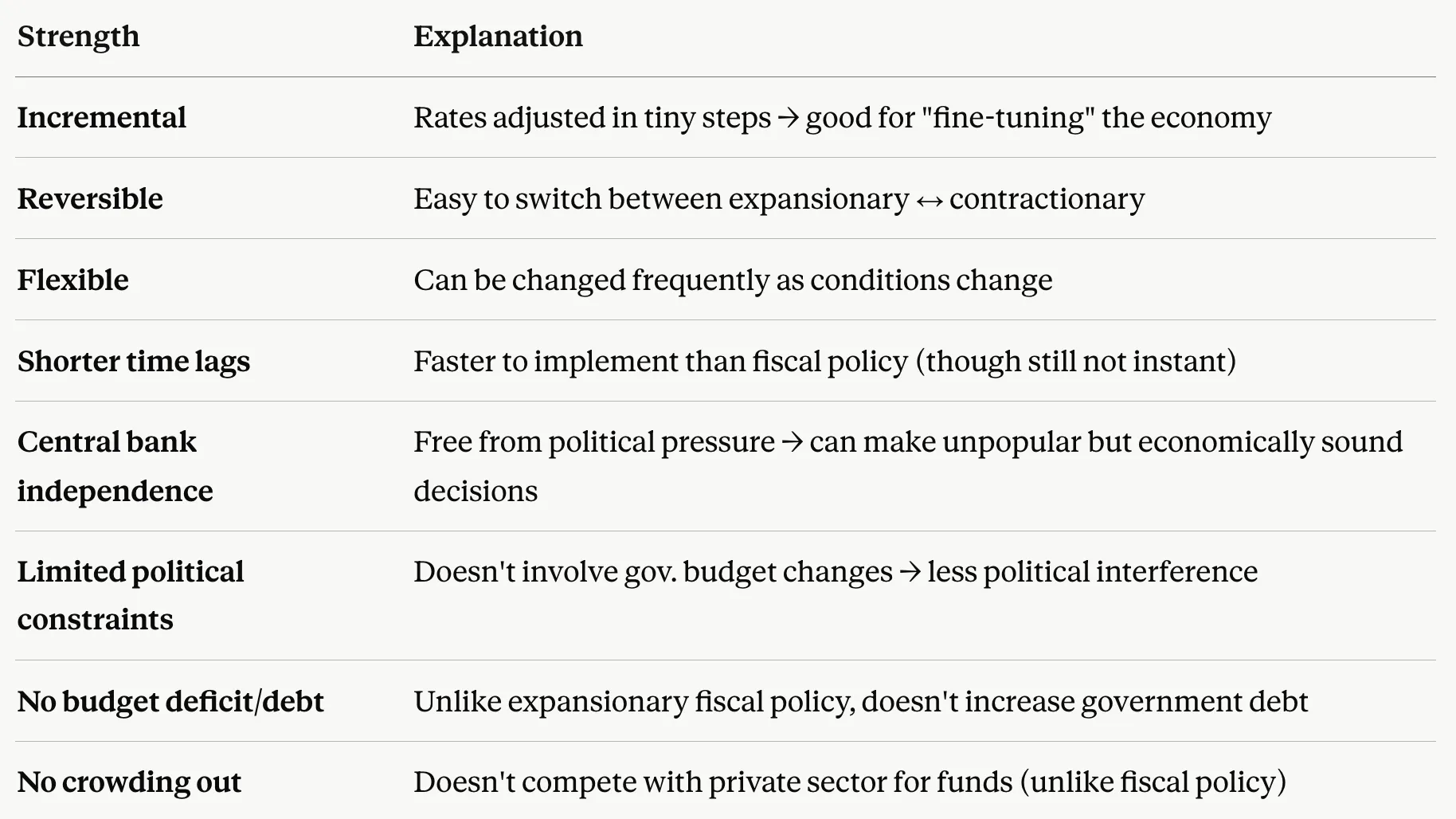
- Strengths of monetary policy
-