macro / ch 13
13.2Demand management and fiscal policy
Fiscal policy involves the use of government spending and taxation to fulfil macroeconomic objectives by influencing AD. There are two types of fiscal policy
- expansionary fiscal policy
- contractionary fiscal policy
Fiscal policy can be used to promote long-term economic growth and reduce unemployment in three main ways
- Government spending on physical capital goods
- Government spending on human capital formation
- Provision of incentives for firms to invest
- increase future productive capacity
Revenues and Expenditures
- Expenditures refer to money spent by governments, either through government spending (G) or transfer payments.
- Transfer payments are payments made by the government without goods or services being received in return, such as welfare payments and donations.
- Current expenditures (short-term)
- Wages for public sector employees
Supplies for public sector businesses
Interest payments for national debt
The provision of subsidies and grants
- Wages for public sector employees
- Capital expenditures (long-term)
- infrastructure, quantity or quality of factors of production
- Revenues are allocated and earmarked to expenses through a government budget
- Balanced: where expenditures = revenues
- Surplus: where expenditures < revenues
- Deficit: where expenditures > revenues
Governments earn money through direct and indirect taxation
- Direct taxes are imposed on income (rent, wages, interest, profit)
- •Income
tax - •Corporation
tax - •Capital
gains tax
- •Income
- Indirect taxes are imposed on expenditure
- sales tax
- excise tax
Fiscal policy has six main objectives
- •Low
unemployment - •Promoting a stable economic environment for long-term growth
- •Low and stable inflation
- •Reducing
business cycle fluctuations - •Achieving
an equitable distribution of income - •Trade
balance.
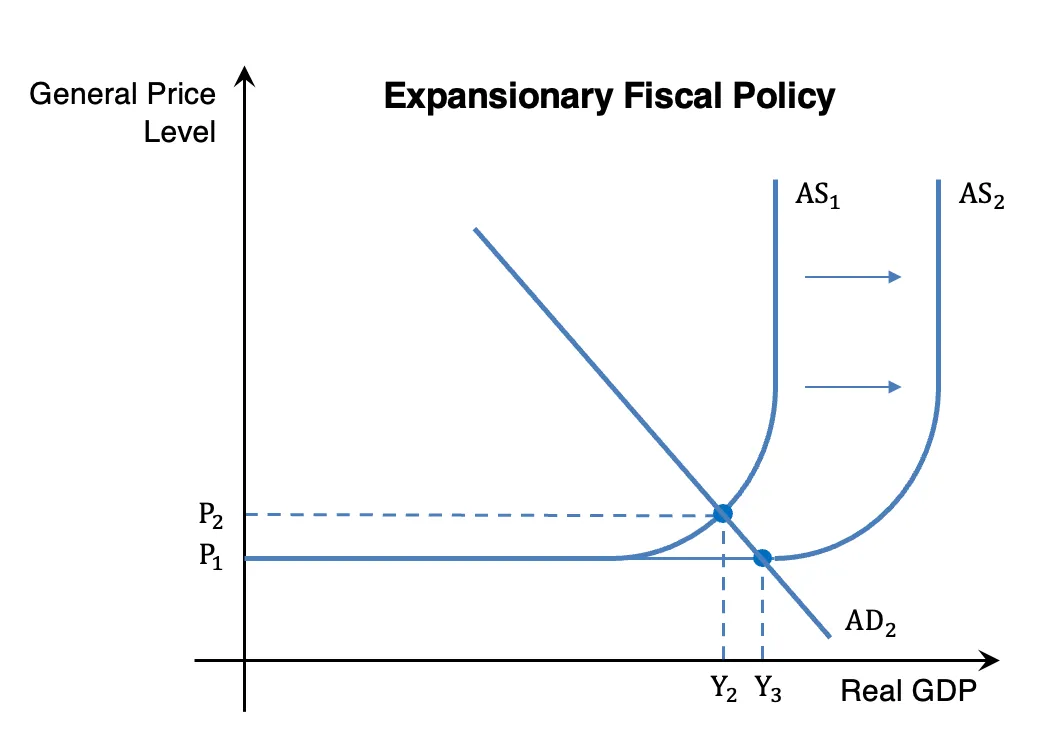
Expansionary Fiscal Policy
- increases AD by
- Increasing government expenditure ”(↑G)“
Decreasing direct and indirect taxation”(↑C, I)” - This is particularly important in Keynesian economics as economies may be stuck in a recessionary gap for long periods of time
- Increasing government expenditure ”(↑G)“
- Any government spending which improves the quantity or quality of resources will improve AD and AS. For example
- Government spending on physical capital goods and R&D which improves technology
Government spending on human capital development through training and education
Provision of incentives for firms to invest through lower business taxes - As a result, the productive capacity of the economy increases, shifting the aggregate supply curve outwards
-
- Government spending on physical capital goods and R&D which improves technology
Contractionary Fiscal Policy
- aims to reduce AD by
- Decreasing government expenditure (”↓” G)
Increasing direct and indirect taxation ”(↓C, I)”
- Decreasing government expenditure (”↓” G)
- This can slow economic growth to a healthy level to prevent the economy from overheating. High levels of economic growth can cause
- Undesirably high levels of inflation
- shortages in labour market, the demand of labour is bigger the number of workers available
Evaluation of Fiscal Policy
- The strengths of fiscal policy include
- Ability to target specific economic sectors
- Fiscal policy can be used to correct regional disparities in income and spending habits
- For example, tax cuts can be applied to low-income households, while marginal tax rates can be increased for high income households to redistribute income
- Similarly, government spending can be targeted at the unemployed, retirees, those with disabilities or those with young children
- “directly” Stimulates recovery from a deep recession
- Government spending provides a direct injection of money into the circular flow of income
- Expansionary fiscal policy can also help to increase confidence levels during a recession, increasing aggregate demand while providing further incentives for firms to continue employing their workers, avoiding further unemployment
- Ability to target specific economic sectors
- However, fiscal policy has its limitations
- Political pressures
- especially decreaseing G expenditures or increasing taxation
- Political pressures prevent the use of contractionary fiscal policy such as higher taxes and less government spending as this may be politically unfavourable
- Time lags
- Recognition lag
- It takes time to tell whether an economy is in need for government intervention
- Furthermore, supply-side shocks can happen at any time, so it is difficult to plan and budget for shocks such as natural disasters and pandemics
- Administrative lag
- After identifying the need for government intervention, it will take more time to implement fiscal policy
- Approval for tax changes
- Changes to the government budget
- Effectiveness lag
- There is a time lag between the implementation of fiscal policies to seeing the actual effects take place in the economy
- A small reduction in income tax will take time to have a significant impact on household consumption
- The construction of a new school will take many years before graduates enter the labor force
- Recognition lag
- Sustainable debt
- The effectiveness of fiscal policy will depend on the extent to which the government can afford to sustain a budget deficit
- In the short run, governments may be able to run budget deficits in order to fund expansionary fiscal policies
- However, this is not sustainable in the long run. Ultimately, the government will need to implement austerity measures to repay its national debts, limiting the effectiveness of fiscal policy
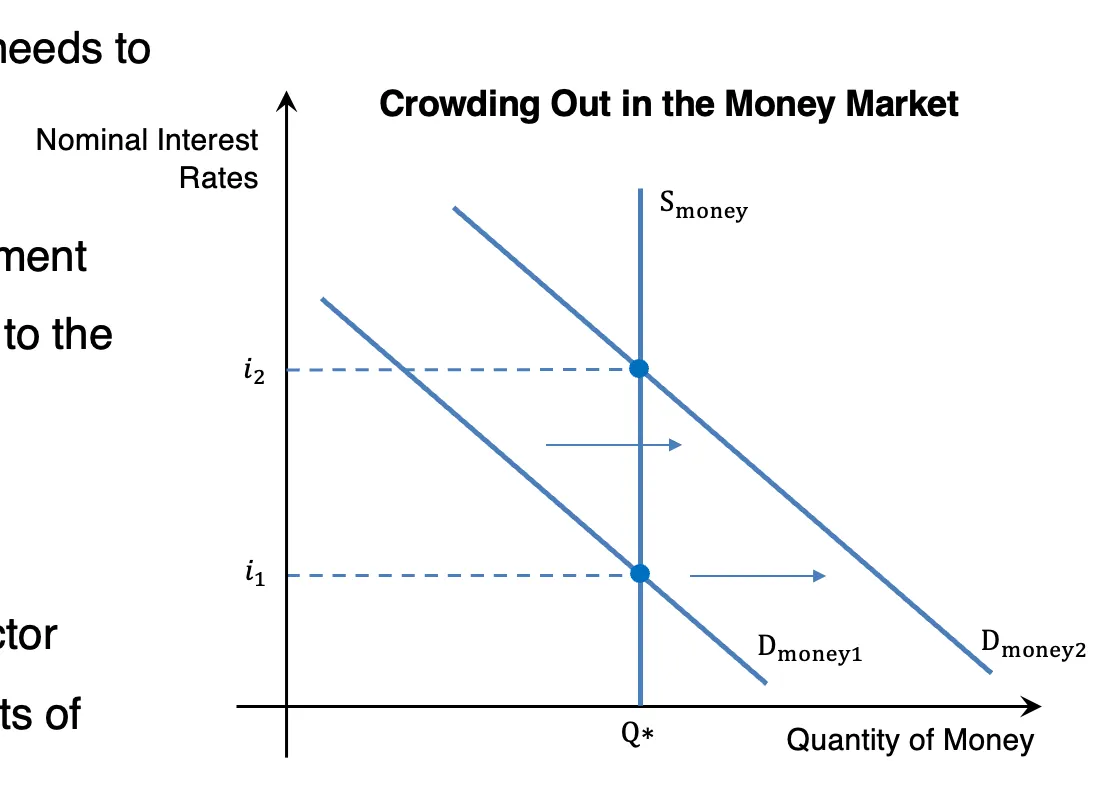
- Crowding out
- When a government runs a budget deficit, it needs to borrow funds (issueing/selling bonds)
- Crowding out occurs when increased government borrowing causes interest rates to rise owing to the higher demand for loanable funds (D_money1→D_money2 ).
- Overall, this causes a reduction in private sector investment expenditure due to the higher costs of borrowing (𝑖_1→𝑖_2 )
-
- Political pressures