macro / ch 9
9.2Short-run aggregate supply and short-run equilibrium in the AD-AS model
Short-run aggregate supply
- The short run and long run in economics
- short run
-
is the period of time when prices of resources are roughly constant or inflexible, in spite of changes in the price level; they do not change together with changes in the price level
Summary: wages do not change very much over relatively short periods of time. It is often rigid(unchanging) because:
- in the short-run, 成本、资源价格(比如工资、租金)不会随着物价水平一起变化
- labour contracts fix wage rates for cetain periods of time
- minimum wage legislation fixes the lowest legally permissible wage
- workers and labour unions resist wage cuts
- wage cuts have negative effects on worker morale, causing firms to avoid them
-
this applies to the wages, or the price of labour
-
- long run
- is the period of time when the prices of all resources, including the price of labour (wages), are flexible and change along with changes in the price level
- short run
- Defining aggregate supply and the short-run aggregate supply curve
- aggregate supply is the total quantity of goods and services produced in an economy (real GDP) over a particular time period at different price levels.
- the short-run aggregate supply curve (SRAS) shows the relationship between the price level and the quantity of real output (real GDP) produced by firms when resource prices (especially wages) do not change.
- Changes in short-run aggregate supply (shifts in the SRAS curve)
- rightward shift means SRAS increases; for any particular price level, firms produce a larger quantity of real GDP/output;
leftward shift means SRAS decreases; for any particular price level, firms produce a smaller quantity of real GDP/output; - determinants of SRAS curve
- changes in wages
- if wages increase, with the price level constant, firms’ costs of production rise
- resulting in a leftward shift in the SRAS curve
- if wages decrease, with the price level being constant, firms’ costs of production fall
- giving rise to the rightward shift in the SRAS curve
- if wages increase, with the price level constant, firms’ costs of production rise
- changes in non-labour resource prices
- changes in the price of non-labour resource prices, such as the price of oil, equipment, capital goods, land inputs, and so on affect the SRAS curve in the same way as changes in wages.
- the change in price of resources will directly affect firms’ costs of production; thus affect the SRAS curve
- changes in indirect taxes
- indirect taxes are treated by firms like costs of production (effectively 等效于)
- higher indirect taxes -> increases in production costs
- shift the SRAS curve to the left
- lower indirect taxes -> decreases in production costs
- shift the SRAS curve to the right
- changes in subsidies offered to businesses
- subsidies involve money transferred (transfer payment) from the government to firms
- subsidies increase -> effectively reduce costs of production
- SRAS shifts rightward
- subsidies decrease -> effectively increase costs of production
- SRAS shifts leftward
- supply shocks
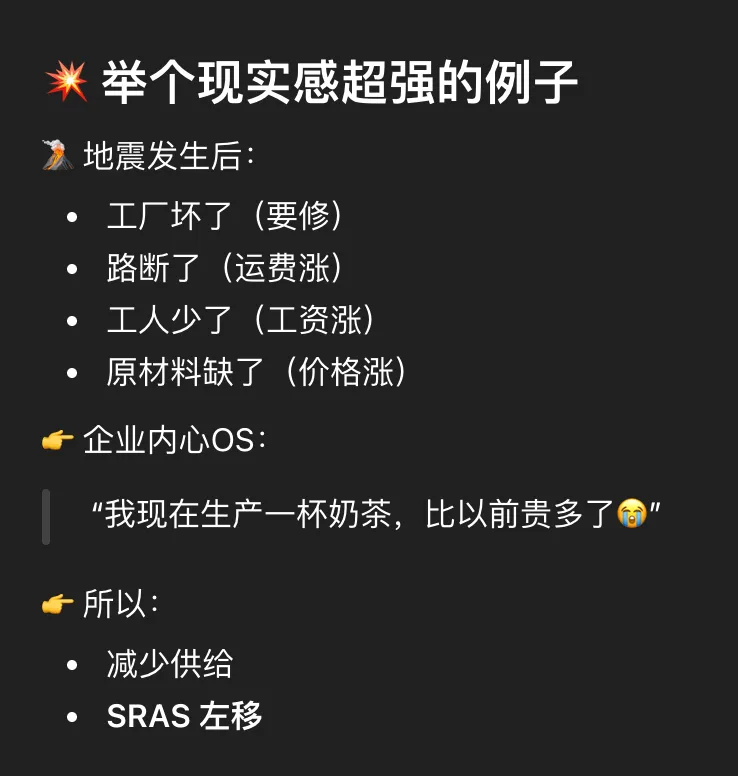
- supply shocks are event that have a sudden and strong impact on short-run AS
- a war or violent conflict can result in destruction of physical capital and disruption of economy; unfavourable weather conditions can cause a fall in agricultural output
- leading to a lower real output/gdp produced and a leftward shift in the SRAS curve
- beneficial supply shocks such as unusually good weather conditions with a positive effect on agricultural output
- can lead to an increase in AS and a rightward shift of the SRAS curve
- 本质还是sudden event对costs of production 产生的影响
- 例如earthquake, war, natural disaster
-
- 例如earthquake, war, natural disaster
- changes in wages
- rightward shift means SRAS increases; for any particular price level, firms produce a larger quantity of real GDP/output;
Short-run equilibrium in the AD-AS model
- the short-run equilibrium price level and level of output/real gdp occurs where AD intersects with SRAS
- real output/GDP increases -> unemployment decreases, since firms need to hire more labours to produce more output
- real output/GDP decreases -> unemployment increases, since firms now need less labour