macro / ch 9
9.3Long-run aggregate supply and long-run equilibrium in the monetarist/new classical model
The monetarist/new classical model
- The long-run aggreagte supply curve and long-run equilibrium
- Long Run Aggregate Supply(LRAS)
- potential GDP/output
- full employment level of real GDP
- it is independent of the price level
- Long Run Aggregate Supply(LRAS)
- Long-run equilibrium and the natural rate of unemployment
- when the economy produces at potential output, the economy is experiencing “full employment”
- under full employment output, the economy still has unemployed labour and other resources
- the unemployment that exists when the economy is producing its full employment output is known as the natural rate of unemployment
- Why the LRAS curve is vertical
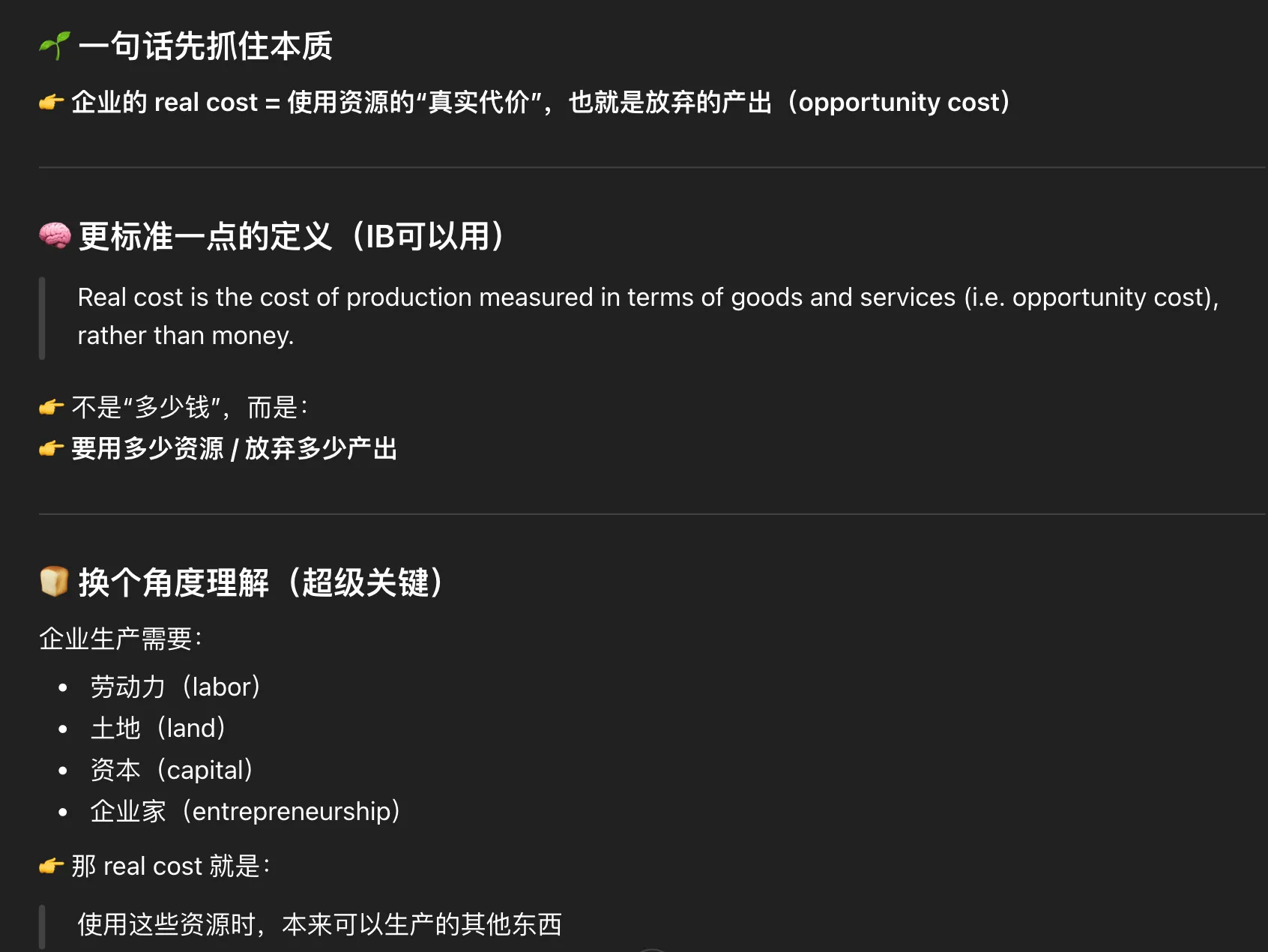
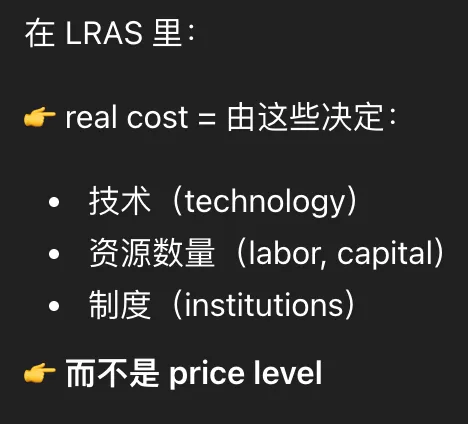
- wages and other resource prices are now changing to match output price changes, firms’ real cost of production remain constant even as the price level changes
-
- therefore, as the price level increases or decreases, with constant real costs, firms’ profits are also constant, and firms no longer have any incentive to increase or decrease their output levels
- wages and other resource prices are now changing to match output price changes, firms’ real cost of production remain constant even as the price level changes
- Short-run equilibrium positions in relation to long-run equilibrium: deflationary (recessionary) gaps and inflationary gaps
- deflationary (recessionary) gap
- when real GDP is less than potential GDP, the economy is experiencing a deflationary gap (also known as recessionary gap), and unemployment is greater than the natural rate of unemployment
-
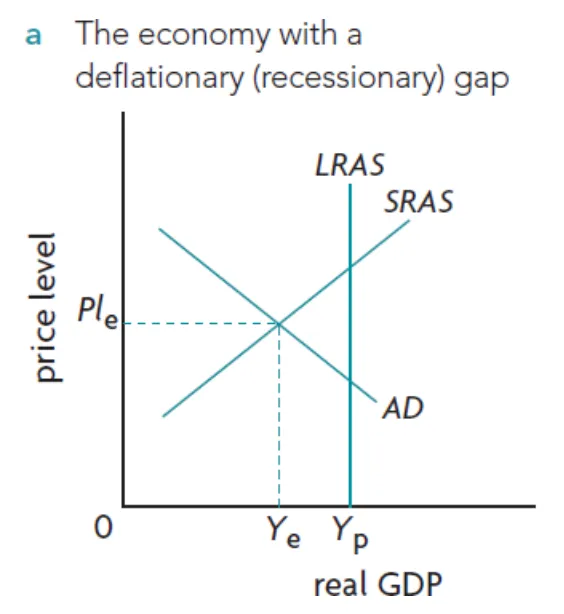
- at the price level Ple, the amount of real GDP that the four components of AD want to buy is less than the economy’s potential GDP
- there is not enough total demand in the economy to make it worthwhile for firms to produce potential GDP
- firms require less labour for their production; therefore, unemployment is greater than the natural rate of unemployment
- inflationary gap
-
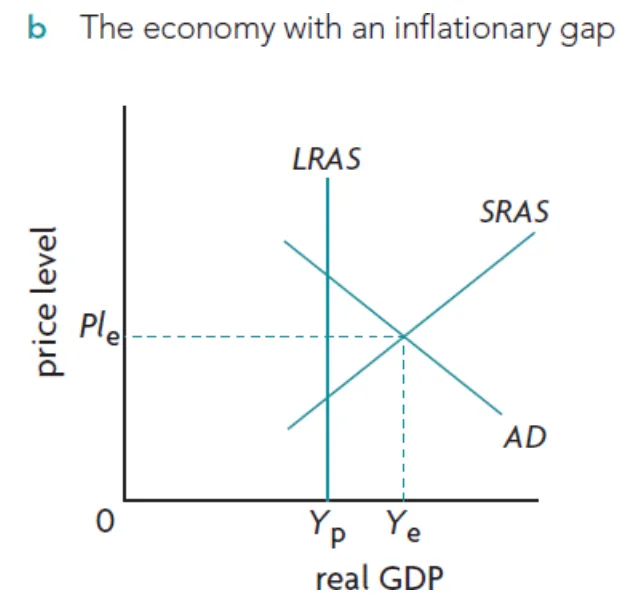
- when real GDP is larger than potential GDP, the economy is experiencing inflationary gap, and unemployment is less than the natural rate of unemployment
- with AD, the quantity of real GDP that the four components want to buy at the price level Ple is greater than the economy’s potential output.
- There is too much total demand in the economy, and firms response by producing a greater quantity of real GDP than potential GDP.
- to produce more output than the potential output/GDP, firms’ labour needs to increase, and unemployment falls to become less than the natural rate of unemployment
-
- full employment level of real GDP, or potential output
-
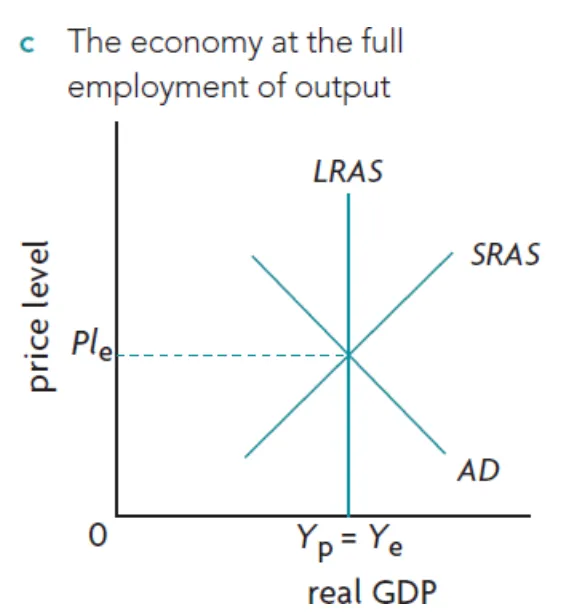
- where equilibrium real GDP is equal to full employment or potential GDP
- when the economy is producing its potential GDP(real GDP = potential GDP), unemployment is equal to the natural rate of unemployment
- there’s no deflationary or inflationary gap
-
- deflationary (recessionary) gap
- Shifts in AD or SRAS as possible causes of the business cycle
- changes in aggregate demand
-
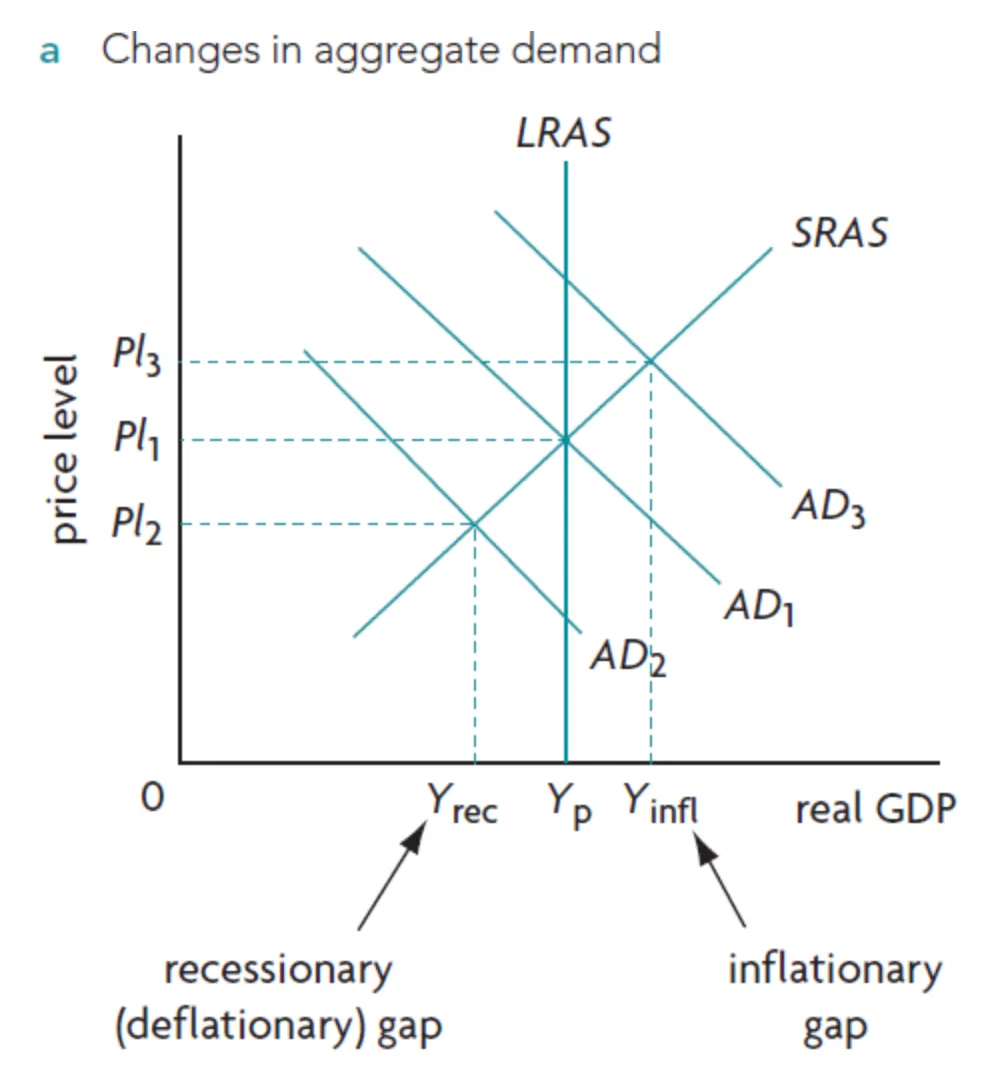
- Initially the economy is at full employment equilibrium and producing at the potential output, or we call it as the full employment level of output.
- a fall in AD, shift leftward from AD1 to AD2 causes a recessionary gap
- if the economy experiences an increase in AD, appearing as a rightward shift in the AD curve from AD1 to AD3, this causes an inflationary gap
-
- changes in SRAS
-
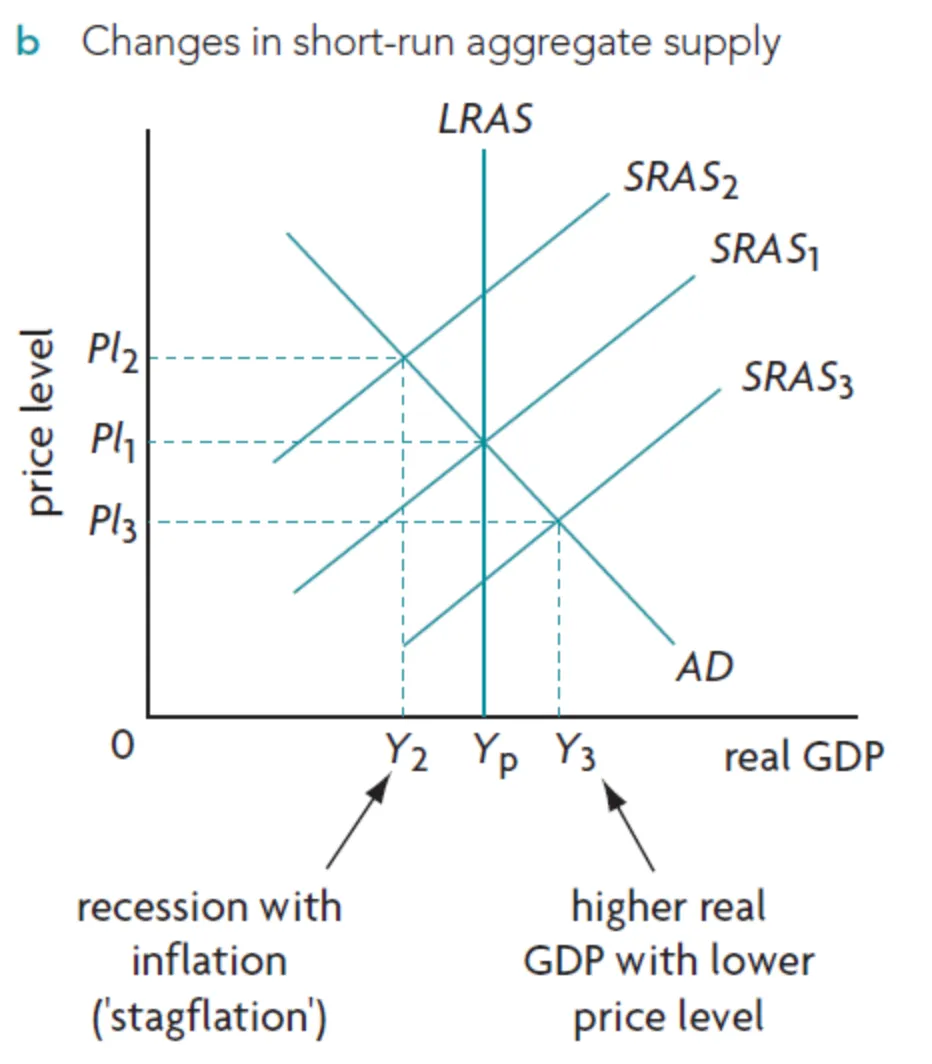
- the economy starts from the full employment equilibrium, or full employment level of output, or potential output, or potential GDP
- a fall in SRAS from SRAS1 to SRAS2 leads to an economic contraction, with real GDP falling to Y2 and unemployment increasing
- this contraction differs from the recessionary gap resulting from the fall in AD
- the fall in SRAS leads to an increase in the price level, along with a decrease in real GDP.
- when recession (with unemployment) and a rising price level (inflation) happen at the same time, the outcome is called stagflation
- an increase in SRAS, shifting from SRAS1 to SRAS3 leads to an economic expansion as real GDP increases to Y3 and unemployment falls
- this expansion results in a falling price level, in contrast to the rising price level when AD increases
-
- changes in aggregate demand
- Automatic adjustment to full employment equilibrium at the level of potential GDP (or why inflationary and deflationary gaps cannot persist in the long run)
-
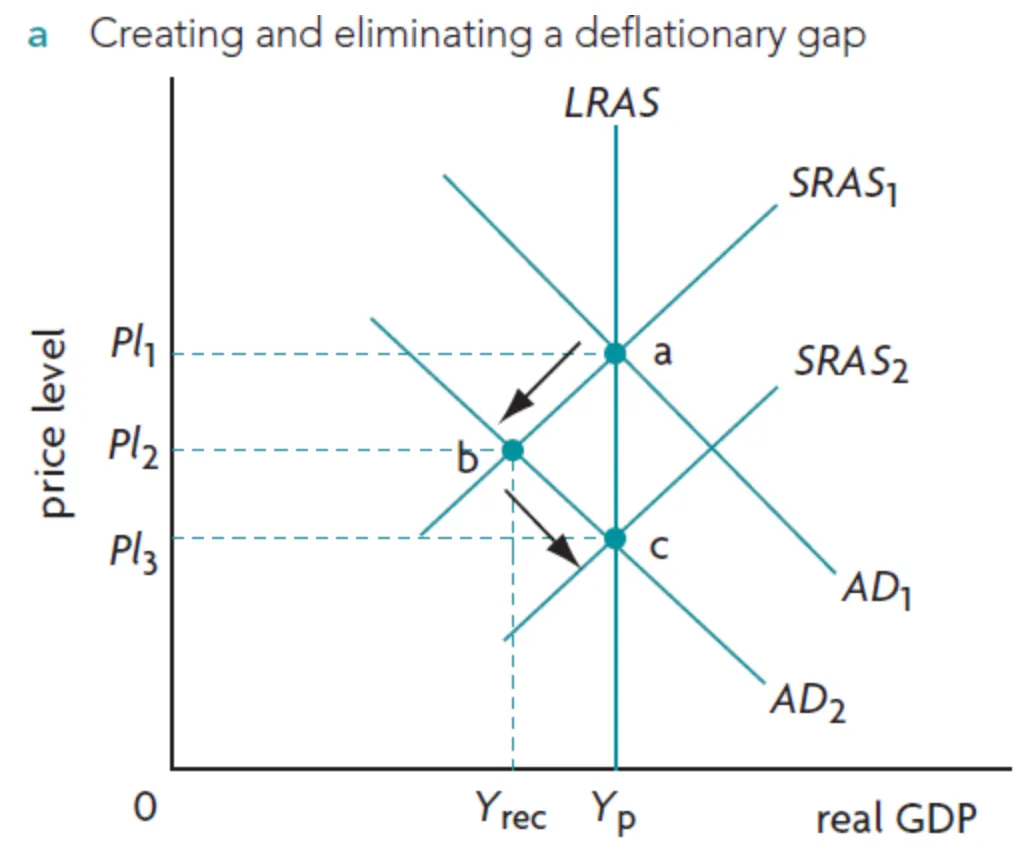
- where economy is initially in long-run equilibrium at point a producing potential output, Yp
- a fall in AD from AD1 to AD2 causes the economy to move in the short run from point a to point b, where there arises a deflationary gap
- at b, real GDP has fallen to Yrec and the price level has fallen from Pl1 to Pl2.
- this situation cannot maintain the long run
- in the long run, the fall in the price level is matched by a fall in wages(and falls in other resource prices), so the SRAS shifts to the right from SRAS1 to SRAS2, because decrease in costs of production.
- until the economy is back on the LRAS, at point c.
- the assumption of wage and price flexibility in the long run has allowed the economy to automatically come back to its long run equilibrium level of output
- the deflationary gap is eliminated, and the only thing that changes due to the fall in AD is the fall in price level from Pl1 to Pl3
-
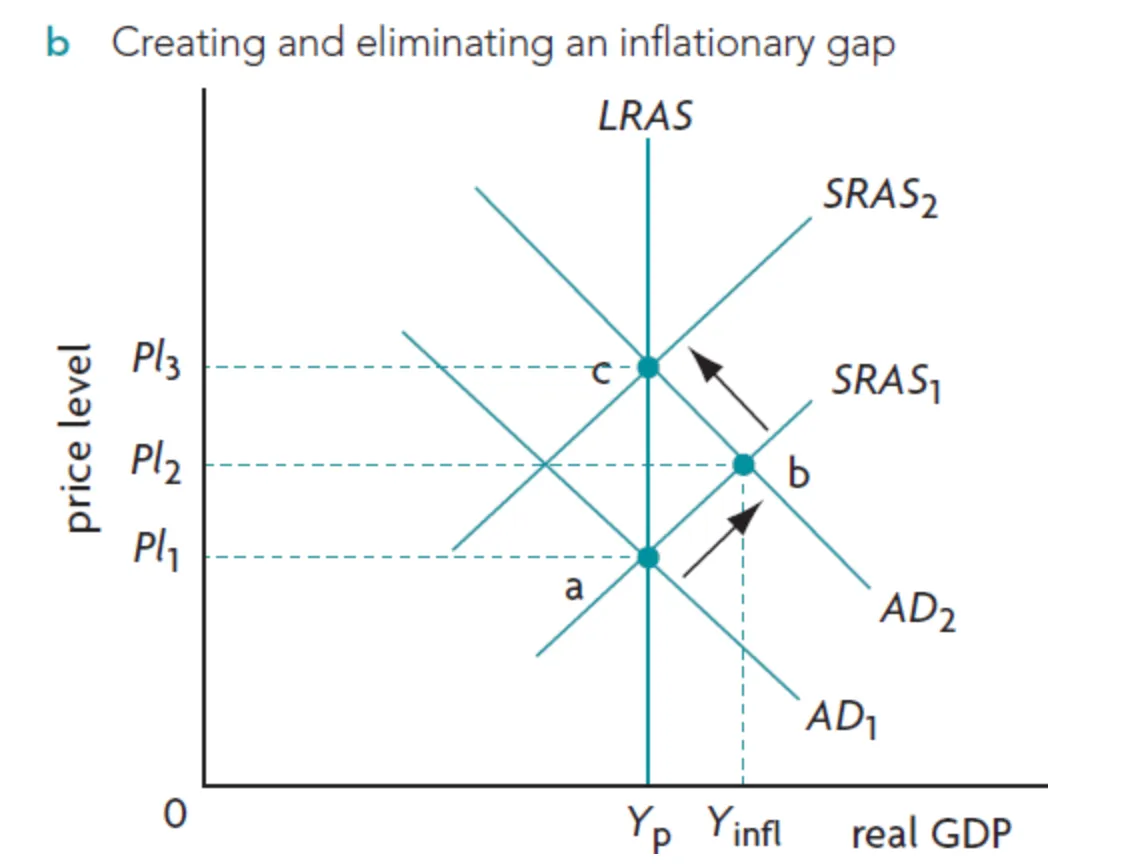
- since the economy moves from point b (graph a) to point a (graph b), the real GDP/output increases. This means firms will higher more labors to produce more output, thus unemployment increases. Consumers’ income increases and will increase the AD, shifting it to the right from AD1 to AD2
- in the short run, the economy moves from point a to point b, real GDP increases from Yp to Yinfl.
- There is an inflationary gap (real GDP > potential GDP), and price level increases from Pl1 to Pl2.
- the economy cannot maintain this situation in the long run
- once wages (and other resource prices) increase to match the increase in the price level, SRAS decreases from SRAS1 to SRAS2, and the economy arrives at point c
- It stops at point c once again on the LRAS curve, the inflationary gap has been eliminated
- the only change due to the increase in AD is the increase in price level from Pl1 to Pl3
-