macro / ch 10
10.1Low unemployment
Unemployment and its measurement
- unemployment refers to people of working age who are actively looking for a job but who are not employed
- underemployment
- people of working age with part-time jobs when they would rather work full time, or with jobs that do not make full use of their skills and education.
- both mean that an economy is wasting scarce resources by not using them fully
- Calculating unemployment: the unemployment rate
- labour force
- defined as the number of people who are employed(working) plus the number of people of working age who are unemployed(not working but seeking work).
- excludes children, retired persons, adult students, all people who cannot work because of illness or disability, as well as people who don’t want to work (not seeking jobs actively)
- the unemployment rate
- unemployment rate = number of unemployed/labour force * 100%
- labour force
- Difficulties in measuring unemployment
- difficult to obtain an accurate measurement of unemployment because of hidden unemployment (underestimation)
- unemployment figures include unemployed persons who are actively seeking for a job
- but this excludes “discouraged workers”, who are unemployed workers who gave up looking for a job because after trying unsuccessfully to find work for some time, they became discouraged and stopped searching
- they are drop out of the labour force
- Unemployment figures do not make a distinction between full-time and part-time employment, and count people with part-time jobs as having full-time jobs though in fact they are underemployed
- Unemployment figures make no distinction on the type of work done. If a highly trained person works as a waiter, this counts as fully employed
- this is underemployment
- involving resource waste
- Unemployment figures do not include people on retraining programmes who previously lost their jobs, as well as people who retire early although they would rather be working
- unemployment figures include unemployed persons who are actively seeking for a job
- overestimation of true unemployment may also occur
- unemployment figures do not include people working in the underground economy (or informal economy)
- this is the portion of the economy that is unregistered, legally unregulated and not reported to tax authorities.
- some people may be officially registered as unemployed, yet they may be working in an unreported (underground) activity
- A further disadvantage of the national unemployment rate (calculated for an entire nation) is that it is an average over the entire population, and therefore does not account for differences in unemployment that often arise among different population groups in a society
- regions
- regions with declining industries may have higher unemployment rates than other regions
- gender
- women sometimes face higher unemployment rates than men
- ethnic groups
- some ethnic groups may be disadvantaged due to discrimination, or due to lower levels of education and training
- age
- youth unemployment often face higher unemployment rates than older population groups, often due to lower skill levels; people who are ageing also sometimes face higher unemployment rates as employers may be less willing to employ them
- occupation and educational attainment
- people who are relatively less skilled may have higher unemployment rates than more skilled workers (though in some countries higher unemployment rates may be found among highly educated groups)
- regions
- difficult to obtain an accurate measurement of unemployment because of hidden unemployment (underestimation)
- Costs of unemployment
- economic costs
- a loss of real output (real GDP)
- Since fewer people work than are available to work, the amount of output produced is less than the level the economy is capable of producing. This is why unemployment means that an economy finds itself somewhere inside its production possibility curve producing a lower level of output than it is capable of producing.
- a loss of income for unemployed workers
- People who are unemployed do not have an income from work. Even if they receive unemployment benefits, they are likely to be worse off financially than if they had been working.
- a loss of tax revenue for the government
- Since unemployed people do not have income from work, they do not pay income taxes; this results in less tax revenue for the government, less spending on hospital, infrastructure, and education
- costs to the government of unemployment benefits
- if the government pays unemployment benefits to unemployed workers, the greater the unemployment, the larger the unemployment benefits that must be paid, and the less tax revenue left over to pay for important government-provided goods and services such as public goods and merit goods.
- costs to the government of dealing with social problems resulting from unemployment
- The social problems that arise from unemployment (noted below) often require government funds to be appropriately dealt with.
- more unequal distribution of income
- Some people (the unemployed) become poorer while others (the employed) are able to maintain their income levels. Since certain population groups (ethnic groups, regional groups, etc., discussed earlier) may be affected more by unemployment than others, the effects of increasing income inequalities and resulting poverty are often concentrated among population groups who are more disadvantaged to begin with. If unemployment is high or tends to persist over long periods of time, this may lead to increased social tensions and social unrest.
- unemployed people may have difficulties finding work in the future
- Long-term unemployment can make it harder for workers to find jobs in the future because they may lose skills, fail to keep up with new skills required by firms, or become less needed as firms adapt to fewer workers. This is known as hysteresis, meaning current high unemployment can cause high unemployment to continue even after the economy improves.
- a loss of real output (real GDP)
- personal and social costs
- personal problems
- Being unemployed and unable to secure a job involves a loss of income, increased indebtedness as people must borrow to survive, as well as loss of self-esteem. All these factors cause great psychological stress, sometimes resulting in lower levels of health, family tensions, family breakdown and even suicide.
- greater social problems
- High rates of unemployment, particularly when they are unequally distributed for the reasons noted earlier, can lead to serious social problems, including increased crime and violence, drug use and homelessness, arising from growing poverty.
- personal problems
- economic costs
Types and causes of unemployment
- Structural unemployment
-
occurs as a result of changes in demand for particular types of labour skills, changes in the geographical location of industries and therefore jobs, and labour market rigidities
-
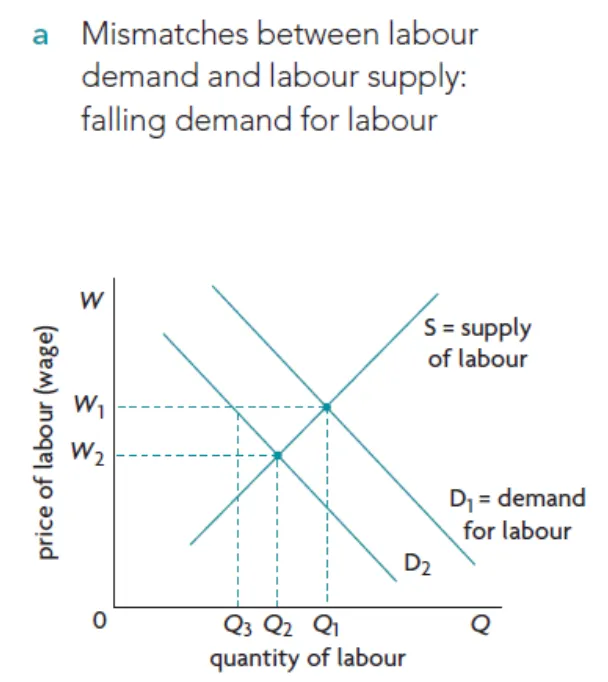
changes in demand for particular types of labour skills
- Technological change and changes in the structure of the economy can create a mismatch between the skills workers have and the skills employers demand, leading to structural unemployment
-
changes in the geographical location of jobs
- When firms or industries relocate, workers in the original region may lose jobs. If they cannot move to areas with new job opportunities, a geographical mismatch between labour demand and labour supply occurs, causing structural unemployment.
-
Structural unemployment occurs when demand for labour falls due to technological change, economic restructuring, or relocation of industries. Because wages are slow to fall, labour supply exceeds labour demand, creating persistent unemployment.
-
技能/地区 mismatch 导致的结构性失业
-
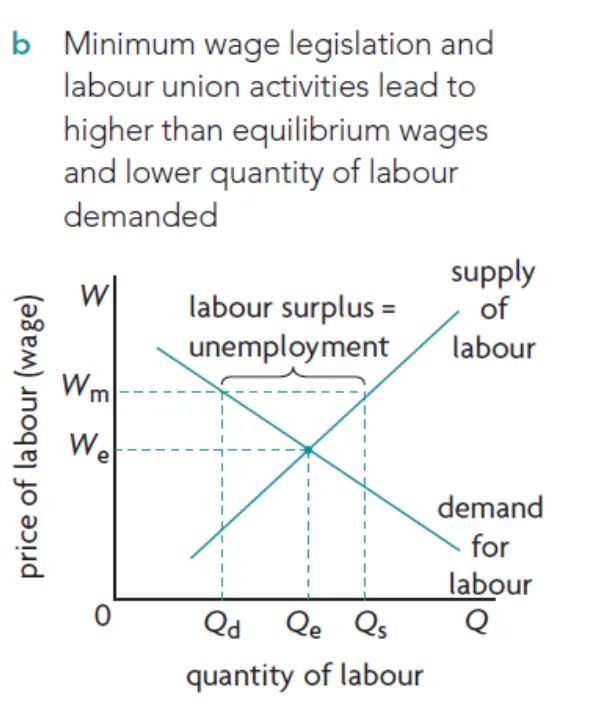
工资“太高”导致失业
-
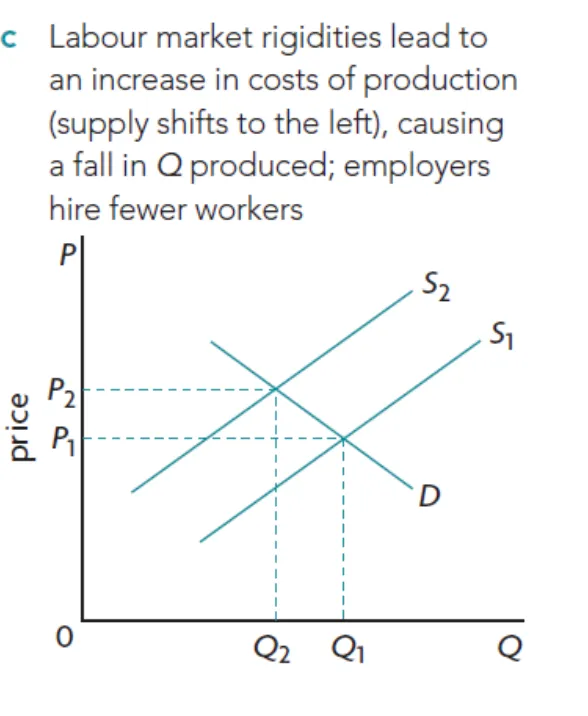
高劳动力成本降低 output 和 employment
-
-
labour market rigidities
- are factors preventing the forces of supply and demand from operating in the labour market
- minimum wage legislation
- resulting in higher equilibrium wages
- labor union activities and wage bargaining with employers
- resulting in higher equilibrium wages
- employment protection laws
- makes it costly for firms to fire workers, because they must pay compensation, thus making firms be more cautious about hiring
- generous(慷慨的) unemployment benefits
- 政府给 unemployed workers 较高福利
- 如果 benefits 很高
- opportunity cost of unemployment falls
- incentives to search for jobs decrease
- people may remain unemployed longer
- minimum wage legislation
- are factors preventing the forces of supply and demand from operating in the labour market
-
- Frictional unemployment
- occurs when workers are between jobs.
- workers may leave their job because they have been fired, or because they are in search of a better job, or they may be waiting to start a new job.
- it tends to be short-term, and does not involve a lack of skills that are in demand by the firms
- frictional unemployment is part of the natural unemployment
- Seasonal unemployment
- occurs when the demand for labour in certain countries changes on a seaonal basis because of variations in needs
- farm workers experience this because they are hired during peak harvesting seasons and laid off for the rest of the year
- ski coaches only work in winter
- also part of the natural unemployment
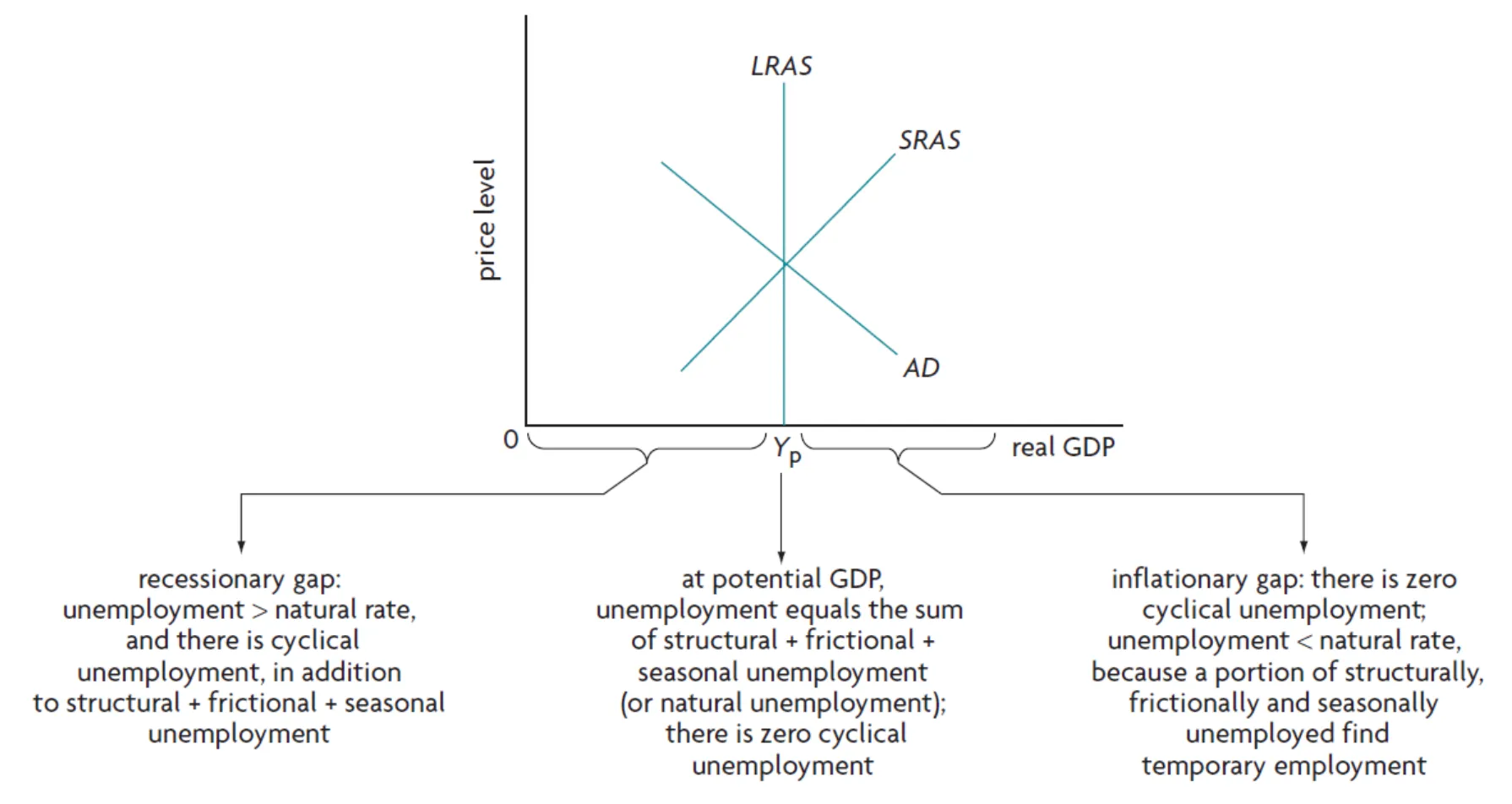
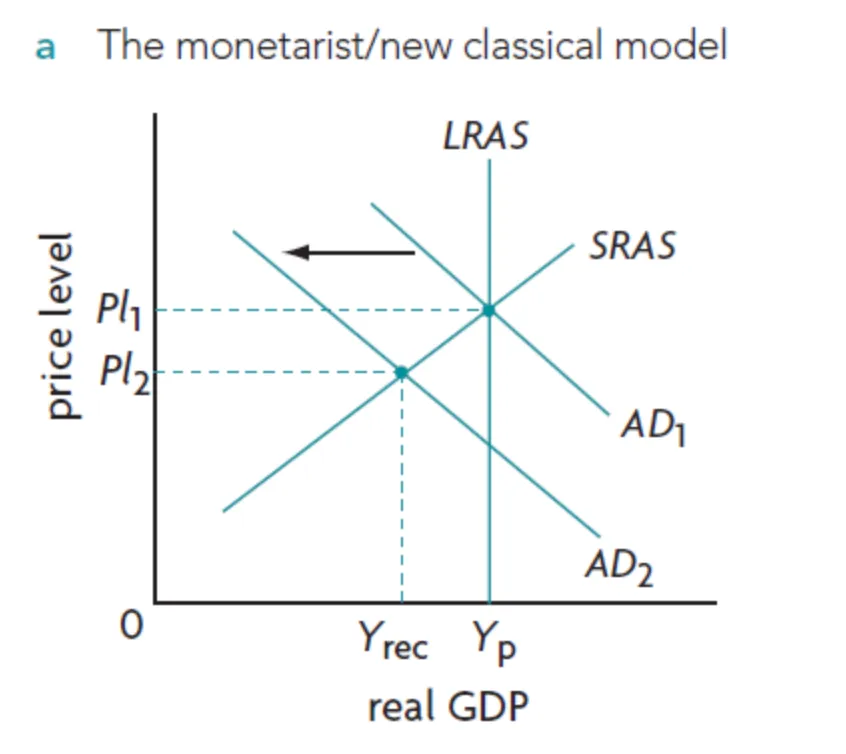
- Cyclical unemployment
- it is a demand-deficient unemployment
- occurs during the downturns of the business cycle, when the economy is in a deflationary/recessionary gap.
- the downturn is seen as arising from declining or low AD, so it is also known as the demand-deficient unemployment
- as real GDP falls due to a fall in AD, unemployment increases because firms lay off workers
- when the economy produces real GDP at the level of potential output, there is no longer any cyclical unemployment, it is equal to zero
-
-
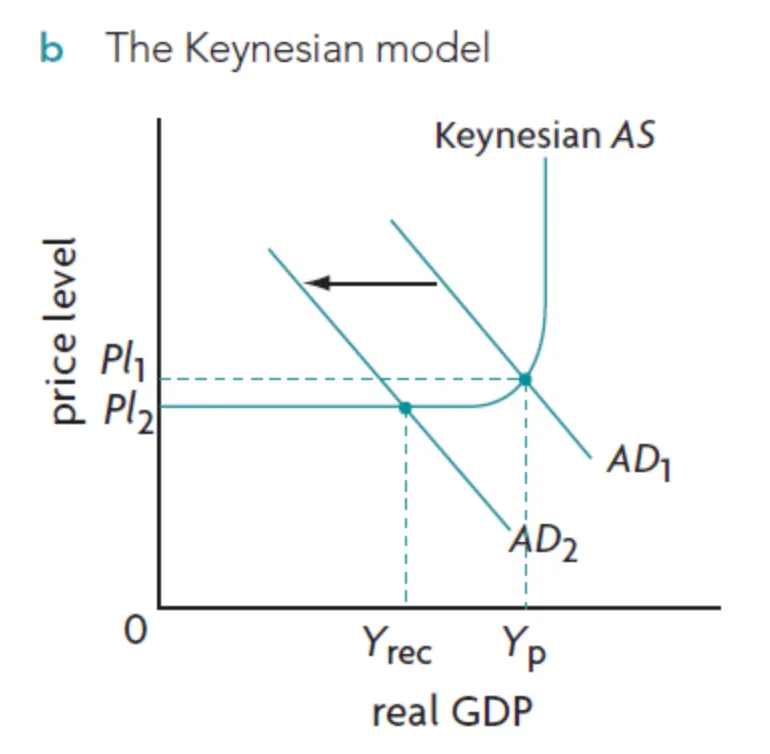
- The four types of unemployment in relation to the AD-AS model
-