macro / ch 8
8.1Economic Activity
the circular flow of income model
- leakages
- household savings
- part of consumer income that is not spent
- place their savings in financial markets(banks)
- imports
- household spending that leaks out to the other countries that produce the goods and services
- taxes
- pay taxes to the government instead of buying goods and services
- household savings
- injections
- exports
- spending by foreigners who buy domestically produced goods and services
- government spending
- government spending on various activities comes back into the flow as injection
- investment
- spending mainly by firms for the production of capital goods (one of the four factors of production)
- firms obtain funds from financial markets(often through loan) to finance investment, or the production of capital goods
- Investment(投资)= 企业对“未来生产能力”的支出
- here, it is real investment
- 企业花钱去买:
🏭 机器(machines)
🏢 建厂房(factories)
🚚 设备(equipment)
📦 存货(inventory) - Investment refers to firms’ spending on capital goods, such as machinery and equipment, which increases future productive capacity.
- exports
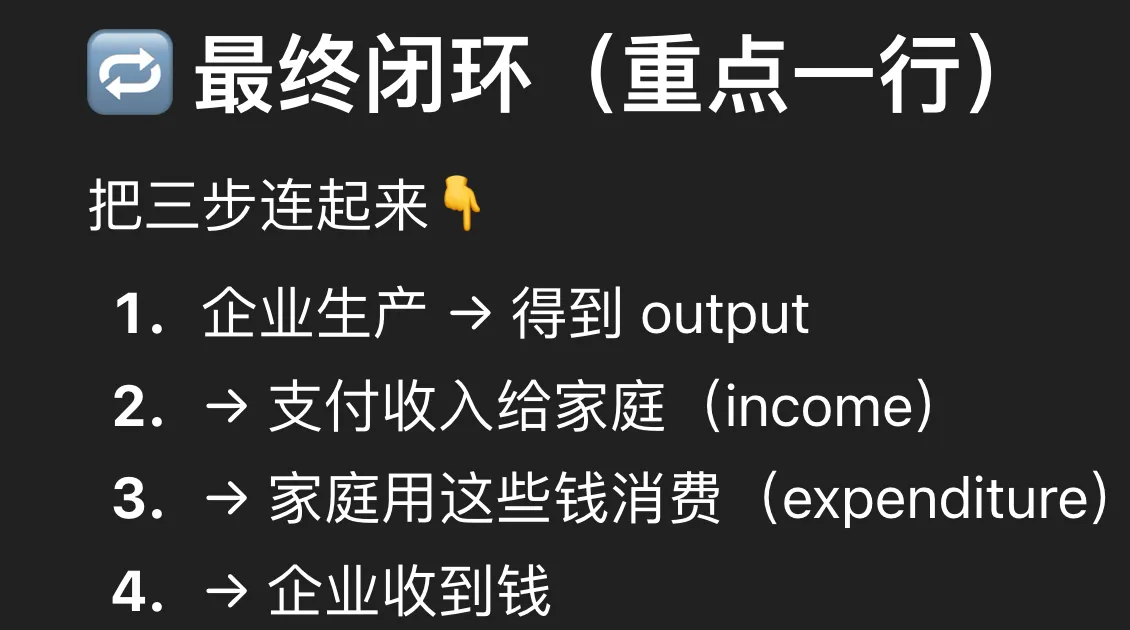
- the value of output produced in an economy is equal to the total income generated in producing that output, which is equal to the expenditures made to purchase that output
- 生产出来的东西的价值 = 生产过程中赚到的钱 = 买这些东西花的钱
- 1. 内圈(real flow)
- households 提供 FOP(劳动力等)
- firms 用这些去生产 goods & services
- 👉 得到:total output(总产出)
- the value of output produced in an economy
- 2. 外圈 (money flow)
-
👉 企业生产的时候,会付:
Summary: 这些全部加起来 = total income
- 工资 wages
- 租金 rents
- 利息 interests
- 利润 profits
-
👉 为什么 output = income?
- 每一份产出,都是用FOP生产的
👉 而使用FOP必须支付报酬(income) - 所以产出的价值 = 支付出去的收入
- 每一份产出,都是用FOP生产的
-
- 3. 外圈 (money flow)
- households 拿到 income 后会去买 goods & services
- 这就是 total expenditure
- 👉 为什么 income = expenditure?
- households 把赚到的钱花出去, consumption expenditure = income received
👉 firms 收到的钱就是销售收入 - 所以收入 = 支出
- households 把赚到的钱花出去, consumption expenditure = income received
-