macro / ch 8
8.2Measures of economic activity
the usages for measuring economic activity
- assess an economy’s performance over time
- make comparisons of income and output performance with other economies
- establish a basis for making policies that will meet economic objectives
how economic activity is measured
- expenditure approach
- adds up all spending to buy final goods and services produced within a country over a time period
- measures the total amount of spending to buy final goods and services in a country(usually within a year)
- Consumption spending, abbreviated as C
- includes all purchases by households on final goods and services in a year
- Investment spending, abbreviated as I
- includes spending by firms on capital goods (buildings, machinery, equipment)
- spending on new construction ( housing and other buildings)
- Government spending, abbreviated as G
- refers to spending by governments within a country
- Net exports(export-imports), abbreviated as X-M, NX
- refers to the value of all exports(X) minus the value of all imports(M)
- Gross Domestic Product, GDP
- a measure of aggregate output
- C + I + G + (X-M)
- GDP measures the total value of final goods and services produced within an economy in a given period of time(usually one year), using current price levels.
- a measure of aggregate output
- income approach
- adds up all income earned by the factors of production that produce all goods and services within a country over a time period
- wages+rent+interest+profit = national income
- see the relative income shares of the different FOPs
- to see how this might change over time
- to make comparisons over time or across countries
- output approach
- calculates the value of all final goods and services produced within a country over a time period
distinction between GDP and GNI
- domestic
- in “gross domestic product” means that output has been produced by the FOPs domestically, or within the country.
- regardless of who owns them (residents or foreigners)
- national
- used in GNI (gross national income)
- means that the income it measures is the income of the country’s residents, regardless where this income comes from
- 一个国家的国民赚的钱(不管人在不在国内)
- GNI
- Gross National Income
- measures the value of all income earned by the country’s citizens including income earned from abroad
- GNI = GDP + net income from abroad (income from abroad - income paid abroad)
Distinction between nominal values and real values
- nominal value
- money value
- value measured in terms of prices that prevail at the time of measurement
- real value
- to eliminate the influence of changing prices on the value of output
- a measure of value that takes into account changes in prices over time
- Nominal GDP and Nominal GNI are measured in terms of current prices(prices at the time of measurement), which does not account for changes in prices, or does not adjusted for inflation
- Real GDP and Real GNI are measures of economic activity that have eliminated the influence of changes in prices, adjusted for inflation
- Real values are measured by using constant price levels
Distinction between total and per capita values
- per capita
- takes the total value(of output, income, expenditure) and divides this by the total population of the country
- it indicates the average income per person in the economy, thus providing a better indication of living standards
- total measures the the value of output and income(such as GPD and GNI), provide a summary statement of the overall size of the economy
- Per capita figures are useful as a summary measure of the standard of living in a country, because they provide an indication of how much of total output or total income in the economy correponds to each person in the population on average
The meaning of real GDP/GNI per capita at purchasing power parity(PPP)
- different countries have different price levels
- this means that the same amount of money in a low-price country has greater purchasing power (can buy more things) than in a high price country
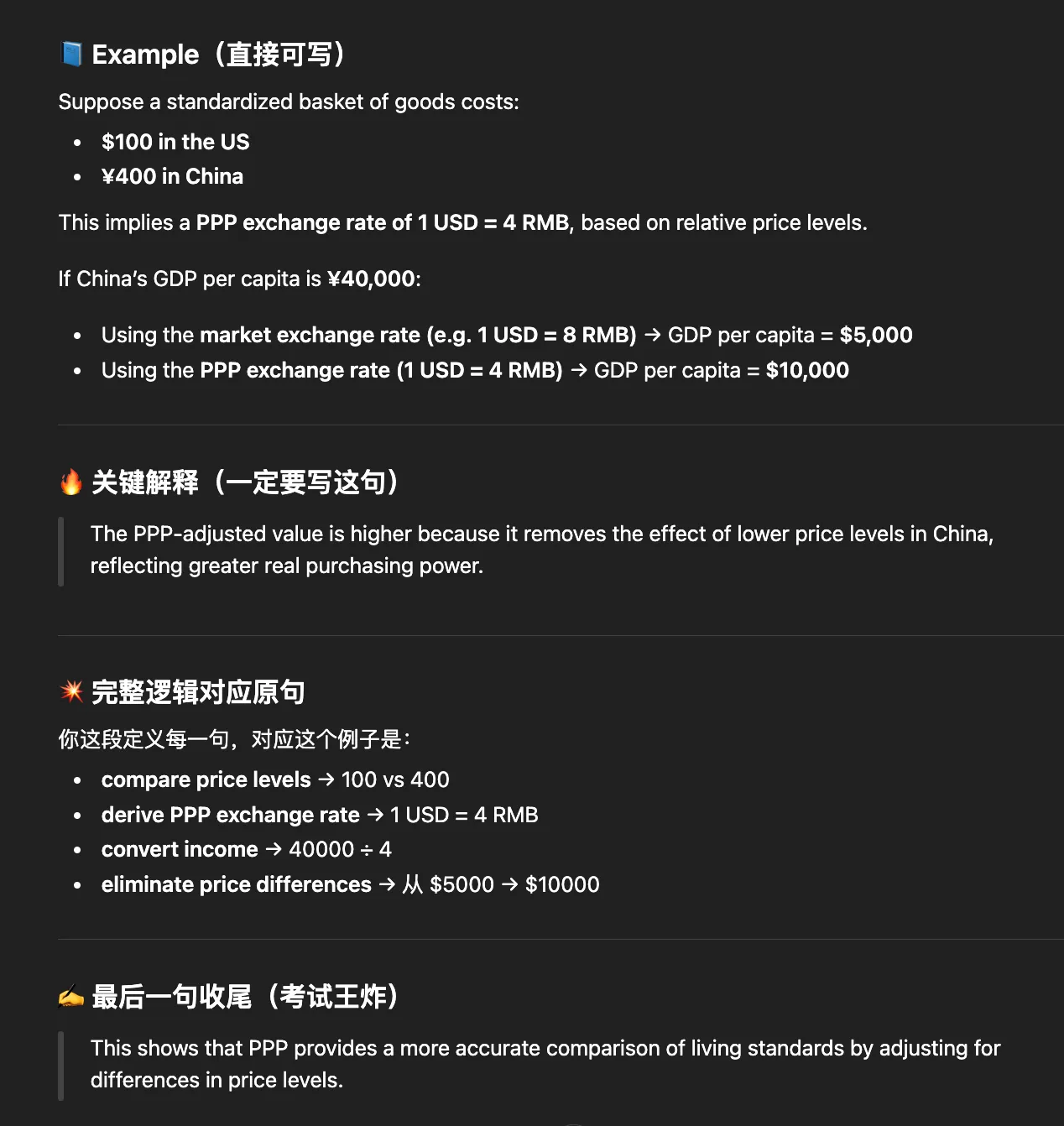
- Purchasing Power Parity (PPP) works by comparing the price levels of a standardized basket of goods and services across countries in order to derive an exchange rate that equalizes purchasing power. This PPP exchange rate is then used to convert national income or output into a common currency, eliminating the influence of price differences on the value of output or income.
-
-
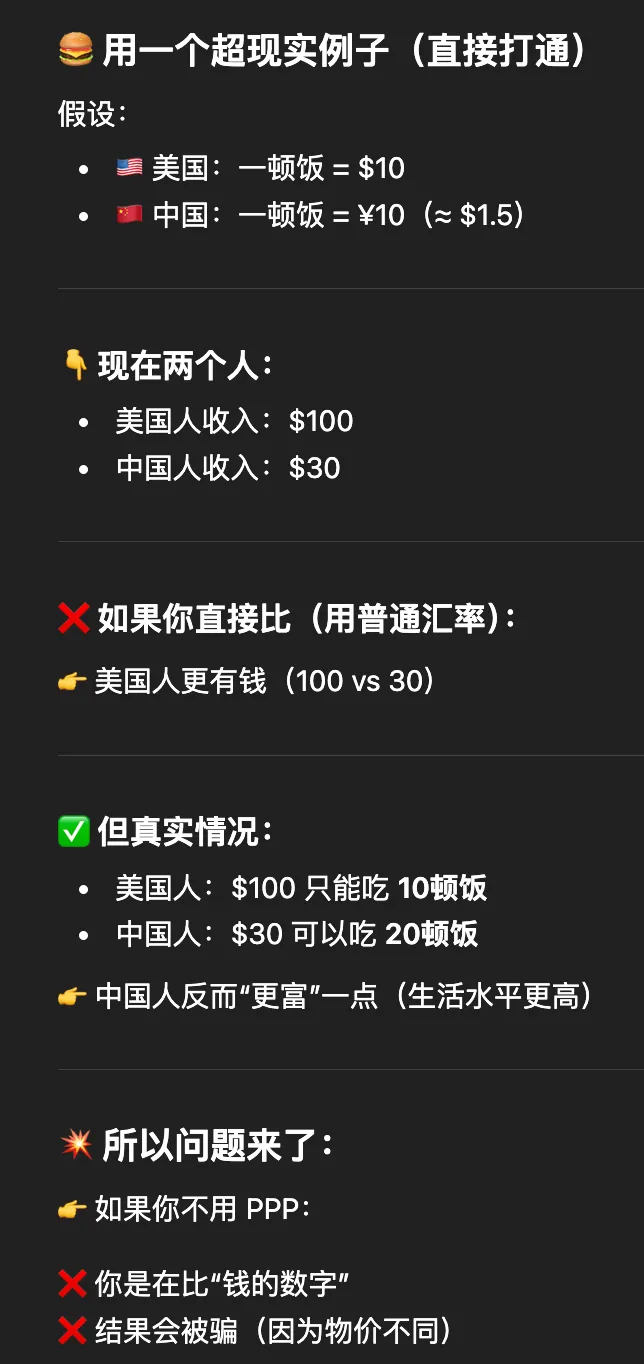
- PPP is used to eliminate differences in price levels between countries so that comparisons of GDP per capita or GNI per capita reflect real purchasing power and living standards