micro
Market Failure: Market Power
market power
- refers to a firm’s ability to control the price of a product. Based on a firm’s level of market power, markets can be categorized into market structures.
- the number and size of firms in the market
- the barriers to entry of a market
- the level of price and non-price competition
cost curves of a firm
- Due to specialization and the law of diminishing marginal returns, the marginal cost of a firm varies with output
- Up to point a, marginal costs fall as specialization improves the efficiency of factors of production
- Beyond point a, marginal costs increase due to the law of diminishing marginal returns
-
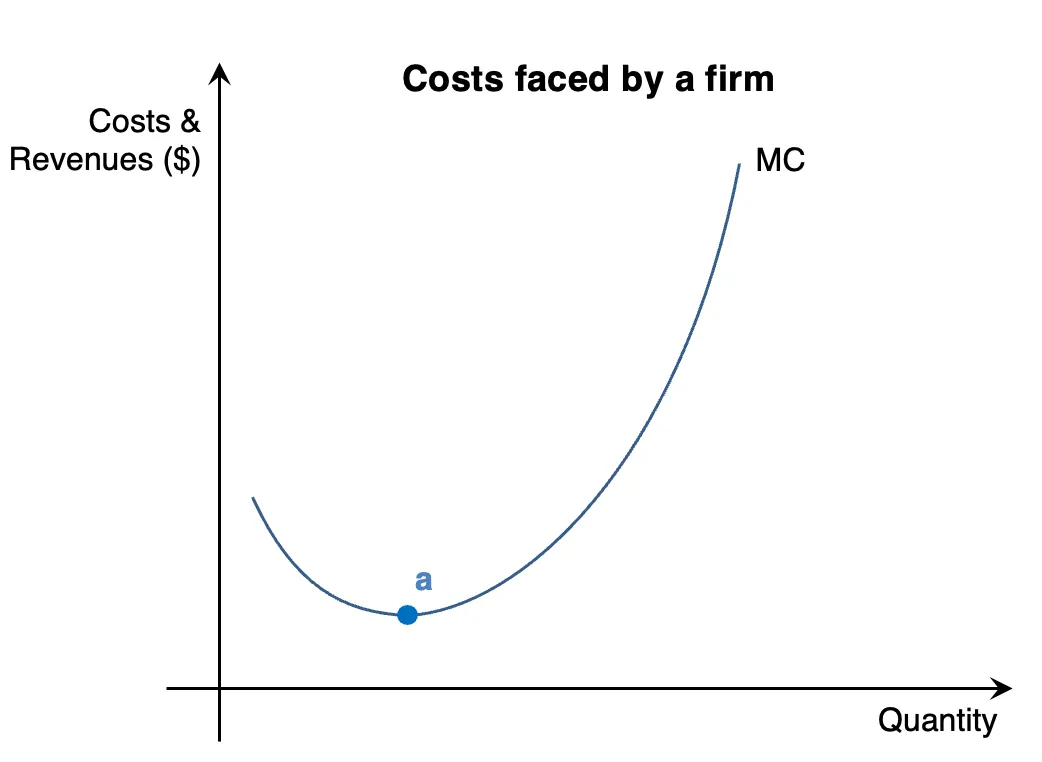
- These factors also lead the (short-run) average total cost curve to be U-shaped (parabolic).
-
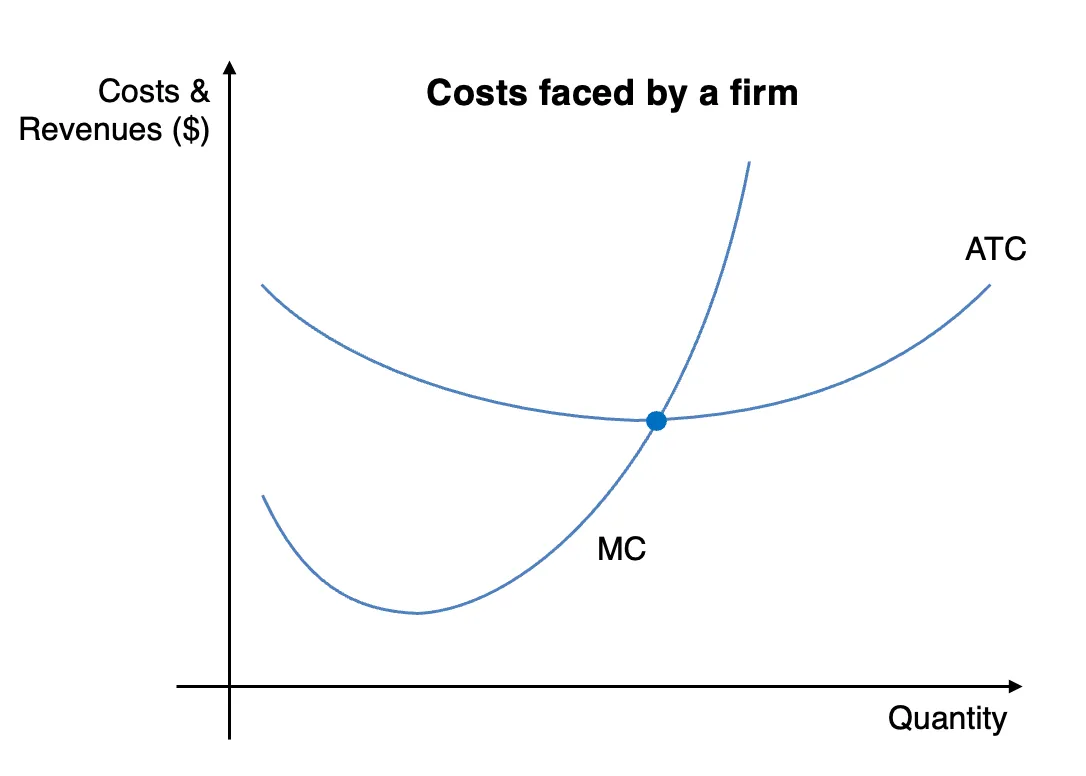
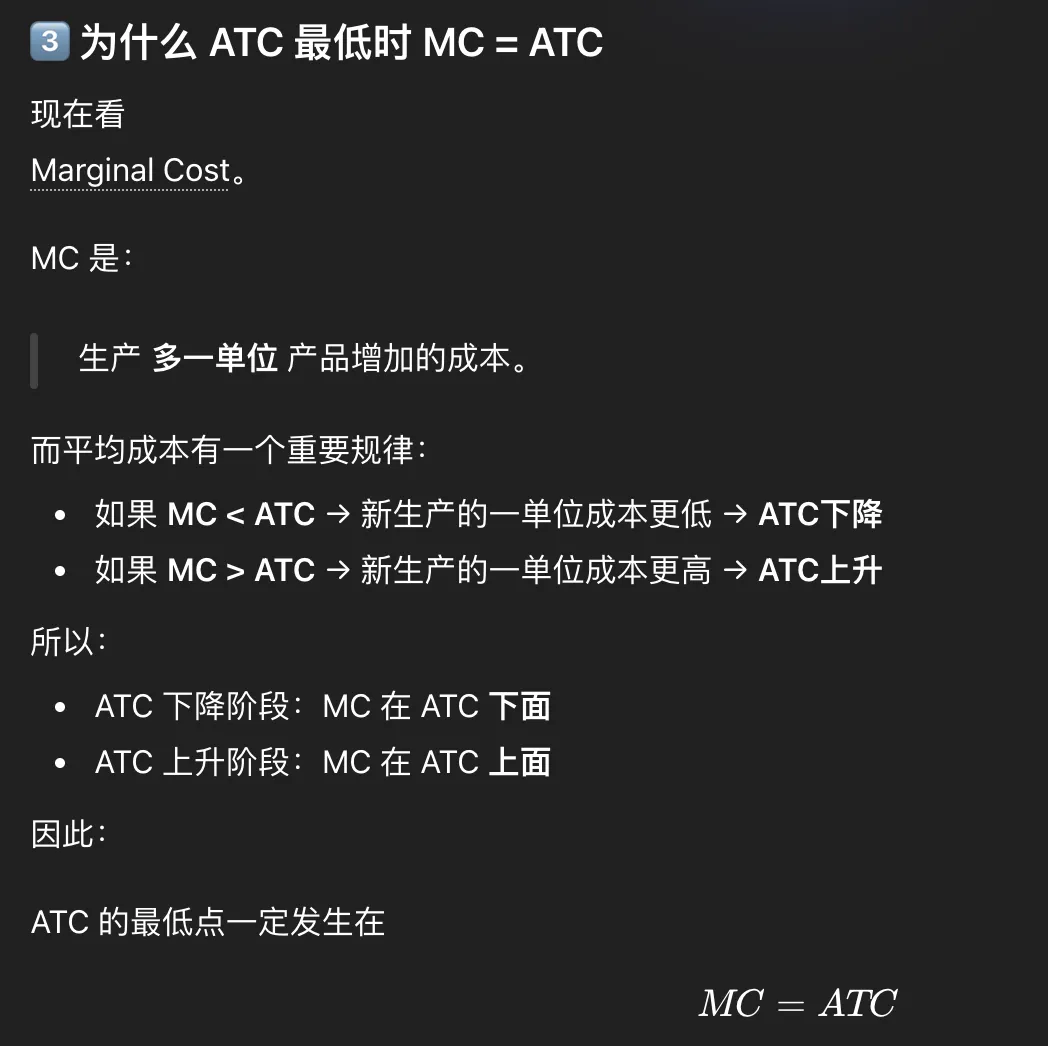
- the marginal cost curve always passes through the lowest point of the average total cost curve
- When MC < ATC(below), an additional unit of output will decrease ATC
- When MC > ATC(above), an additional unit of output will increase ATC
-
Perfect Competition
-
perfect competition has the following characteristics and assumptions
- many small firms
- There are many buyers and sellers in perfect competition.
- No one firm is large enough to affect the market.
- homogeneous products (identical, perfect substitutes)
- Firms produce identical products and one firm’s product is just as good as another’s.
- there is no incentive to advertise as it would only increase costs (the exception being industry-wide advertising).
- one firm’s product is a perfect substitute for another’s. As such, the demand curve faced by a firm is perfectly price elastic.
- no market power (firms are price takers)
- no barriers to entry or exit
- Firms can enter and leave the industry at will, without costs.
- due to market forces, firms will always earn normal profit in the long run.
- perfect information
- potential & existing producers have perfect information on the costs and revenues of producers.
- buyers are aware about the industry and that products are homogeneous.
- perfect factor mobility
- factors of production can be moved in and out of production freely.
- many small firms
-
demand curve faced by a single firm
- As firms have no market power, the demand curve they face is perfectly elastic. The demand and price for an individual firm is determined by market demand and market supply.
-
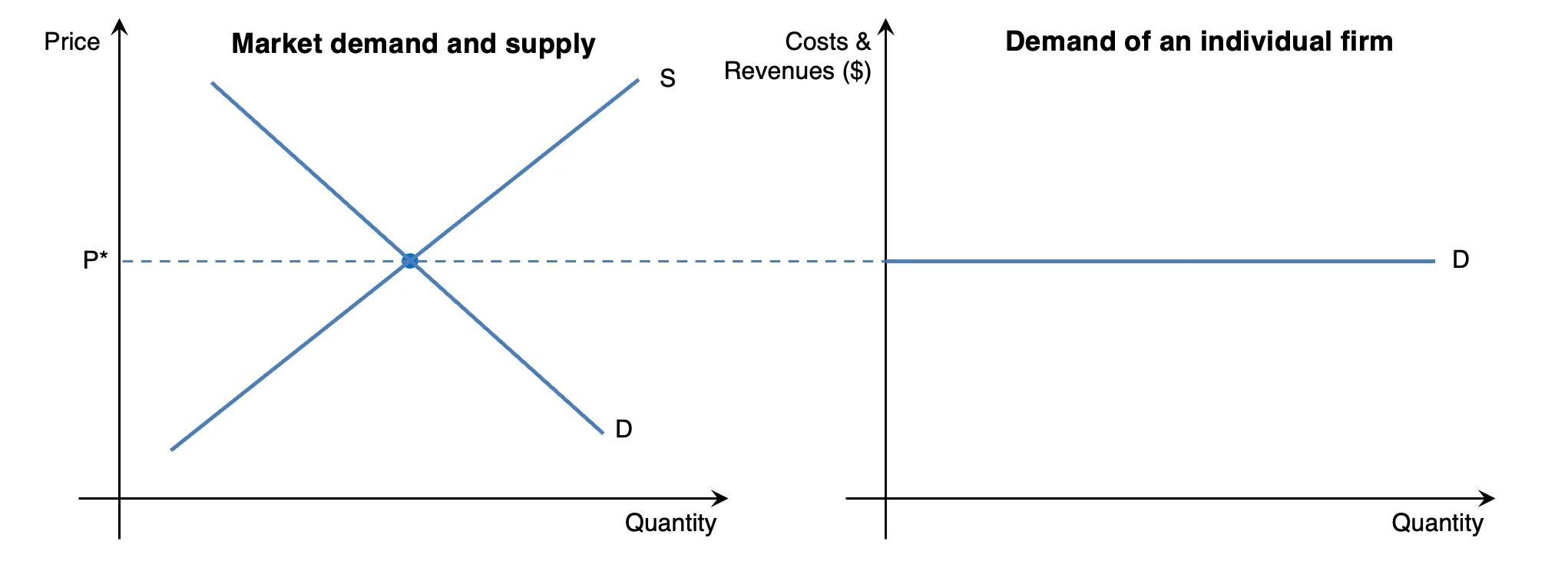
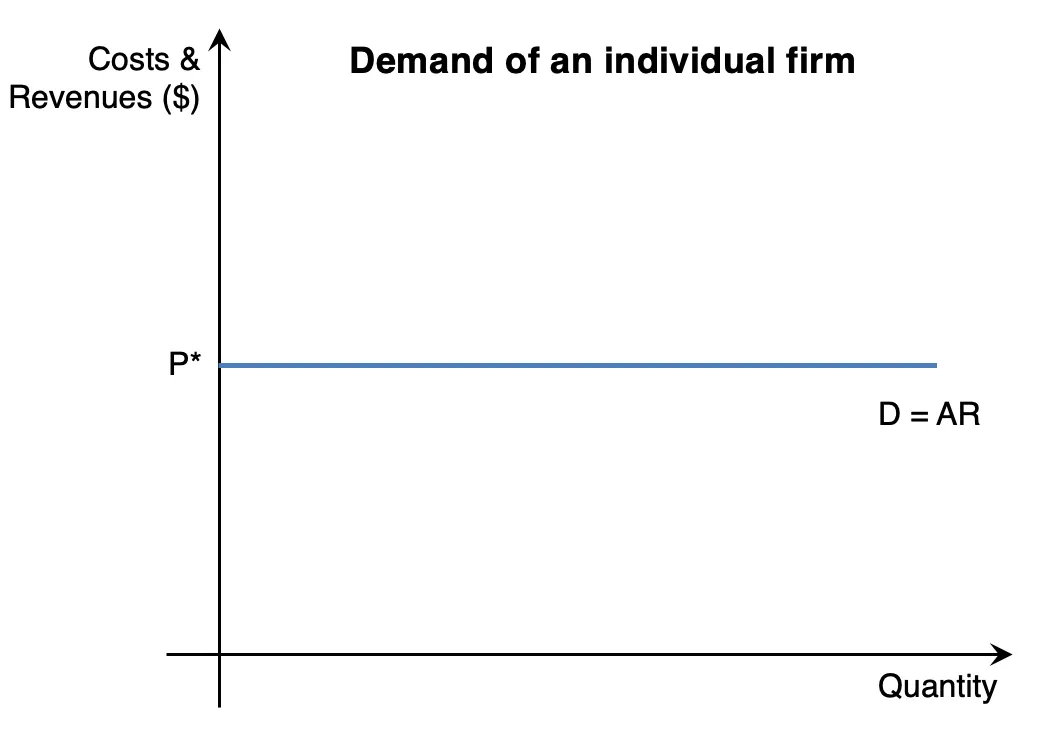
- As the demand curve represents the quantity of goods&services that consumers are willing and able to consume at different prices, the demand curve faced by a firm can be referred to as the average revenue curve.
-
We know that AR = P. A simple way to understand this is by using Mathematics. Demand curve is basically a function. The independent variable (the function value) is basically the values on the y-axis, which is the price.
-
-
normal profits (short run)
-
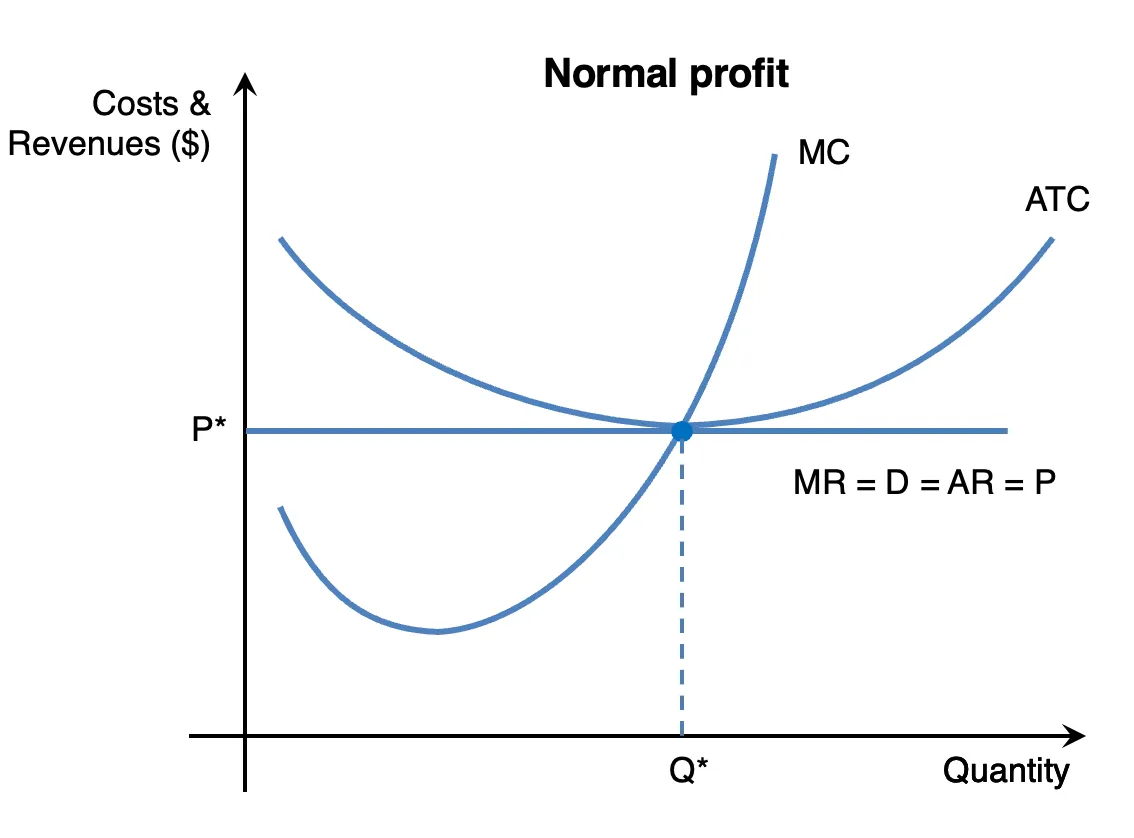
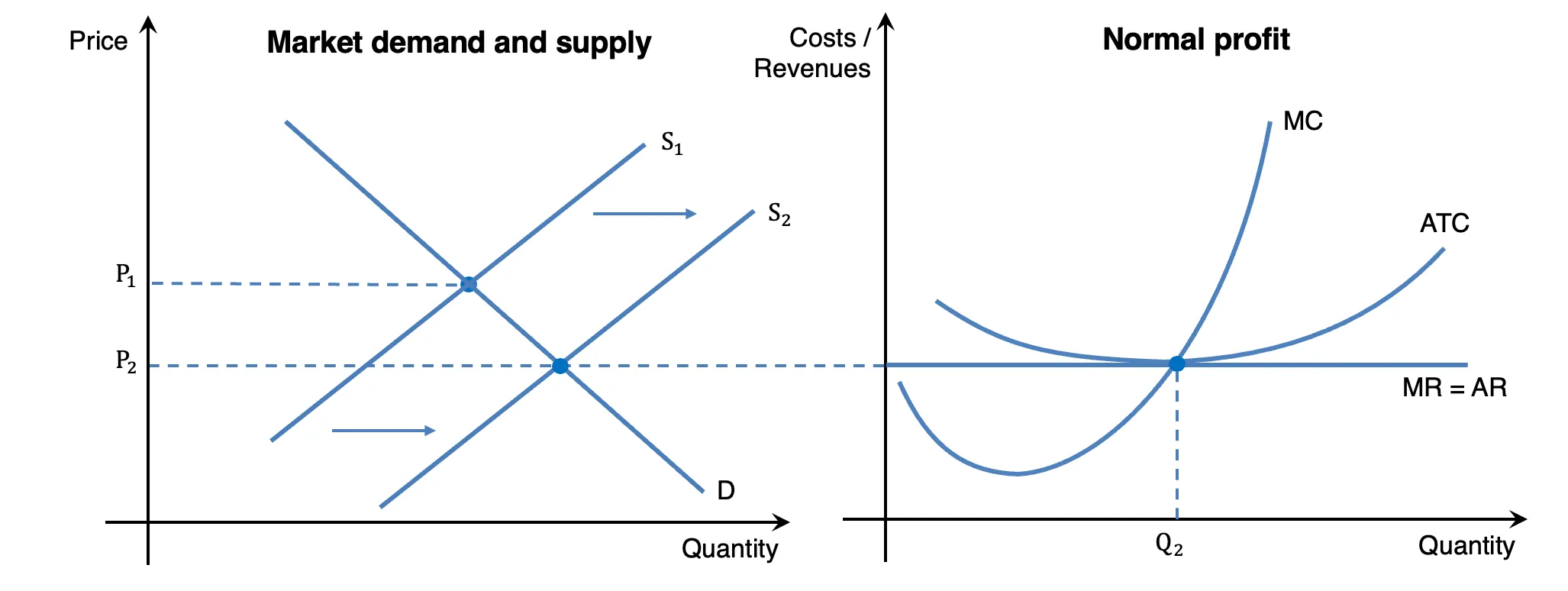
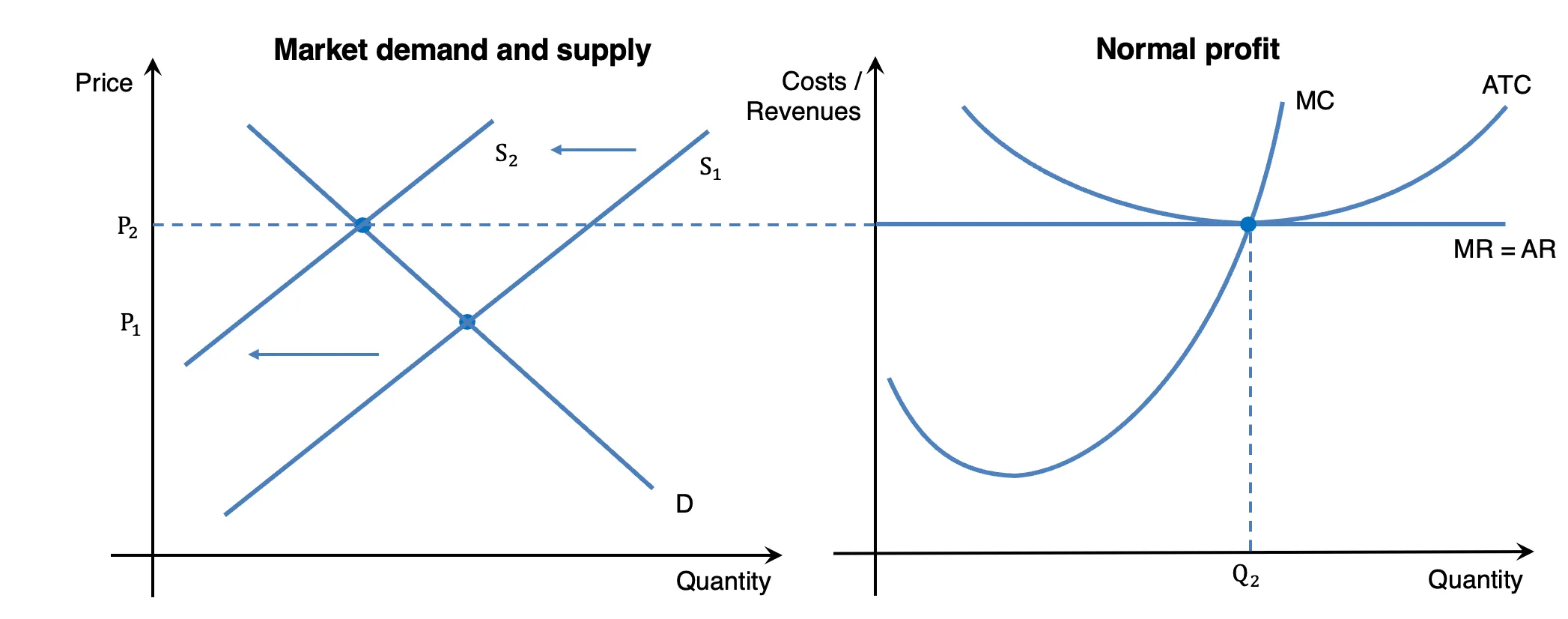
- Due to the profit-maximizing assumption, firms will operate where MR = MC at P*, Q*.
- Firms earn normal profit when ATC is at a tangent to the MR curve.
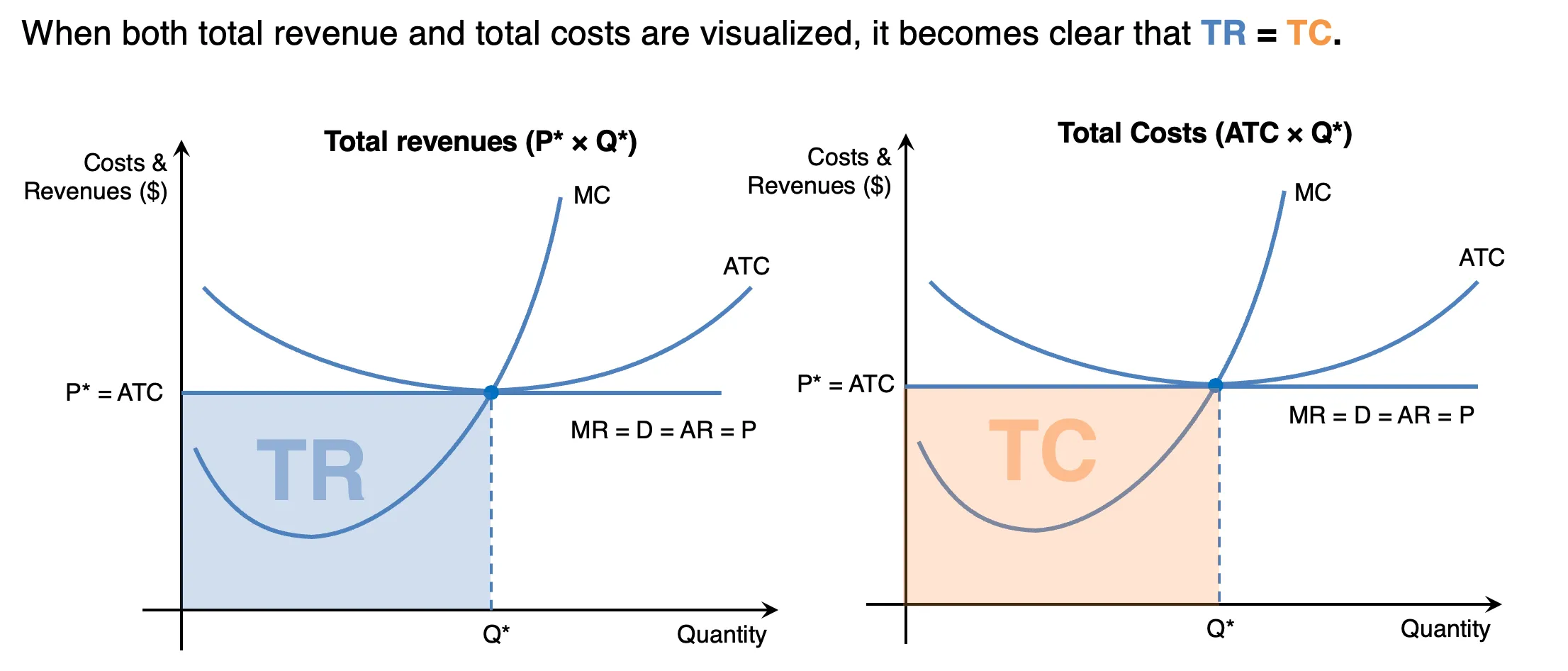
- This is because at (P*, Q*), P = ATC and hence TR = TC.
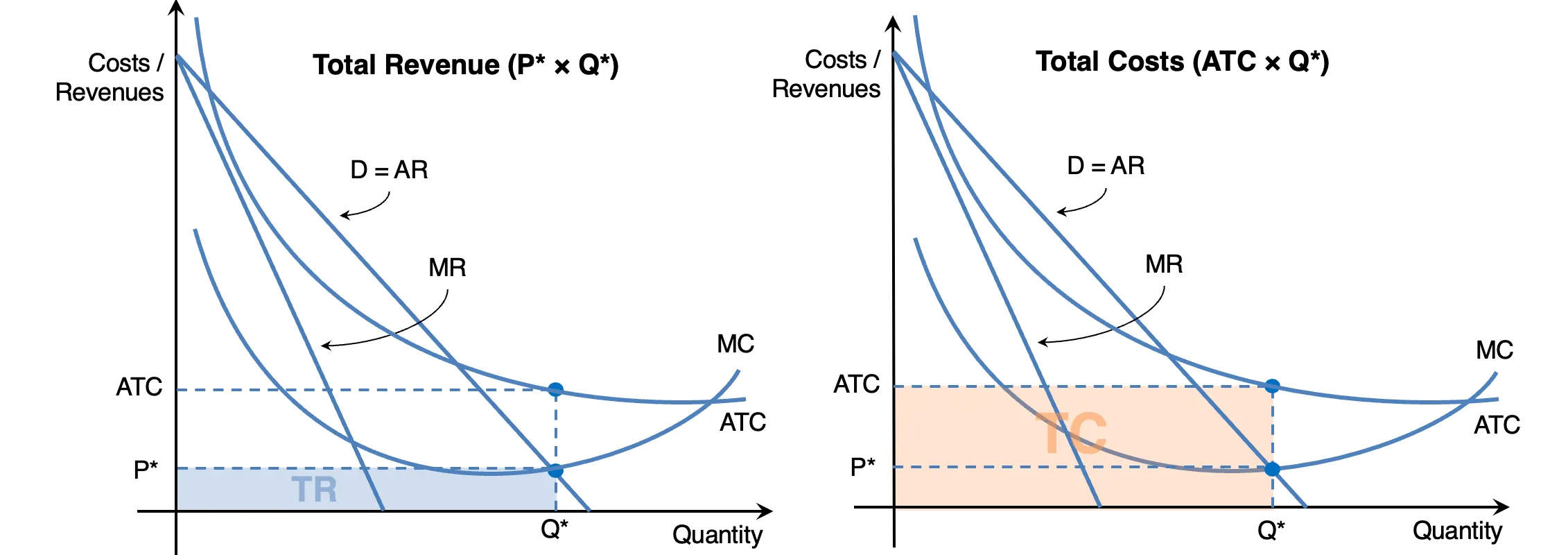
- TR = TC = P* ✖️ Q* = ATC ✖️ Q*
-
-
-
supernormal profits (short run)
-
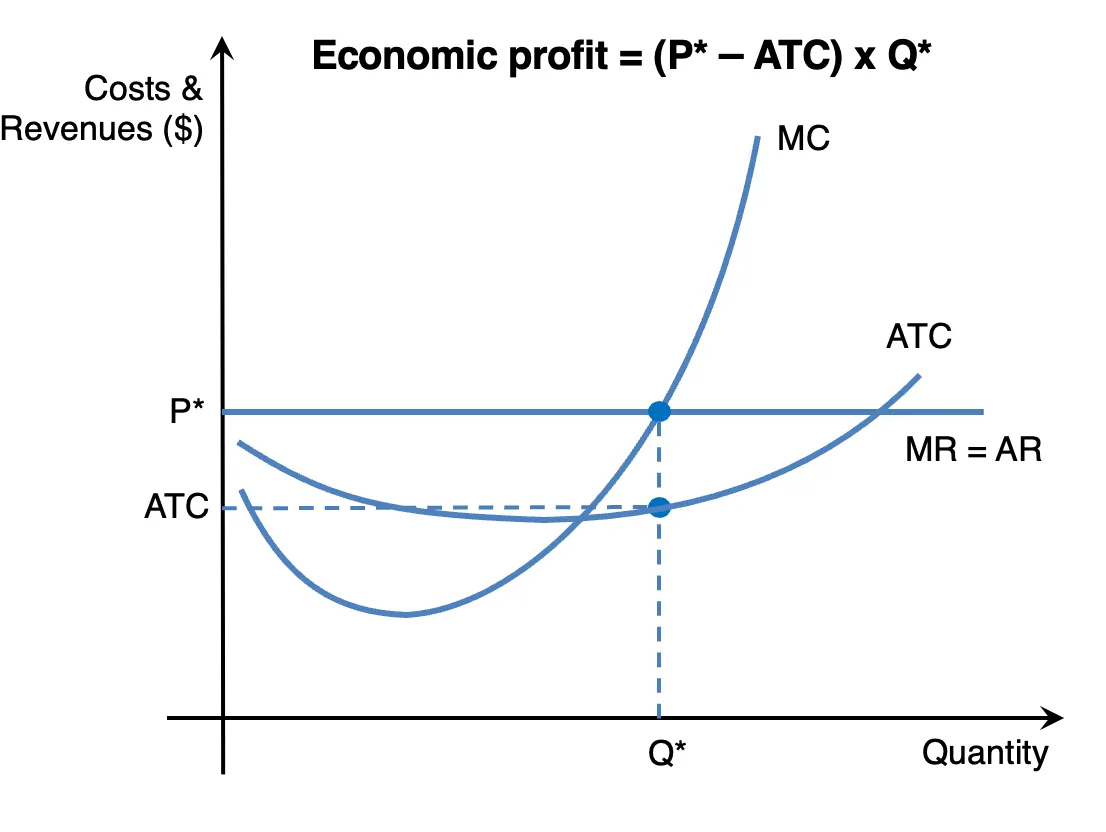
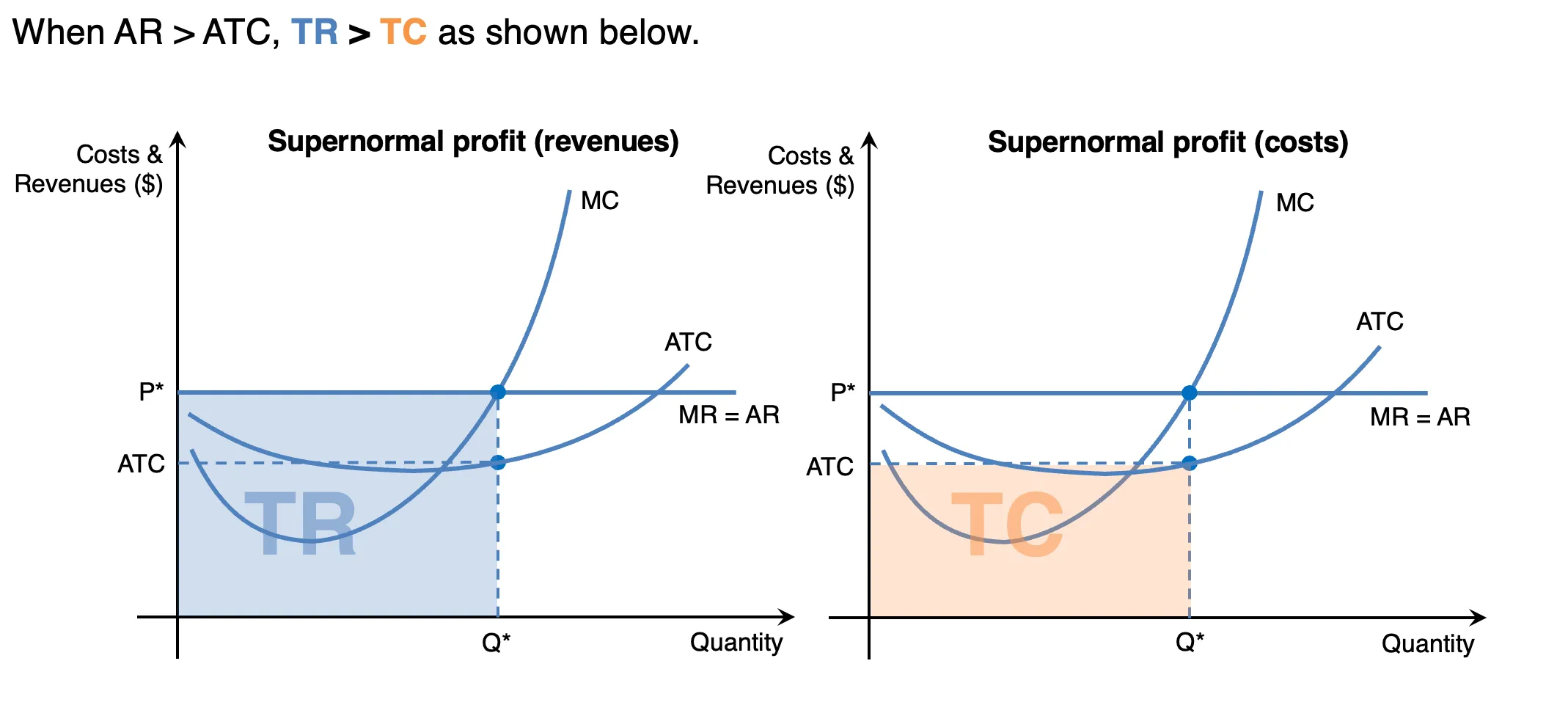
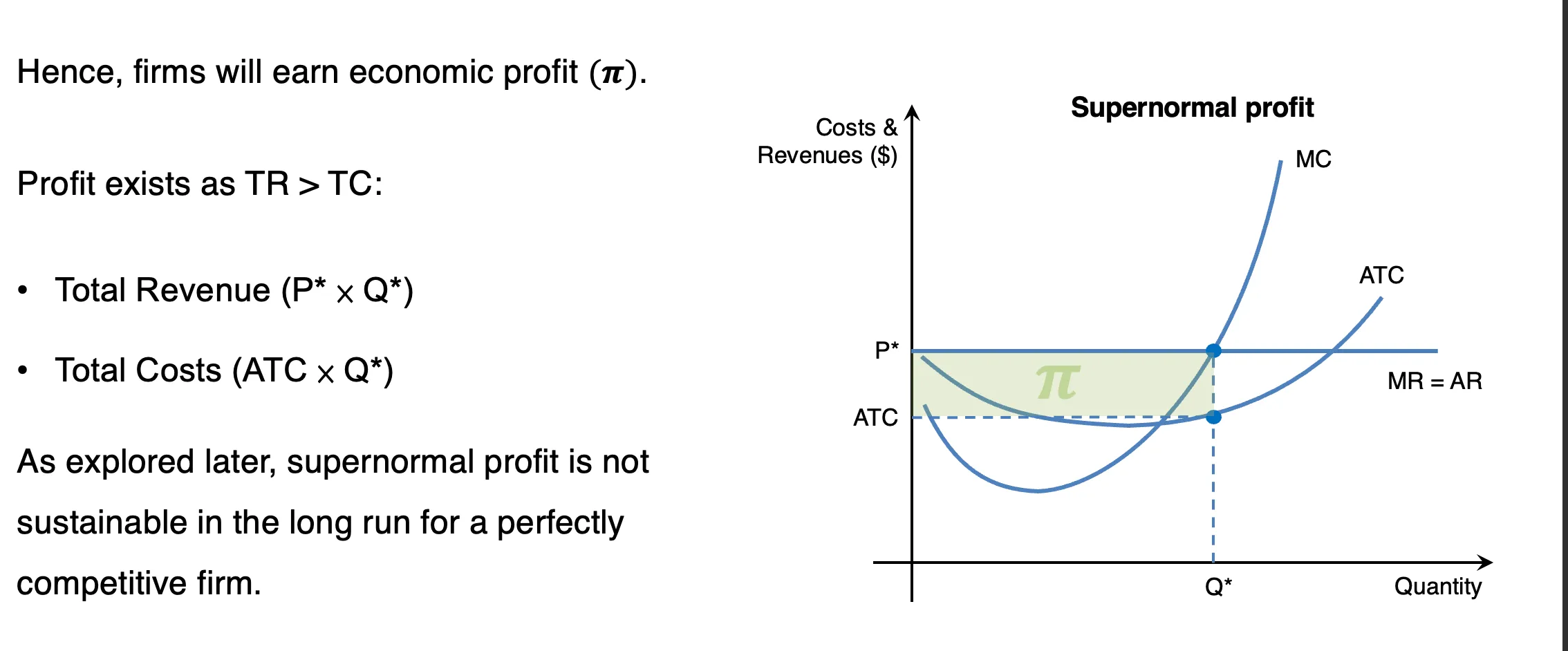
- Firms earn economic profit (or supernormal profit, or abnormal profit) when AR > ATC at the quantity where MR = MC.
-
-
-
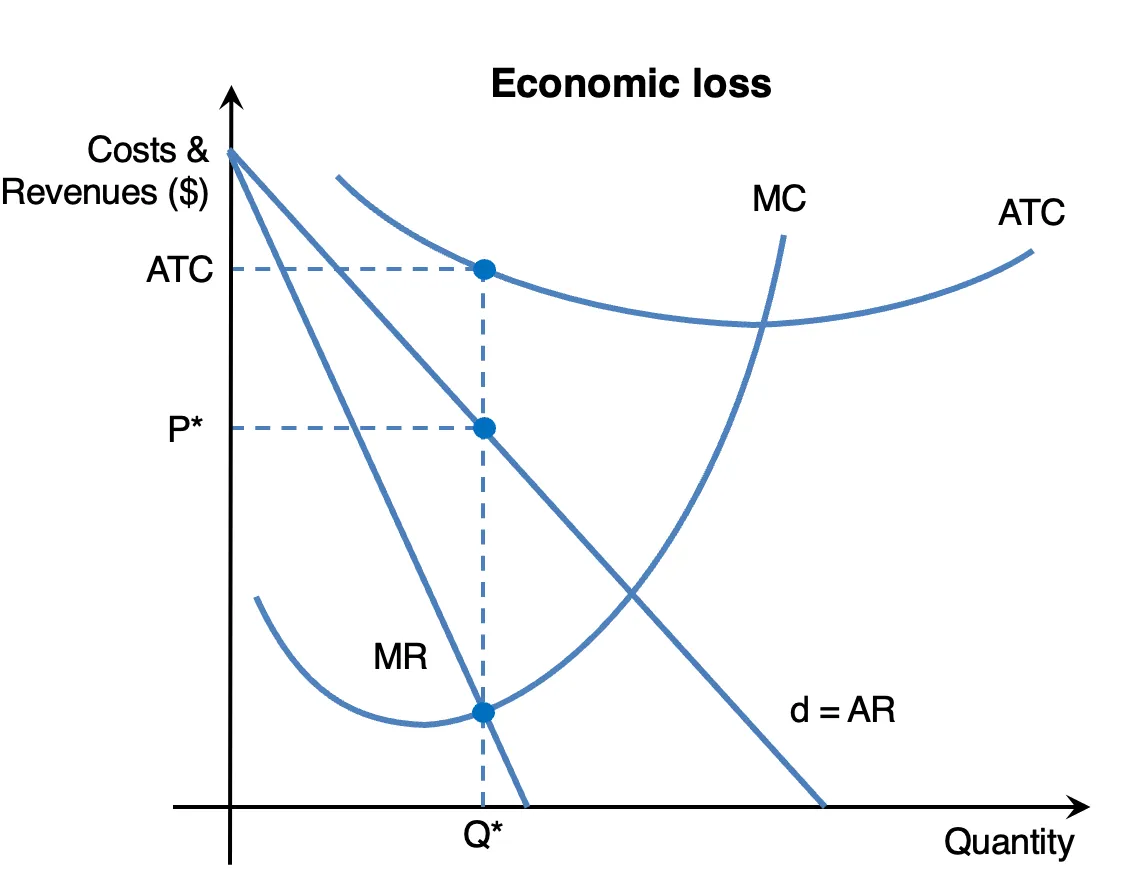
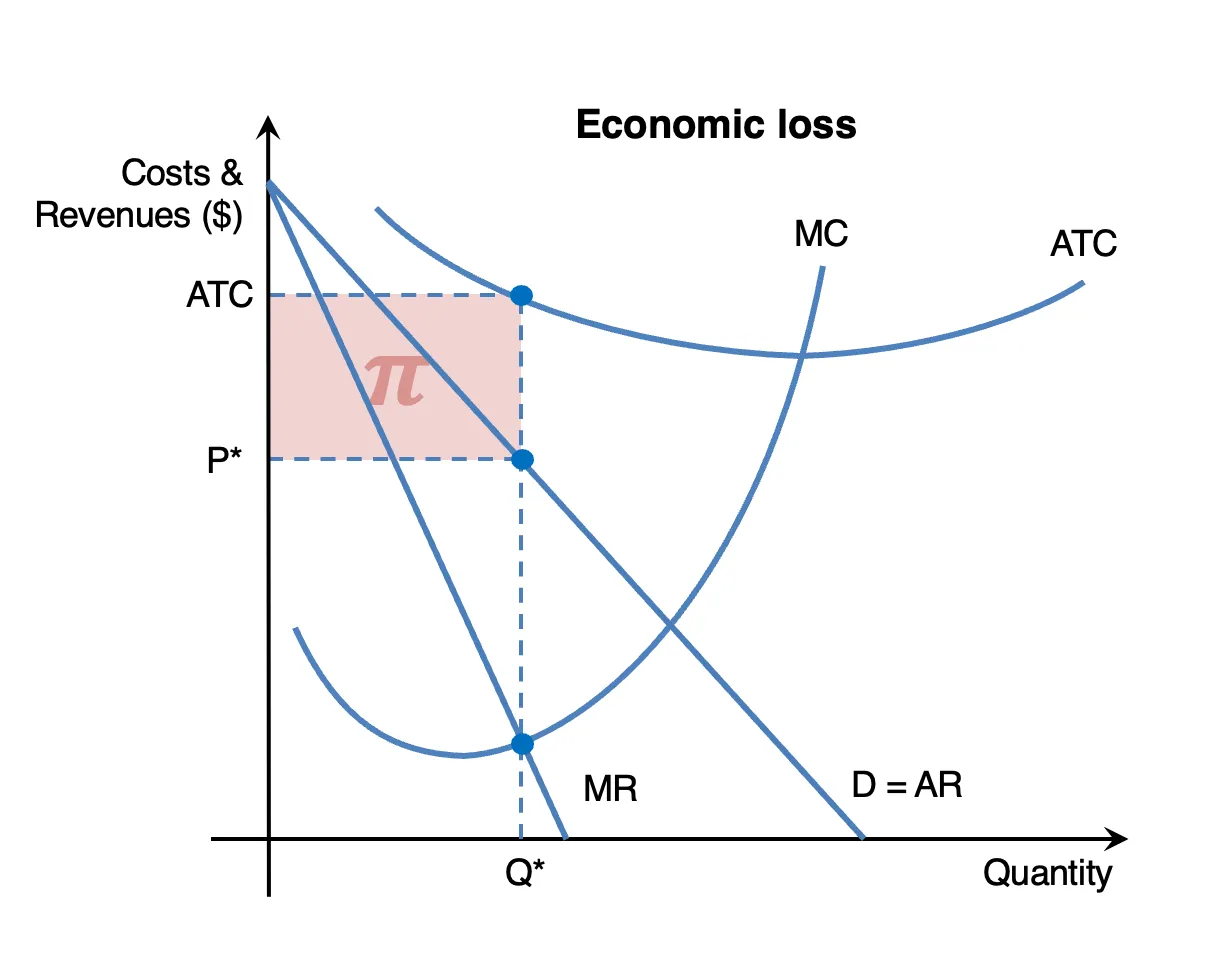
economic loss (short run)
-
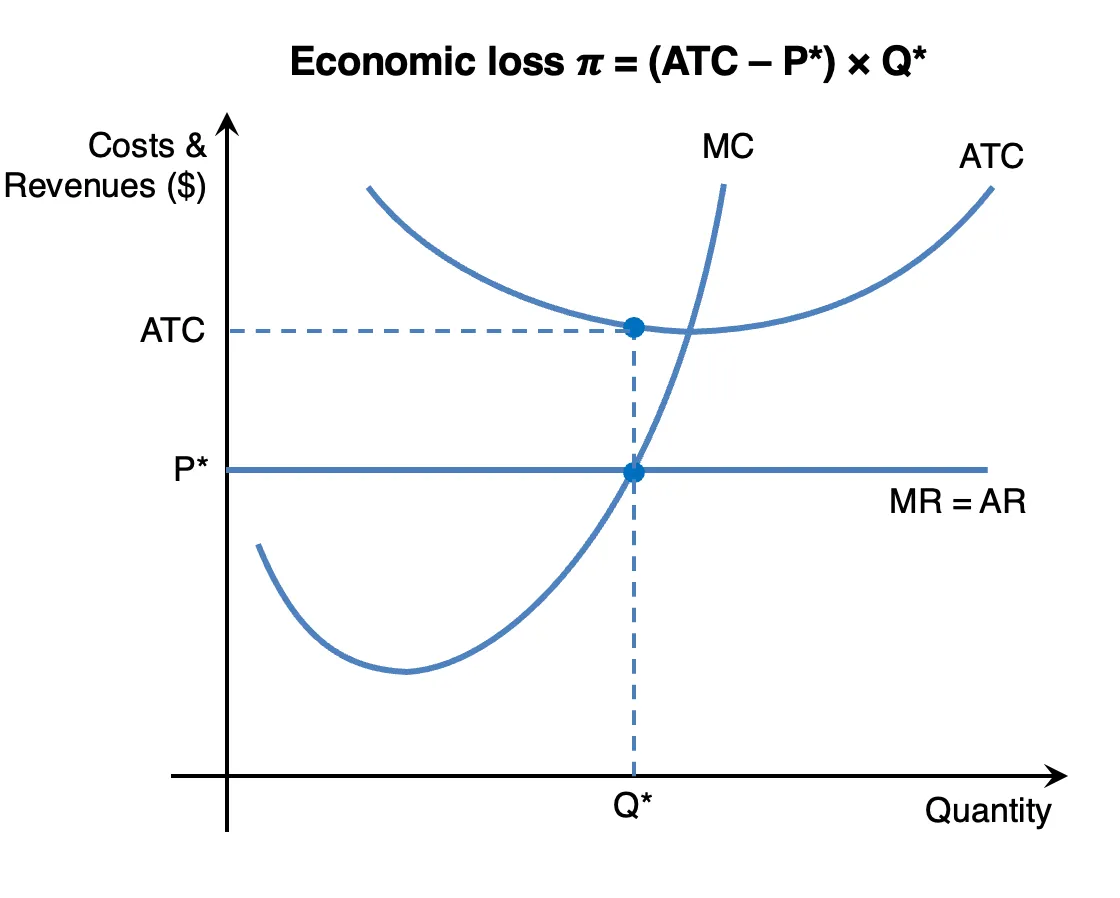
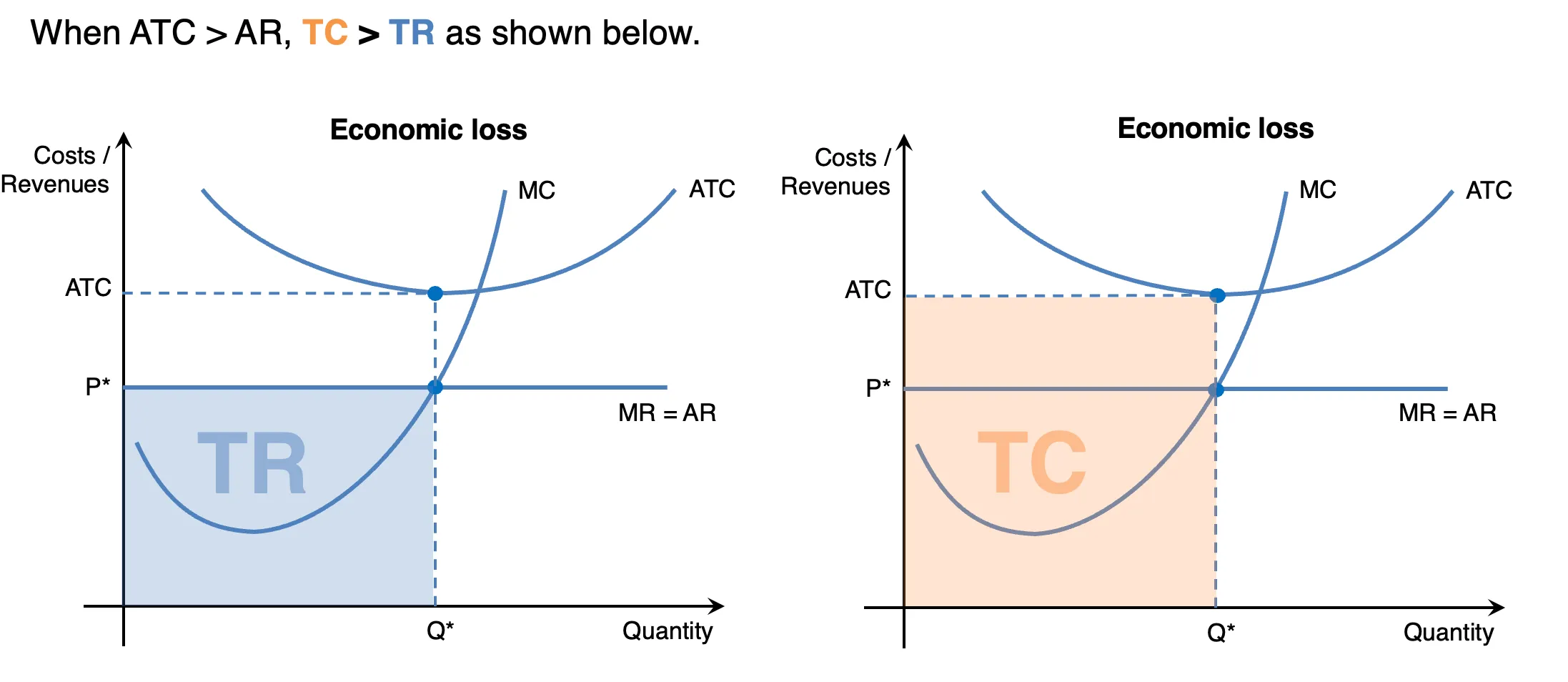
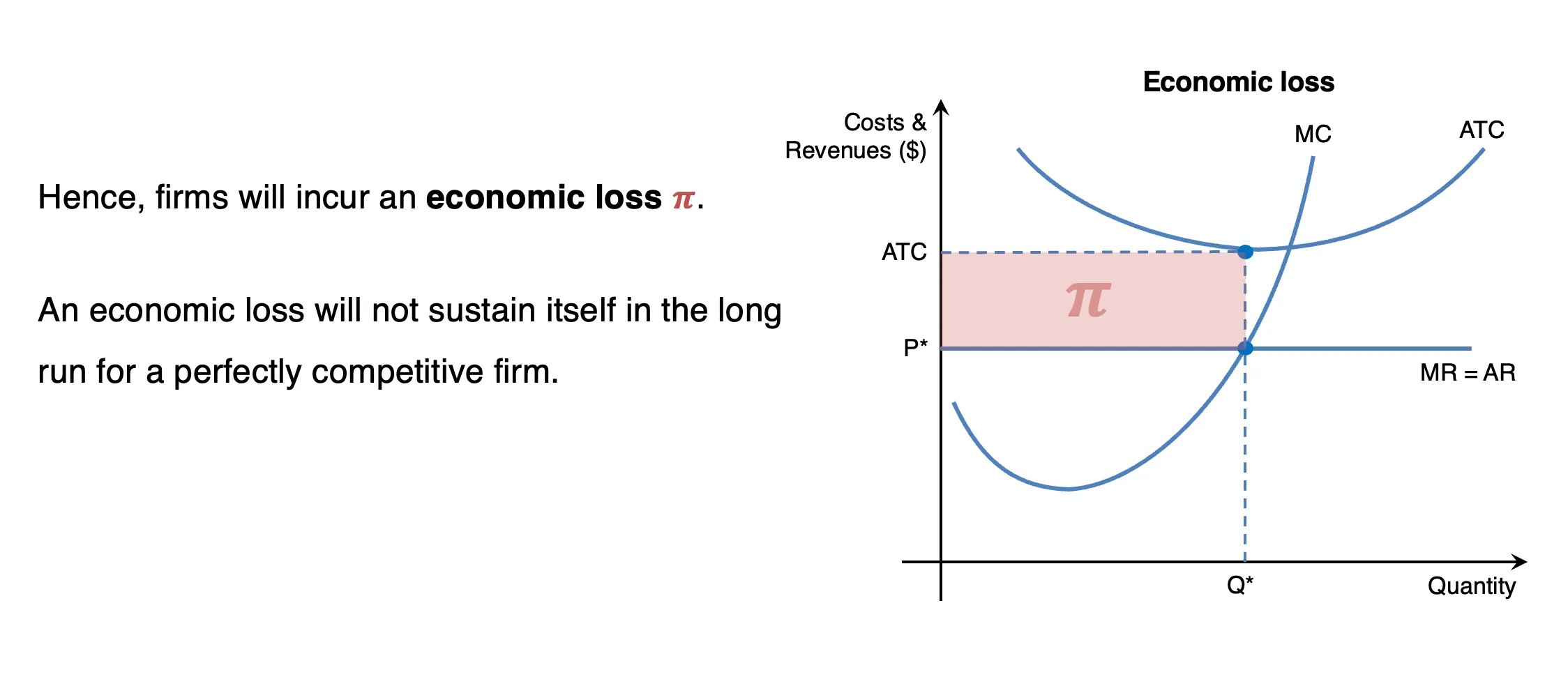
- Firms will incur an economic loss when ATC > AR at the quantity where MR = MC.
-
-
-
supernormal profits(long run)
- As potential producers have perfect information, they will enter the market to compete for economic profits.
- This increases the market supply and reduces the market price until all supernormal profits are competed away, resulting in normal profit.
-
-
economic loss (long run)
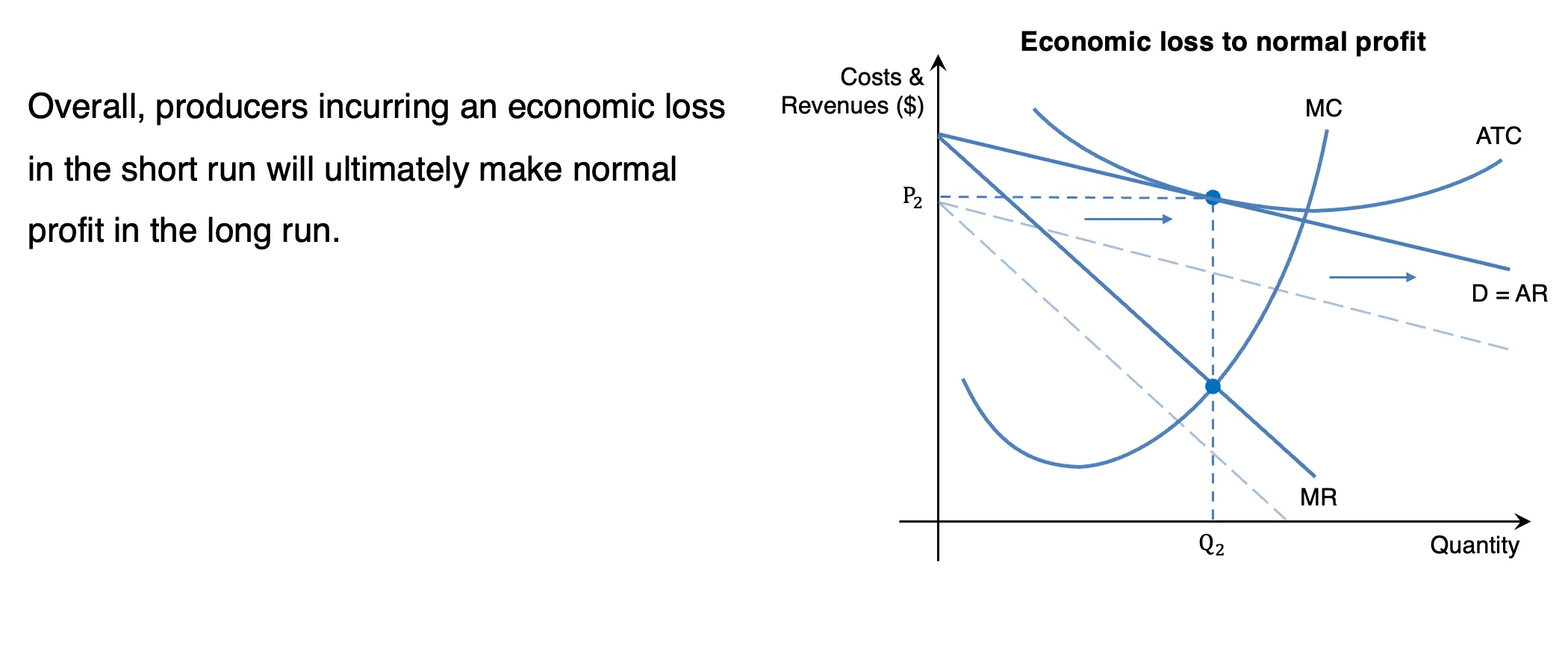
- In the long run, rational producers making a loss will exit the market.
- As a result, market supply shifts inwards, raising market prices until economic losses disappear, returning every firm to a level of normal profit.
-
-
evalution
- benefits
- Allocative efficiency
- The demand curve shows consumers’ willingness to pay for an additional unit, which represents marginal benefit. Therefore price is the monetary measure of marginal benefit.
- Thus, allocative efficiency is always reached in perfect competition, P = MB = MC.
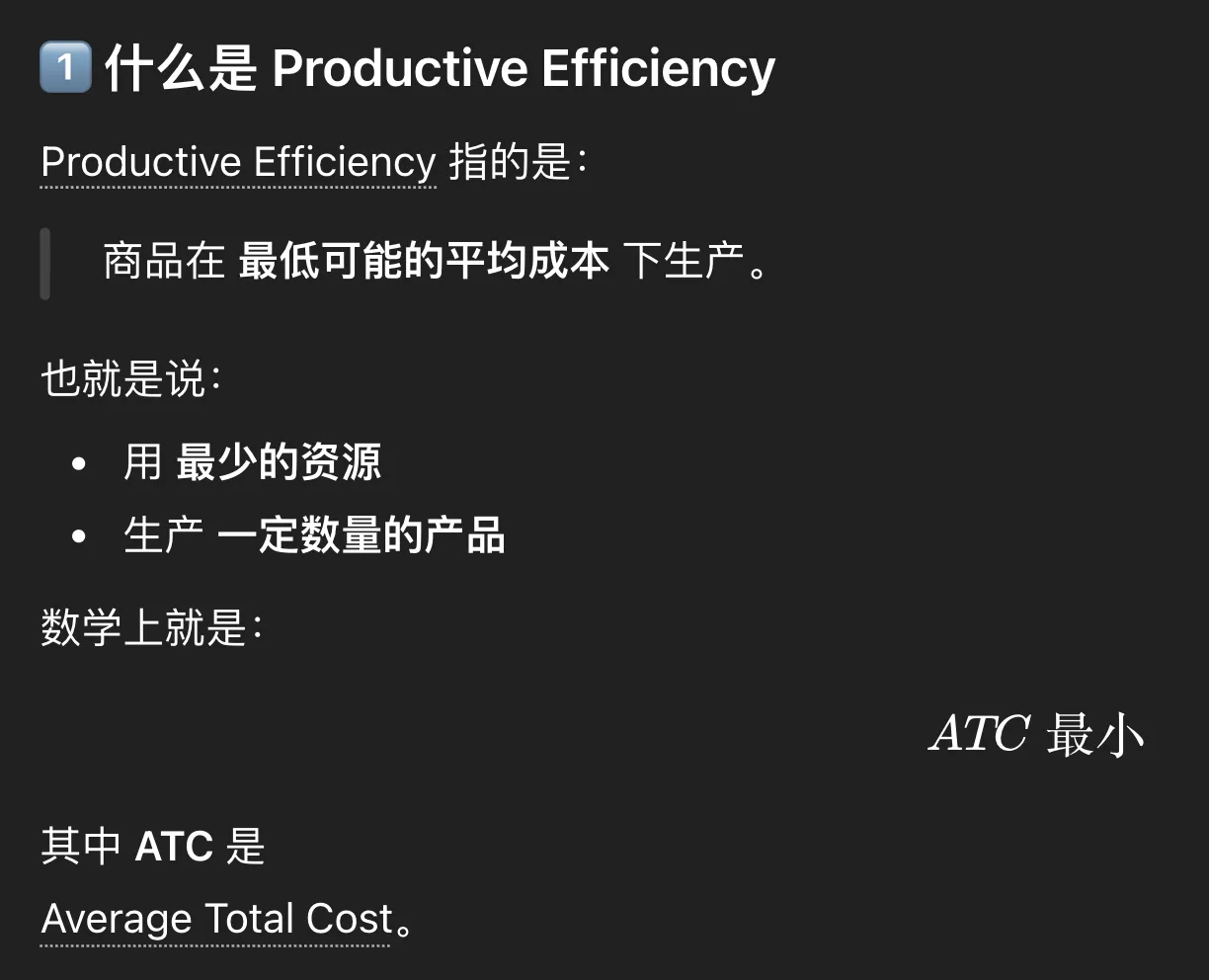
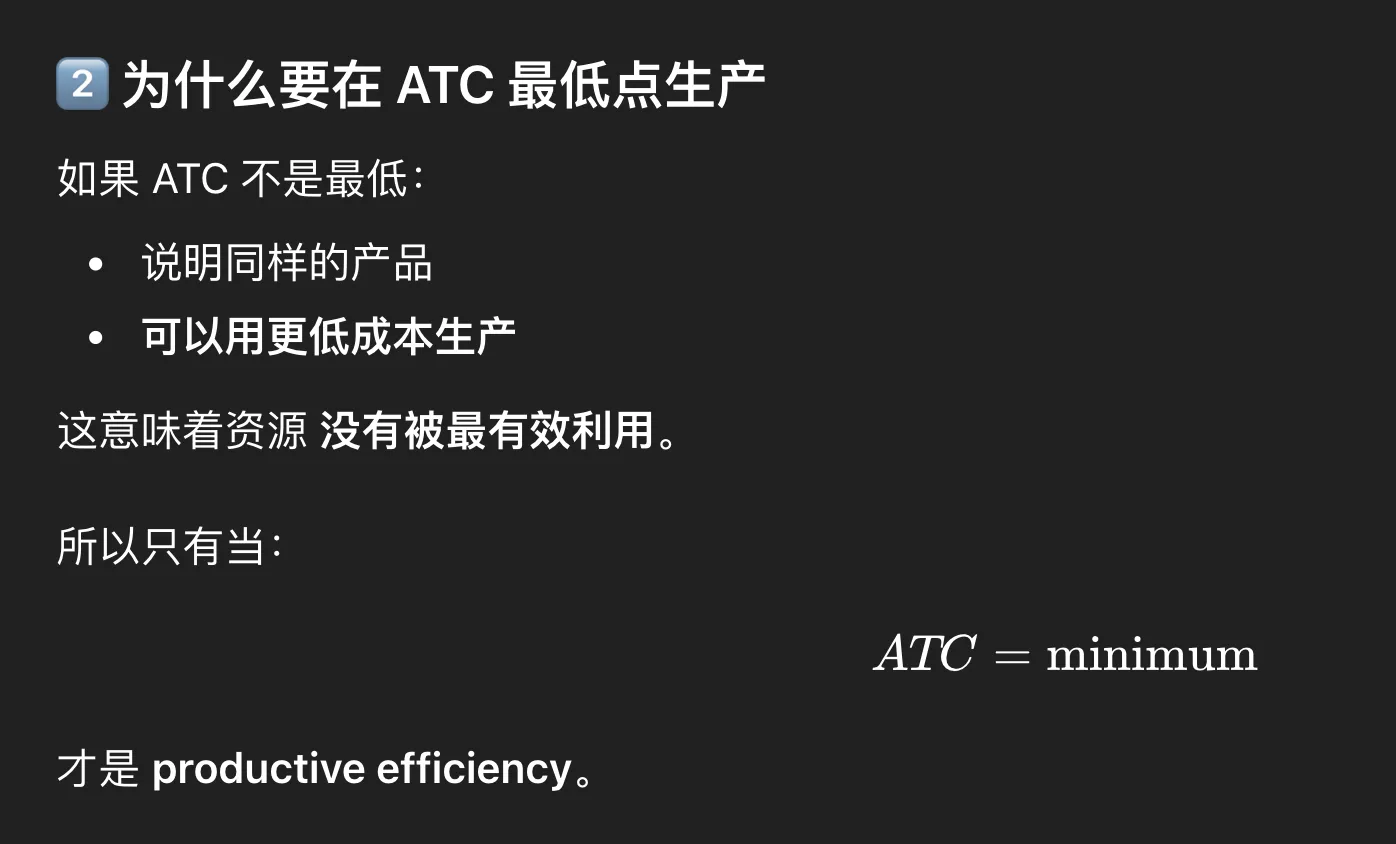
- Productive efficiency
-
- Low prices for consumers
- Competition leads to the closing down of inefficient producers
- The market responds to consumer tastes
- The market responds to changes in technology or resource prices.
- Allocative efficiency
- drawbacks
- Unrealistic assumptions
- Limited possibilities to take advantage of economies of scale
- Lack of product variety(identical perfect substitute)
- Waste of resources in the process of long-run adjustment
- Limited ability to engage in research and development
- benefits
Monopolistic Competition
- Monopolistic competition are markets which display the following characteristics
- Many firms
- There are many buyers and sellers in monopolistic competition
- Firms are small to medium in size
- Slightly differentiated products
- Firms produce similar products that are imperfect – or close – substitutes
- Due to a slight level of product differentiation, there is a small incentive to advertise
- Insignificant market power (some price-setting power)
- Due to subtle product differentiation, firms will hold some market power
- However, as substitutes are close in monopolistic competition, the demand curve faced by a firm is relatively price elastic. Hence, firms have less freedom to control prices without experiencing large changes in quantity demanded.
- Insignificant barriers to entry or exit
- There are low levels of barriers to entry, although they are insignificant
- As a result, due to market forces, firms will always earn normal profit in the long run
- Imperfect (close) substitutes exist
- Many firms
- demand curve faced by a single firm
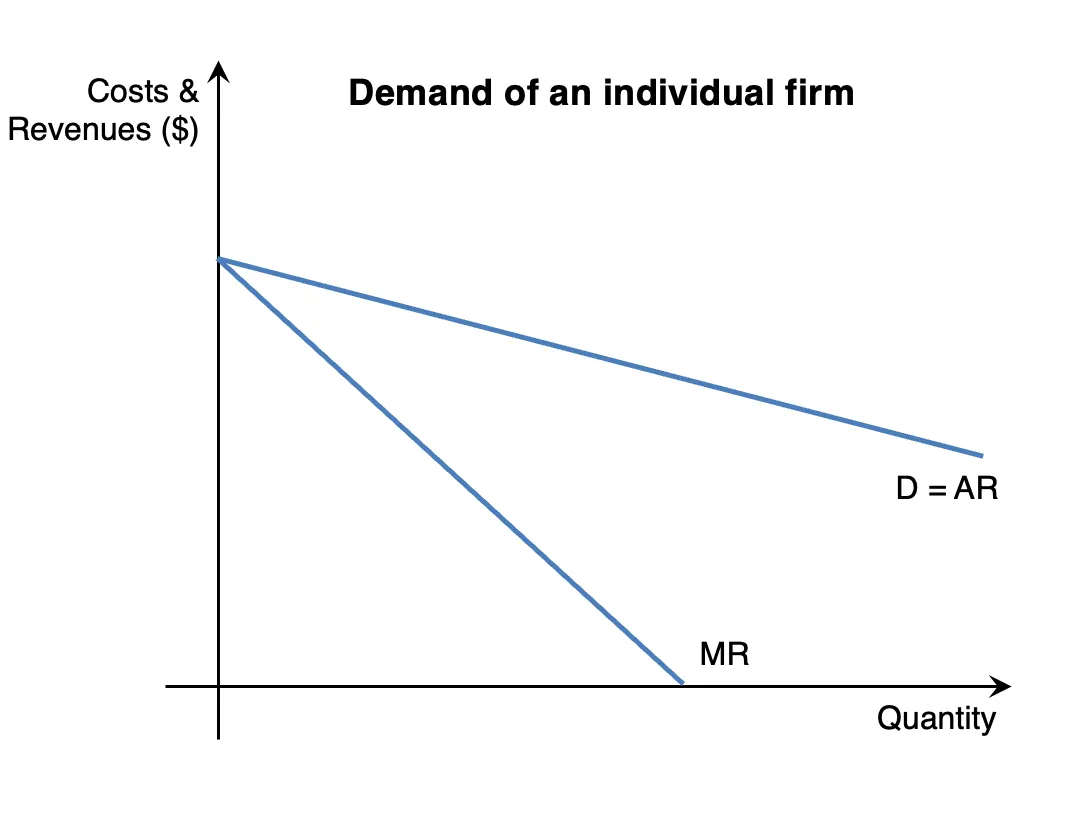
- Due to imperfect substitution, the demand curve faced by a firm, or the AR curve, is downward-sloping and relatively price elastic
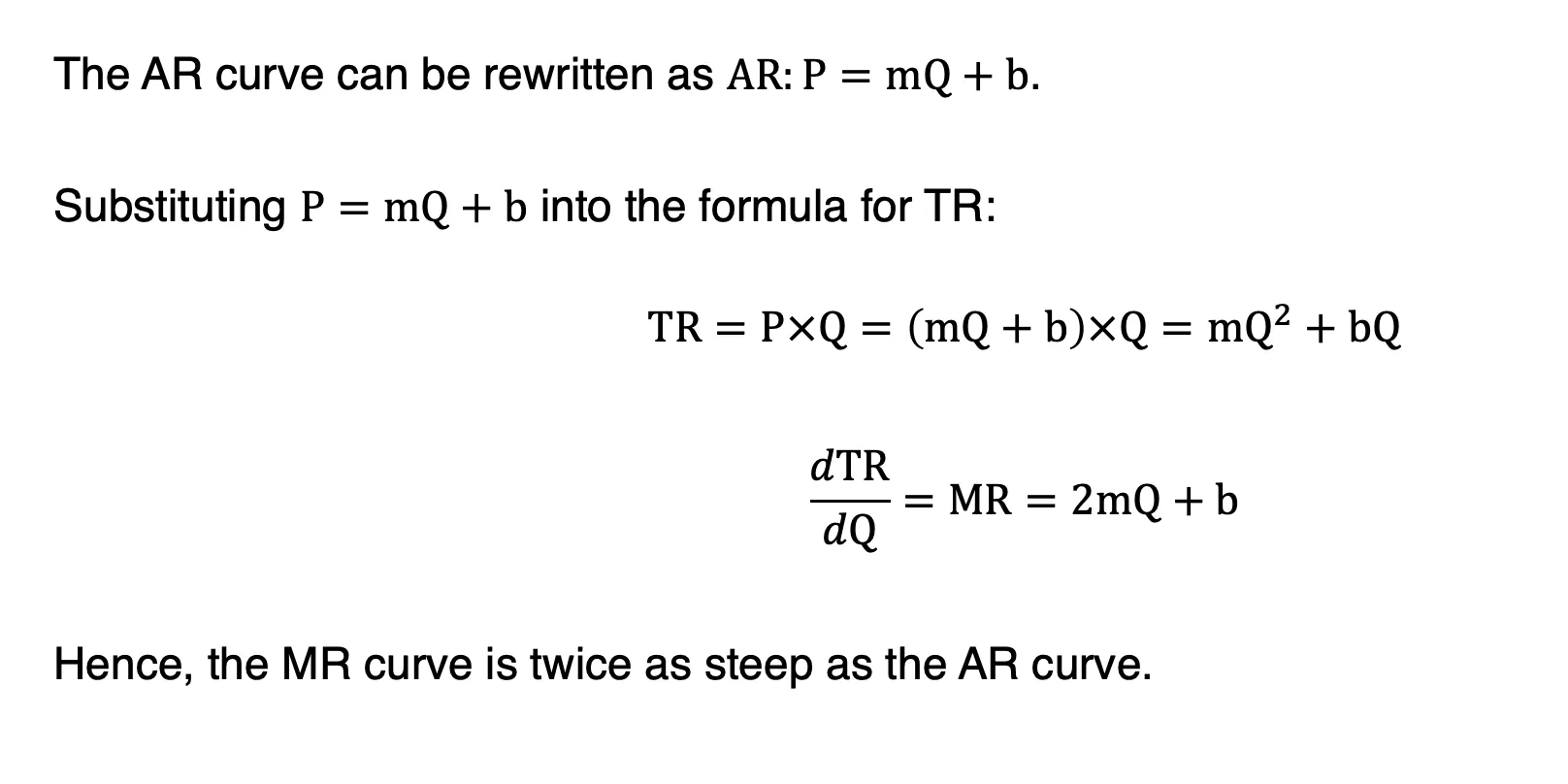
- Furthermore, the MR curve is twice as steep as the AR curve. The MR is equal to zero at the midpoint of the AR curve.
-
-
- normal profits (short run)
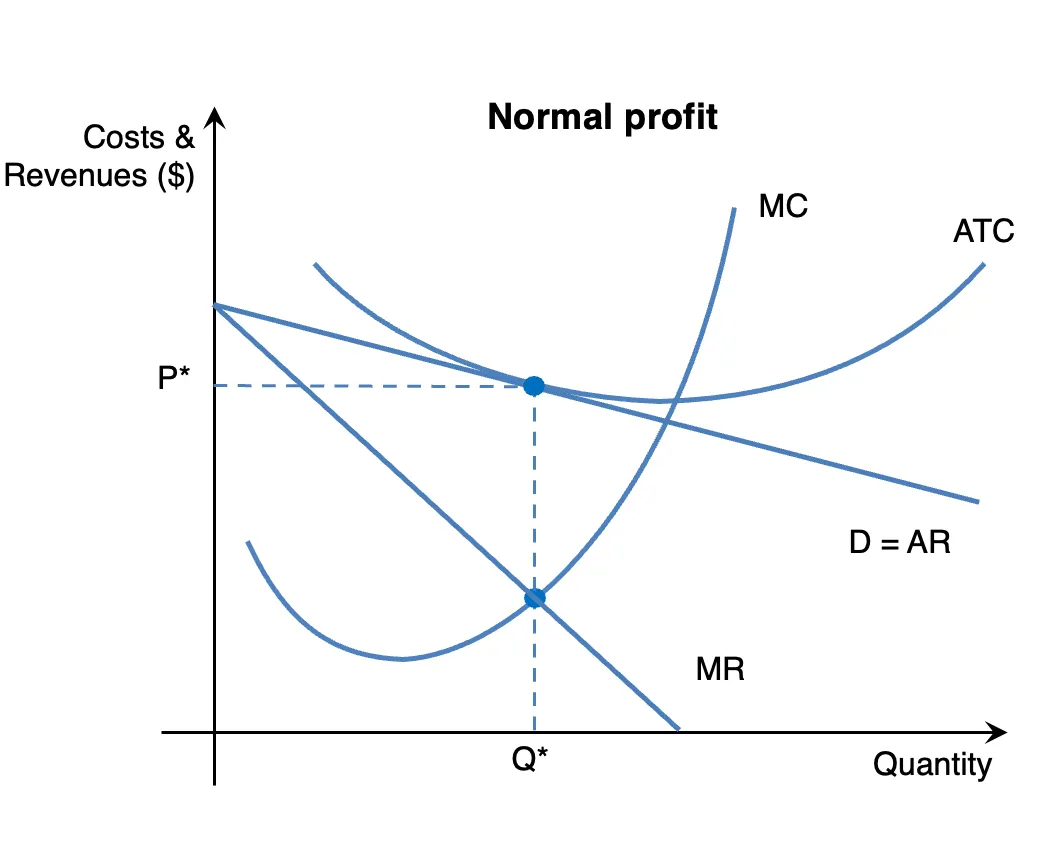
- Due to the profit-maximizing assumption, firms will operate at the quantity Q*, where MR = MC.
- The average revenue P* is then found by referring to the AR curve, at Q*.
- Here, this firm is earning normal profit as AR = P = ATC and hence TR = TC.
-
- supernormal profit (short run)
-
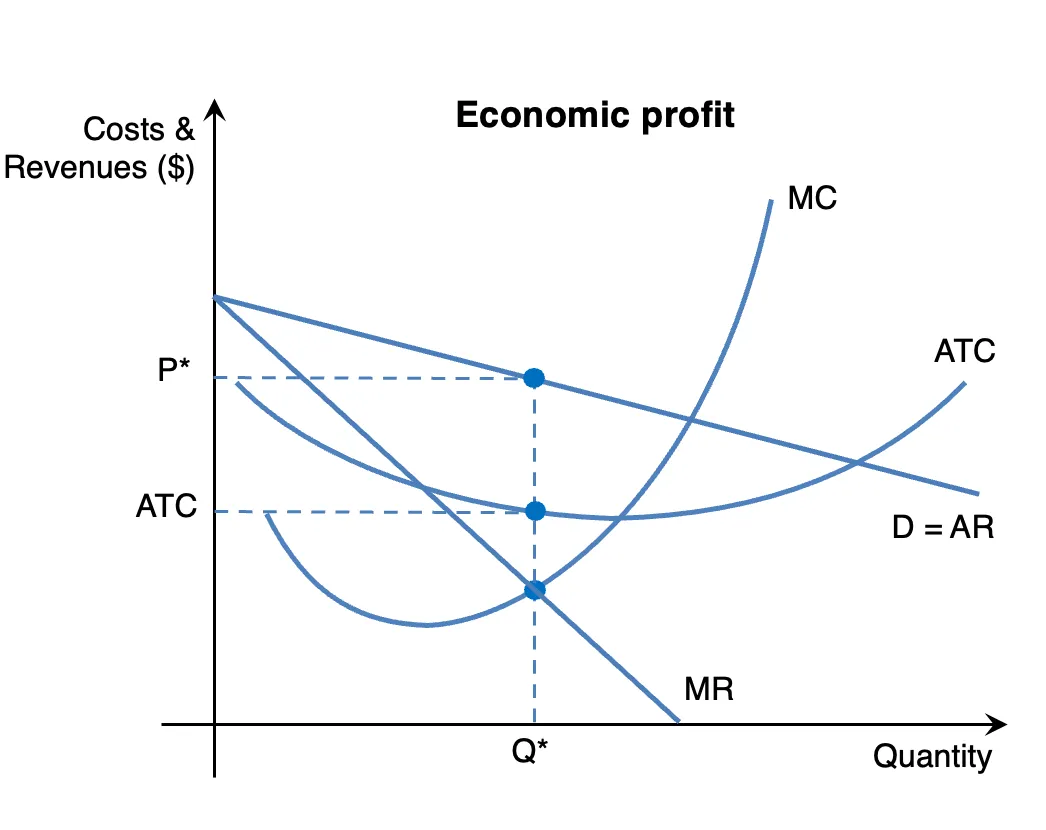
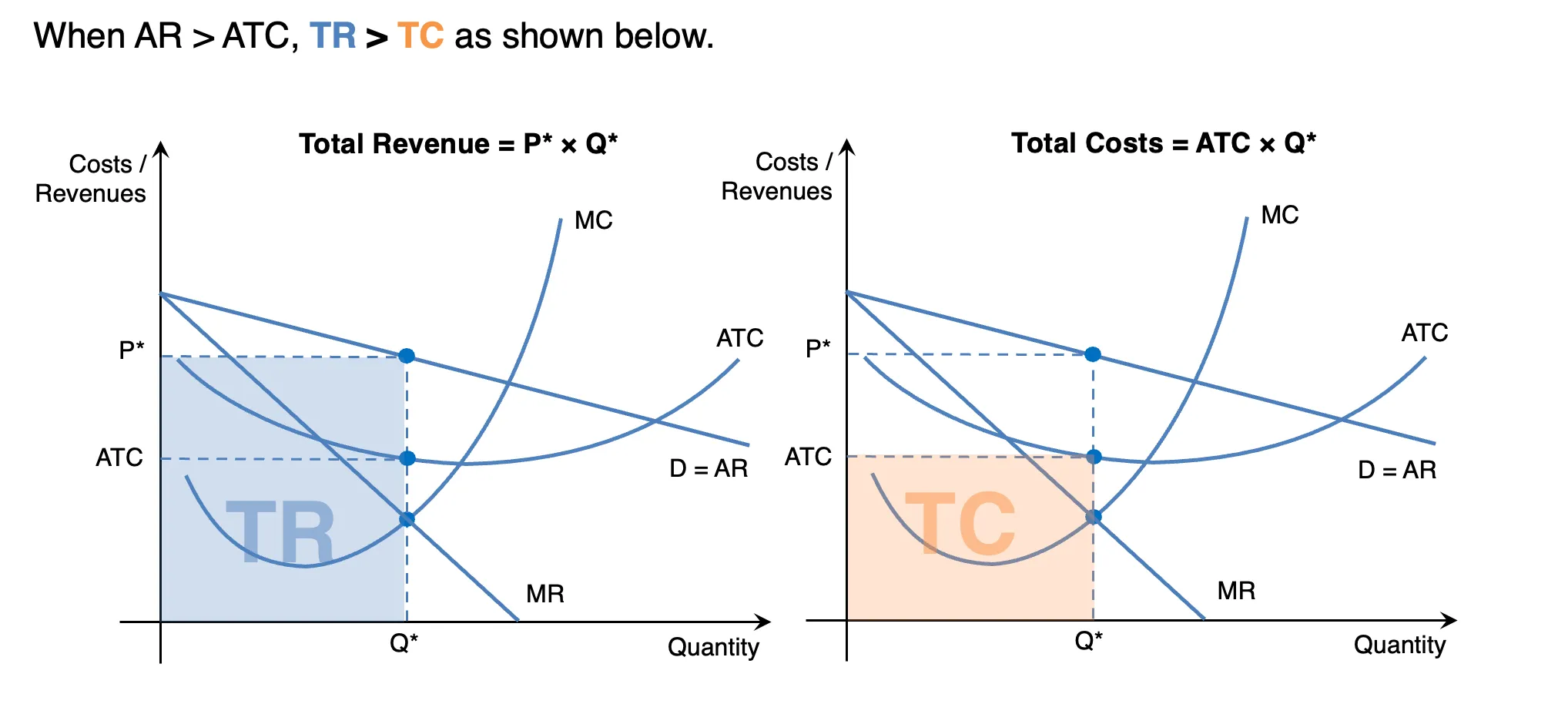
Due to the profit-maximizing assumption, firms will operate where MR = MC, at P*, Q*
-
The average revenue P* is found by referring to the AR curve, at Q*.
-
The average total cost is then found by referring to the ATC curve, at Q*
-
Firms earn supernormal profit when AR > ATC at the quantity where MR = MC.
-
abnormal profit occurs when ATC is below D=AR.
-
-
- economic loss (short run)
-
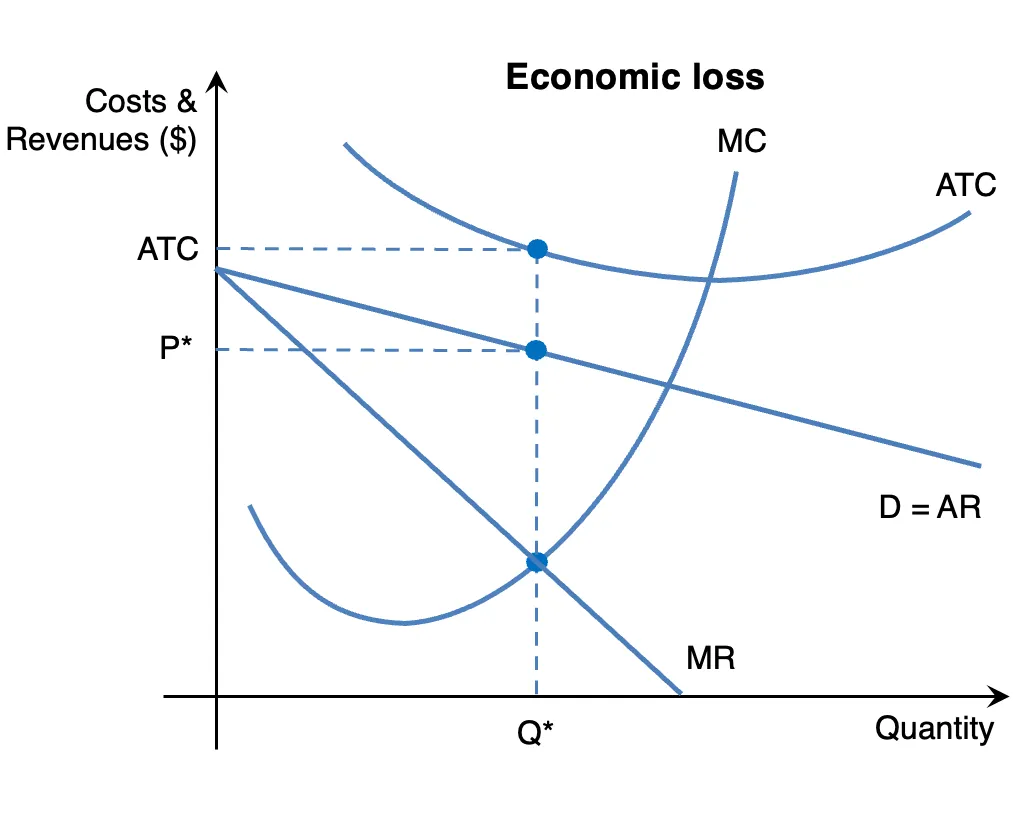
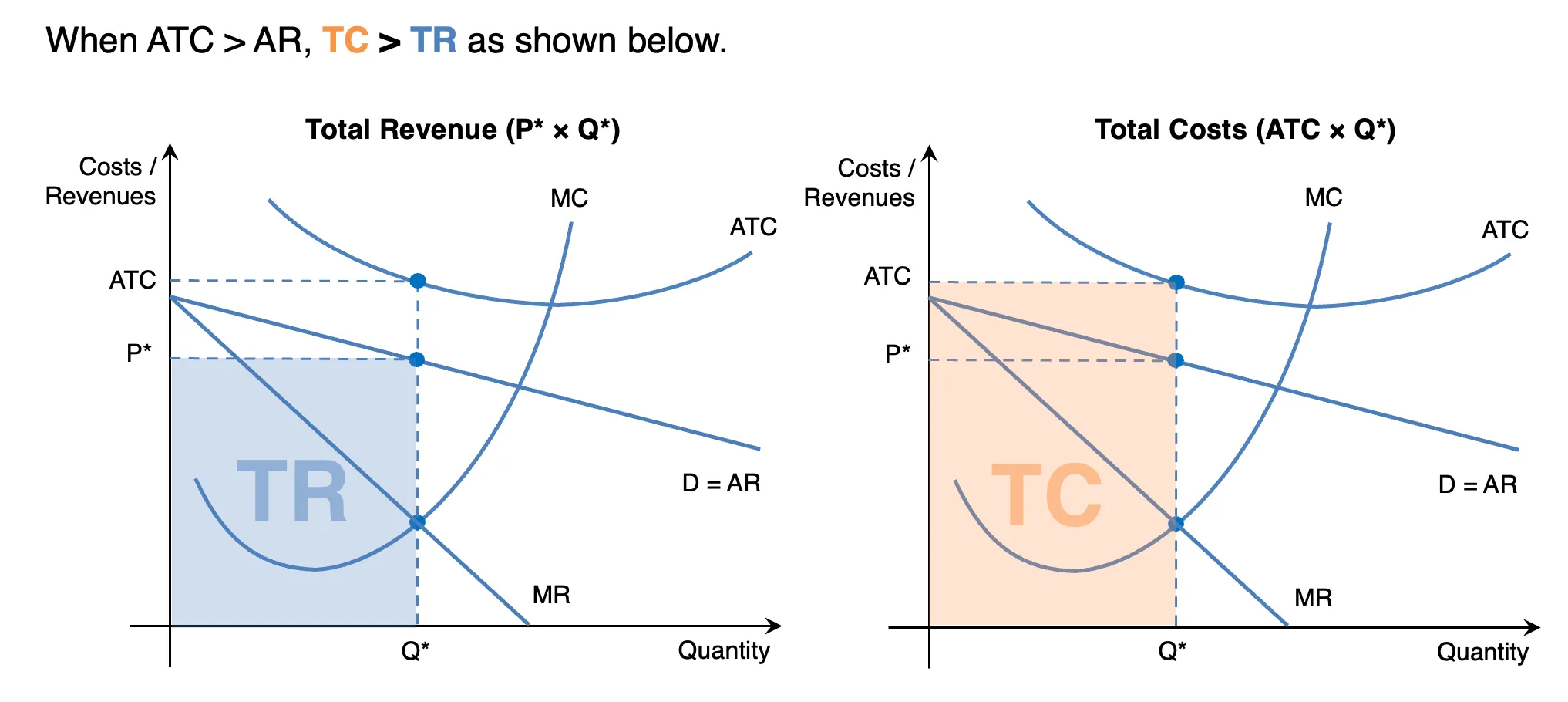
Due to the profit-maximizing assumption, firms will operate where MR = MC at P*, Q*
-
Firms will incur an economic loss when ATC > AR at the quantity where MR = MC.
-
firm incurs a loss when ATC is above D=AR.
-
-
- supernormal profit (long run)
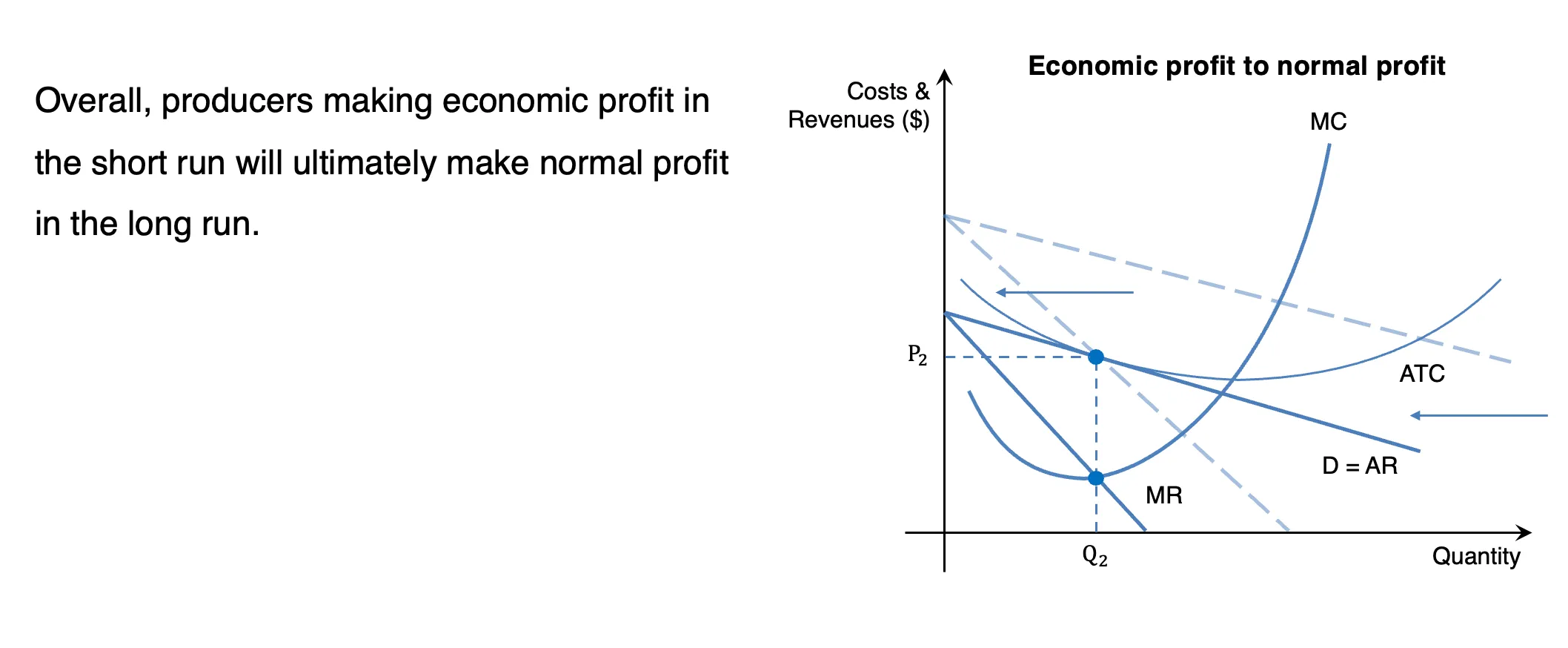
- As potential producers have perfect information, they will enter the market to compete for economic profits. Assumption is that firms will enter the market with more innovative products.
- New firms increase the number of substitutes for any given individual firm, shifting the demand curve faced by an individual firm inwards (switch to other products).
-
- economic loss (long run)
- In the long run, rational producers making a loss will exit the market.
- With less firms in the market, the number of substitutes for an individual firm falls, resulting in the demand curve faced by the individual firm to shift outwards.
-
Monopoly
- The characteristics of a monopoly include
- A single or dominant firm
- A firm can be considered a monopolist if it has significant market share and is much larger than other firms in the market
- Dominant power (price-makers)
- High degrees of market power allows them to make high levels of profits
- High barriers to entry (artificial or natural)
- Monopolists can earn supernormal profit in the long run due to high barriers to entry
- Natural barriers to entry include
- Ownership of key factors of production
- Economies of scale
- Economies of scale occur when a firm’s average cost falls as output increases because total cost rises less than proportionally due to efficiencies such as technical, managerial, and purchasing advantages gained from large-scale production
- Natural monopoly
- Artificial barriers to entry include
- Advertising
- Patents
- High costs of switching for the consumer
- No close substitutes
- Products in a monopoly are unique and there are no close substitutes
- As a result, demand is relatively price inelastic and monopolists have the power to affect market prices by themselves
- A single or dominant firm
- demand curve faced by a single firm
- Due to the lack of substitutes, the demand curve faced by a firm, or the AR curve, is downward-sloping and relatively price inelastic
-
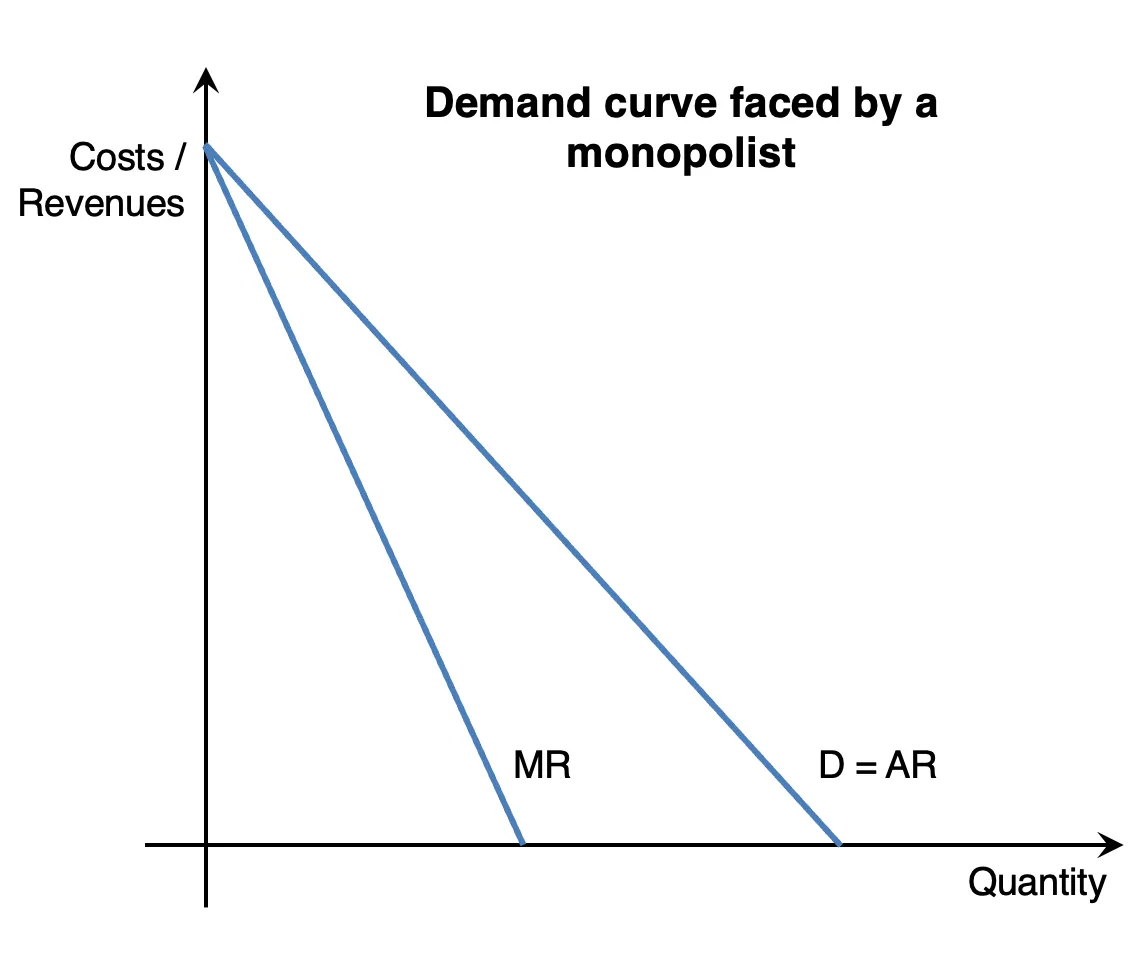
- normal profit
- Due to the profit-maximizing assumption, firms will operate at the quantity Q*, where MR = MC
- The average revenue P* is then found by referring to the AR curve, at Q*
- This firm is earning normal profit as
AR = P = ATC and hence TR = TC -
- economic profit
- Due to the profit-maximizing assumption, firms will operate where MR = MC, at P*, Q*
- The average revenue P* is found by referring to the AR curve, at Q*
- The average total cost is then found by referring to the ATC curve, at Q*
- Firms earn supernormal profit when AR > ATC at the quantity where MR = MC
-
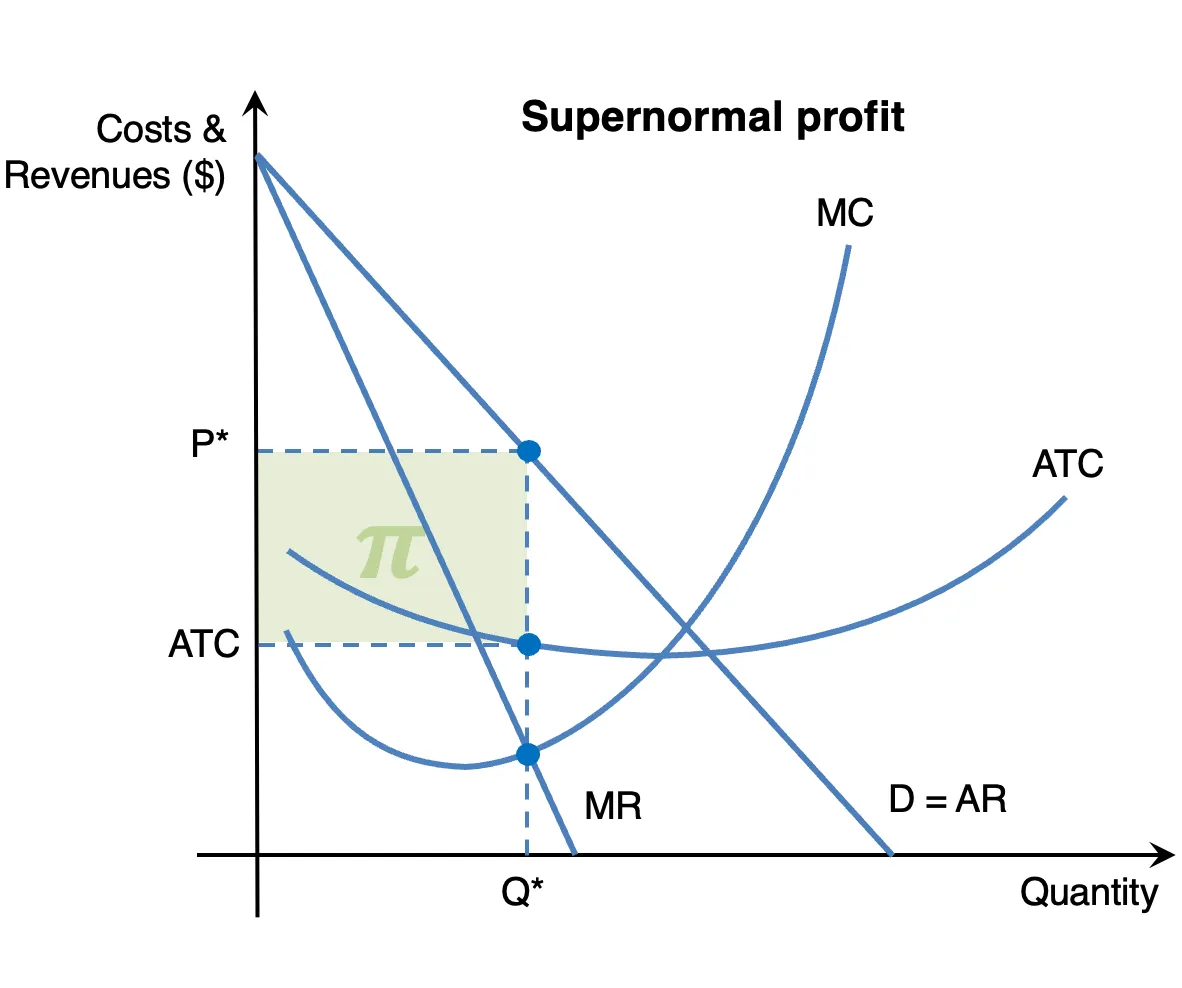
- Due to high barriers to entry, potential firms are unlikely to enter the industry to compete for economic profits. Hence, a monopolist will continue to earn supernormal profits in the long run
- welfare loss in economic profit
-
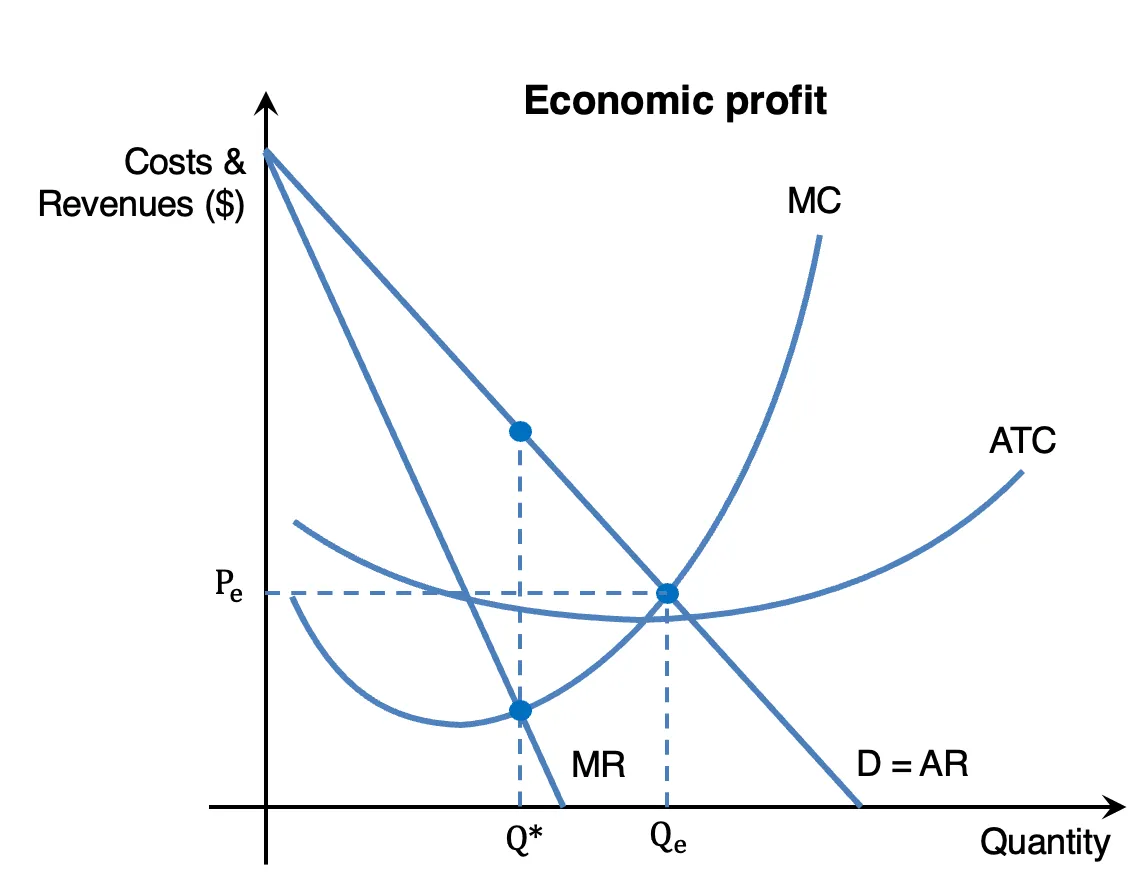
- market equilibrium and allocative efficiency is achieved at (P_e, Q_e) when AR = P = MC, and hence MB = MC
- At MR = MC, a monopolist is allocatively inefficient in the short run and long run
- the market suffers from welfare loss to society
- A loss in consumer surplus due to higher prices
- A loss in producer surplus due to restricted output
-
- economic loss
- Due to the profit-maximizing assumption, firms will operate where MR = MC, at P*, Q*
- Firms will incur an economic loss when
ATC > AR at the quantity where MR = MC -
- Due to high barriers to exit, a monopolist will continue to incur an economic loss in the long run
-
- natural monopoly
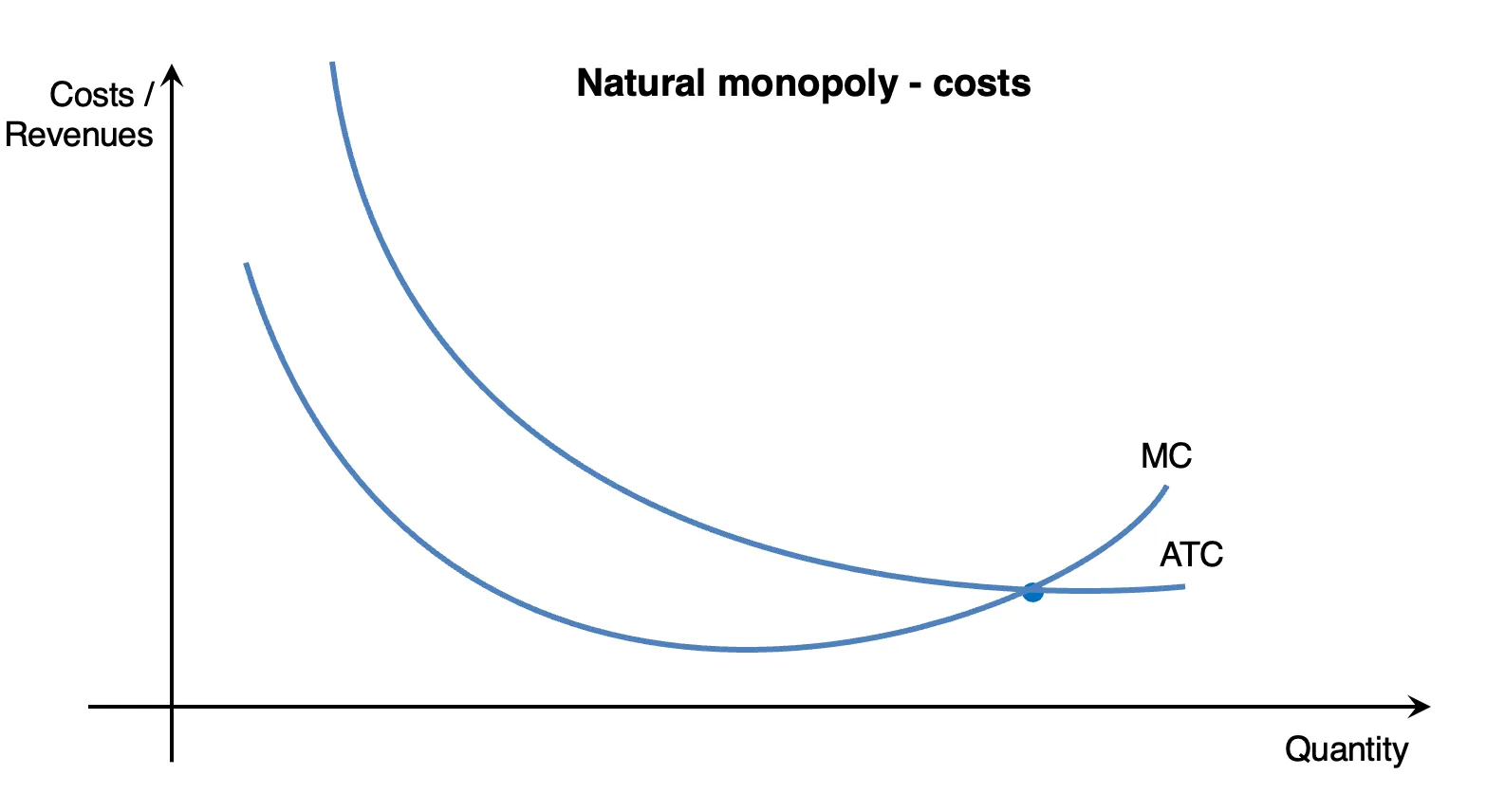
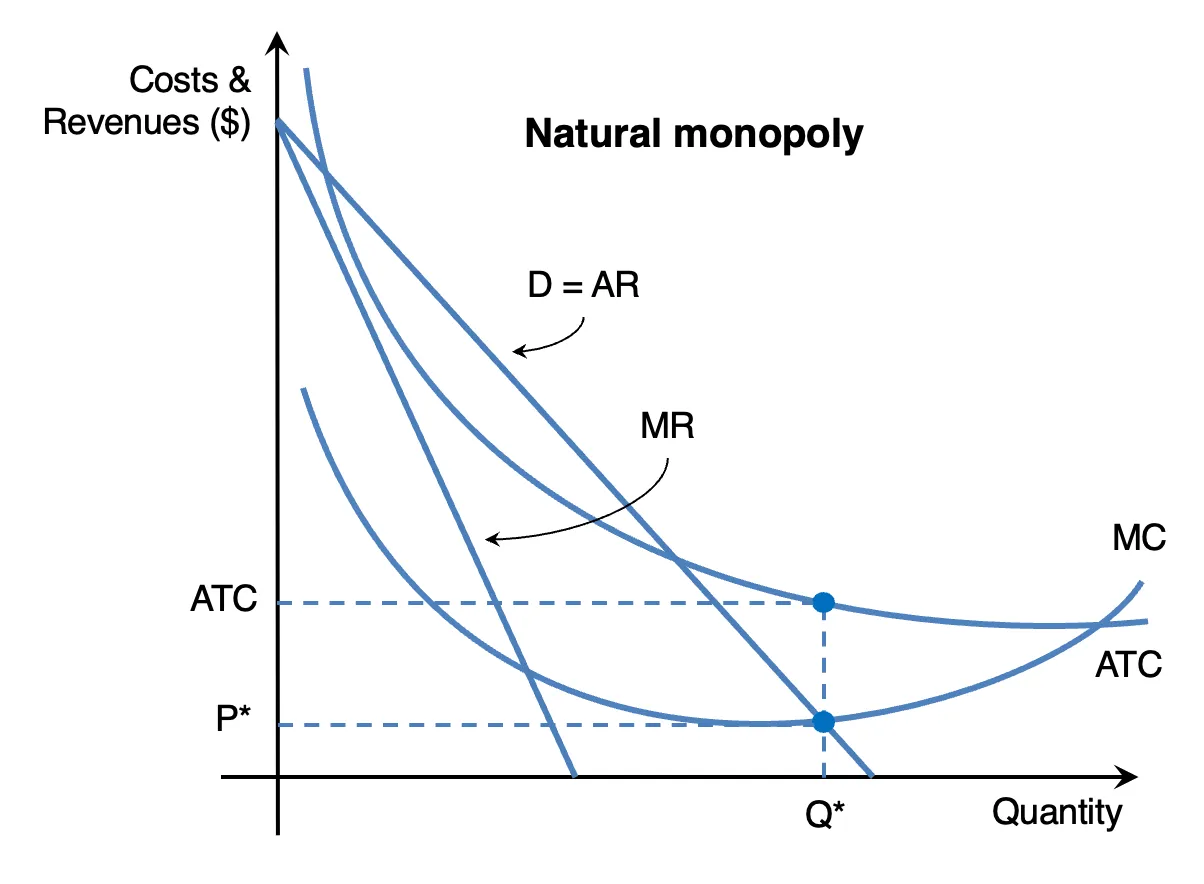
- A natural monopoly occurs when economies of scale are so significant that one firm can supply the entire market at a lower average cost than multiple firms
- A natural monopoly arises because high fixed costs mean that average cost falls as output increases. If multiple firms share the market, each produces less output and therefore faces higher average costs, making the industry less efficient than if a single firm supplies the entire market
- economies of scale is an example of a natural barrier to entry
- In some cases, initial start-up costs are so high that a firm can only survive through economies of scale. Hence, this market structure is known as a natural monopoly
- As a result of these high costs, it is more efficient for one large firm to supply the entire industry, rather than two or more smaller firms
- Due to high start-up costs, average total costs are spread throughout a much larger range of output
-
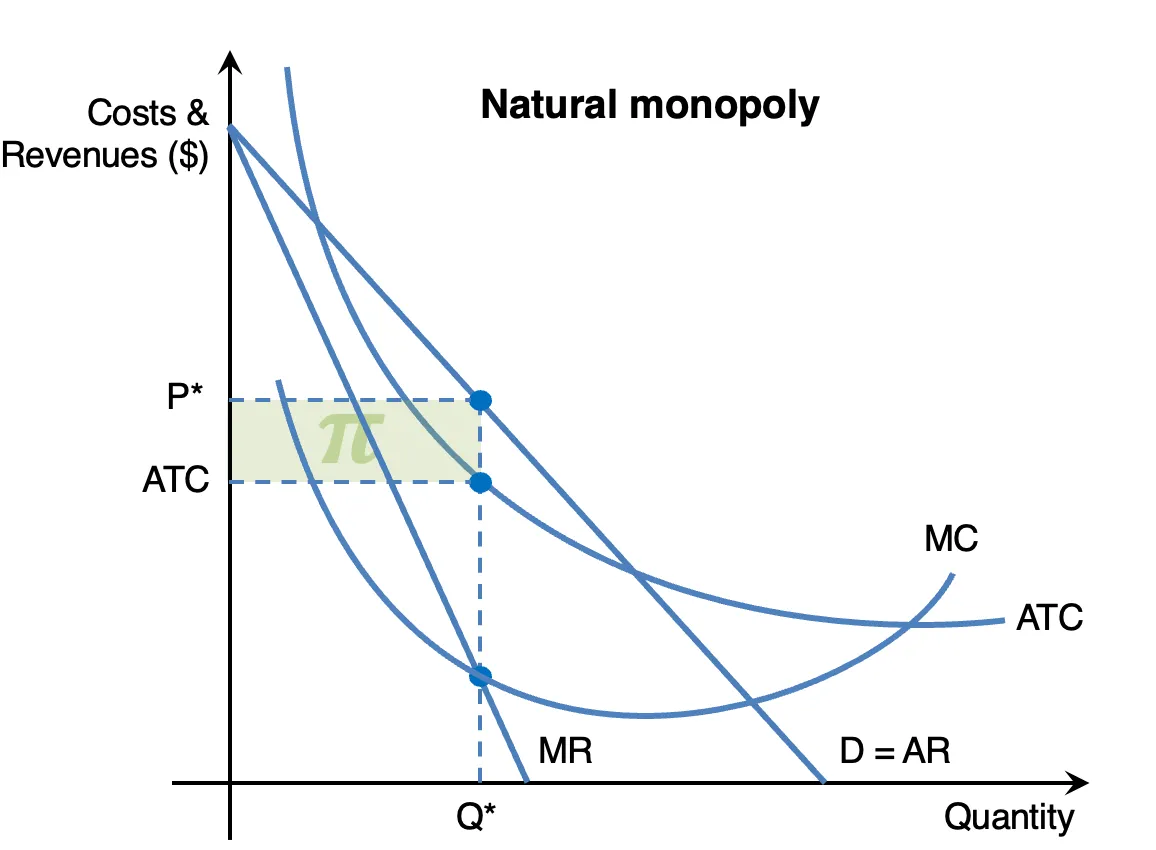
- profit maximizing natural monopoly
- A profit maximizing natural monopoly will operate where MR = MC, at P*, Q*
- Firms earn supernormal profit when
AR > ATC at the quantity where MR = MC -
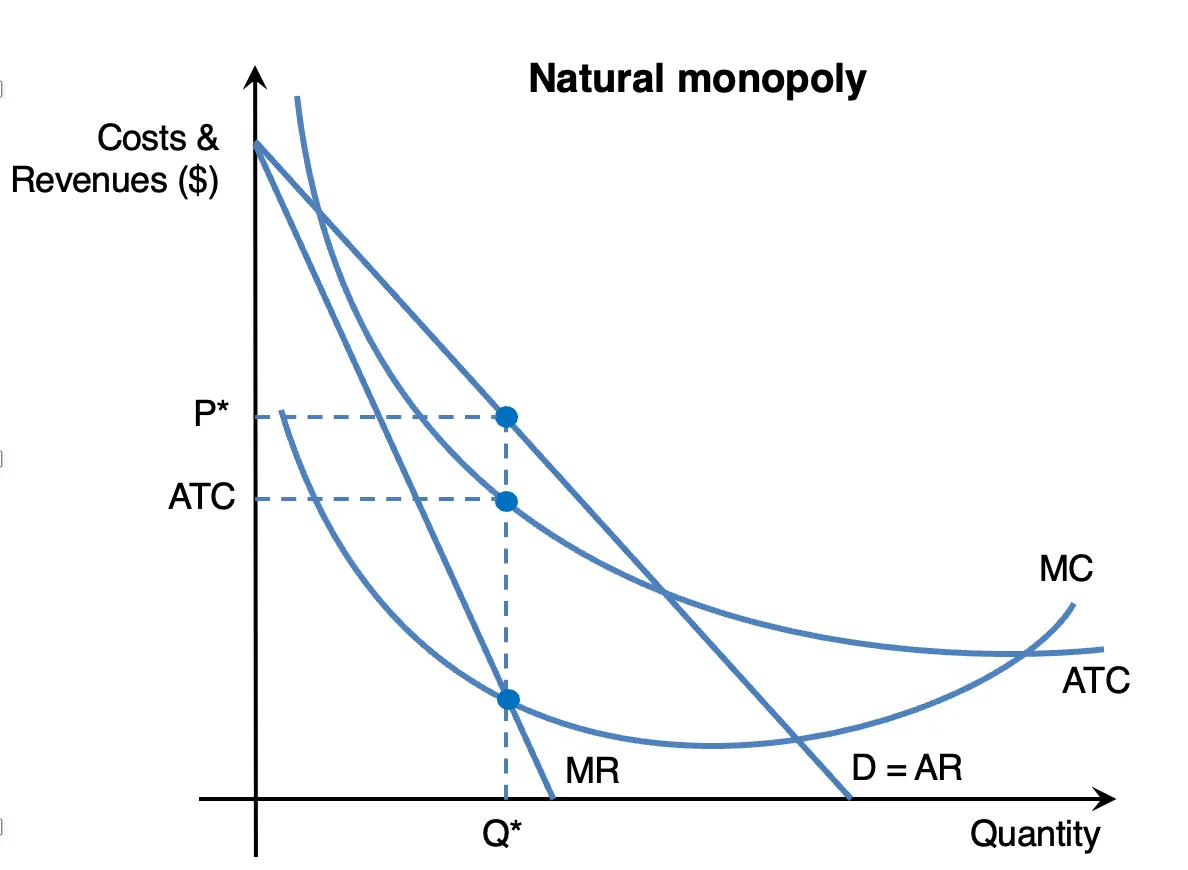
- Due to high barriers to entry, a natural monopolist will continue to earn supernormal profits in the long run
-
- natural monopoly with government intervention
- However, at the profit maximising level of output, a welfare loss to society is incurred. Furthermore, natural monopolists often supply necessities e.g. utilities and public transportion
- As a result, it is more socially efficient to operate at AR = P = MC, where allocative efficiency is achieved
-
- However, there is no incentive for a natural monopoly to operate at P = MC as ATC > AR and hence TC > TR
-
- Hence, allocatively efficient monopolists will incur an economic loss 𝝅, shown by (ATC – P*) × Q*
-
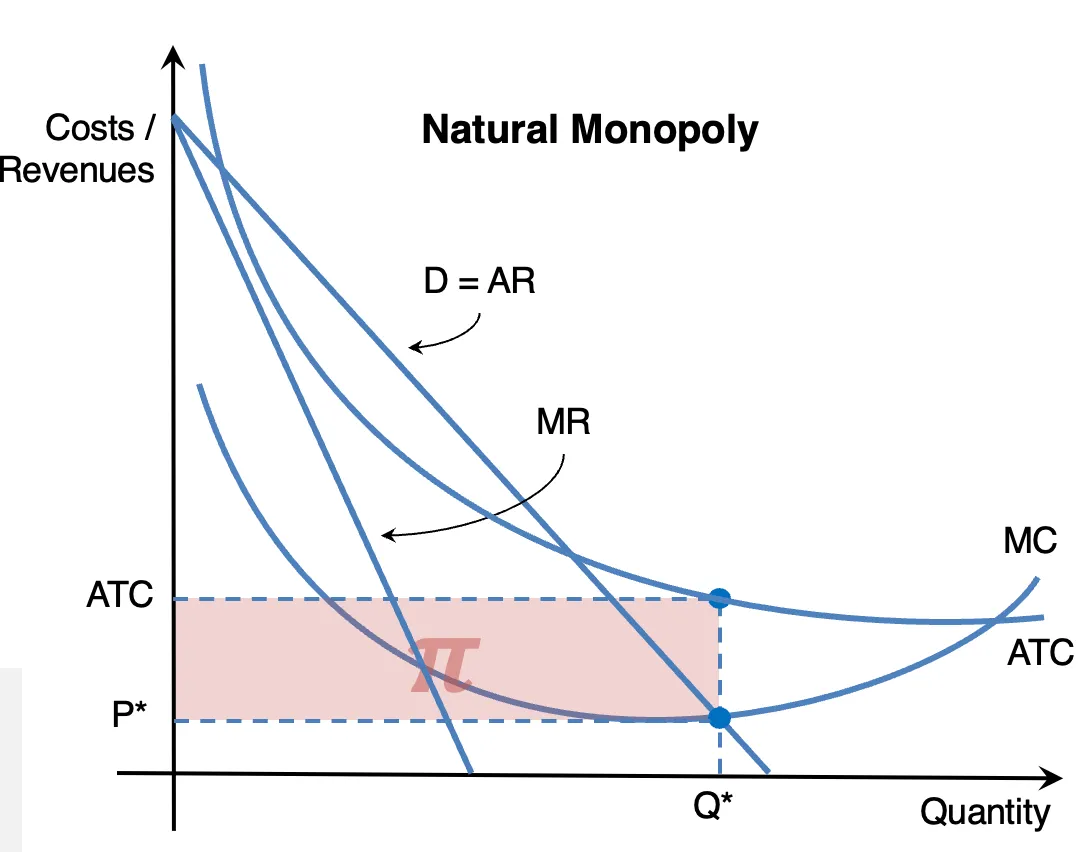
- As a result, a per-unit subsidy of ATC - AR is often granted to natural monopolists to cover the losses associated with producing at P = MC. In some cases, natural monopolists are nationalized.
-
- A natural monopoly occurs when economies of scale are so significant that one firm can supply the entire market at a lower average cost than multiple firms
Oligopoly
- Non-Collusive Oligopoly
- Oligopolies are markets which display the following characteristics
- Two or more large firms
- There are a few large firms that are in direct competition
- Firms’ decisions are mutually interdependent
- Firms are mutually interdependent, meaning they consider each other’s behaviours and decisions to develop pricing and non-pricing strategies
- Firms may engage in price wars, where they attempt to steal demand from each other by lowering their prices
- Significant barriers to entry
- There are significant natural and artificial barriers to entry, preventing new entrants
- Two or more large firms
- concentration ratios
- Concentration ratios measure the sum of market share held by the largest firms in the industry
- For example, the four-firm concentration ratio (CR_4) measures the market share of the four largest firms combined (C_1+C_2+ C_3+ C_4). This is used to demonstrate the collective market share of the largest firms in a market
- An oligopoly market will have high concentration ratio
- Game Theory – Prisoner’s Dilemma
- Non-price competition
- Due to mutual interdependence, oligopolists often engage in non-price competition instead.
- Examples of non-price competition include
- Advertising
- Innovation
- Quality of products and/or services
- Corporate Social Responsibility
- After-sales service
- collusion
- Collusion is an agreement between oligopolists to fix prices, collectively limit output, and to create artificial barriers to entry. The incentive to collude is engendered by the potential to earn supernormal profits
- An example of a collusive oligopoly is the Organization of Petroleum Exporting Countries (OPEC), where members collectively limit the world supply of oil to maintain high prices and supernormal profits
- Oligopolies are markets which display the following characteristics
- Collusive Oligopoly
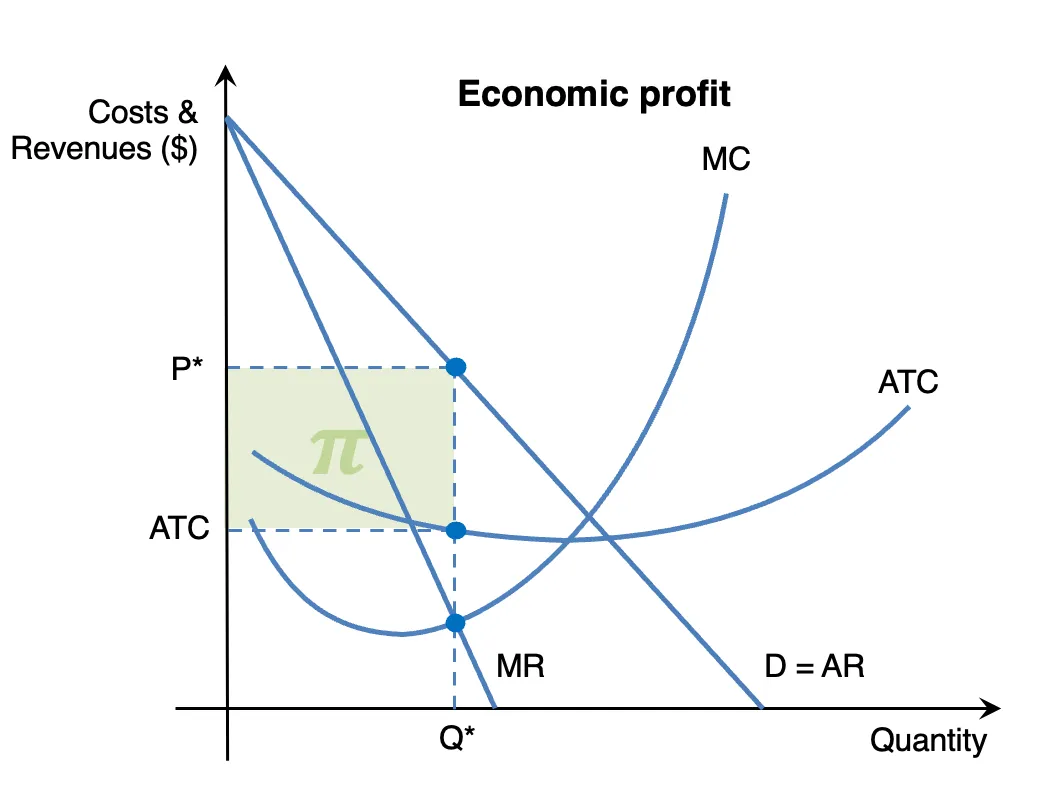
- When firms collude through price fixing and output restrictions, their collective market power combines to act as one dominant firm
- As a result, collusive oligopolists behave as a single monopolist, often earning economic profit 𝝅, shown by the area (P* – ATC) × Q*
-
- Advantages of large firms having significant market power
- While perfect competition is the most efficient market structure, there are benefits of large firms:
- Economies of scale
- As production increases, the long run average costs of production fall as fixed costs are spread over a larger range of units. There are two types of economies of scale:
- Internal economies of scale
- Specialisation
- Efficiency
- Marketing
- Purchasing
- External economies of scale
- Lower recruitment costs
- Ancillary services
- Internal economies of scale
- LRAC = (fixed costs+ variable costs)/quantity
- As production increases, the long run average costs of production fall as fixed costs are spread over a larger range of units. There are two types of economies of scale:
- Innovation
- Large firms with significant market power are able to earn supernormal profits, which can be invested into research and development (R&D)
- Process innovation
- Process innovation includes innovations in production that allow for the more efficient production of goods and services
- Product innovation drives new products which offer greater consumer choice
- Research and development
- Process innovation
- Large firms with significant market power are able to earn supernormal profits, which can be invested into research and development (R&D)
- Economies of scale
- While perfect competition is the most efficient market structure, there are benefits of large firms:
Risks in markets dominated by one or a few very large firms
- A deficiency of competition in a market allows firms to control
- Market supply (output)
- Under the profit maximising assumption, firms will always produce at MR = MC
- This is allocatively inefficient (P ≠ MC), leading to a underprovision and underconsumption of a product, ultimately creating a welfare loss
- Market prices
- Owing to the law of demand, restricted output will also lead to higher market prices, reducing consumer surplus
- As large firms have enough power to manipulate market prices, a contestable monopolist may lower prices to increase barriers to entry as a form of anti-competitive behaviour
- Consumer choice
- Despite supernormal profits allowing firms to invest in R&D, a lack of competition lowers the incentive for large firms to innovate
- Furthermore, with fewer large firms as opposed to more smaller firms, consumers have less options to choose from
- Market supply (output)
Government responses to abuses of market power
- Legislation and regulation
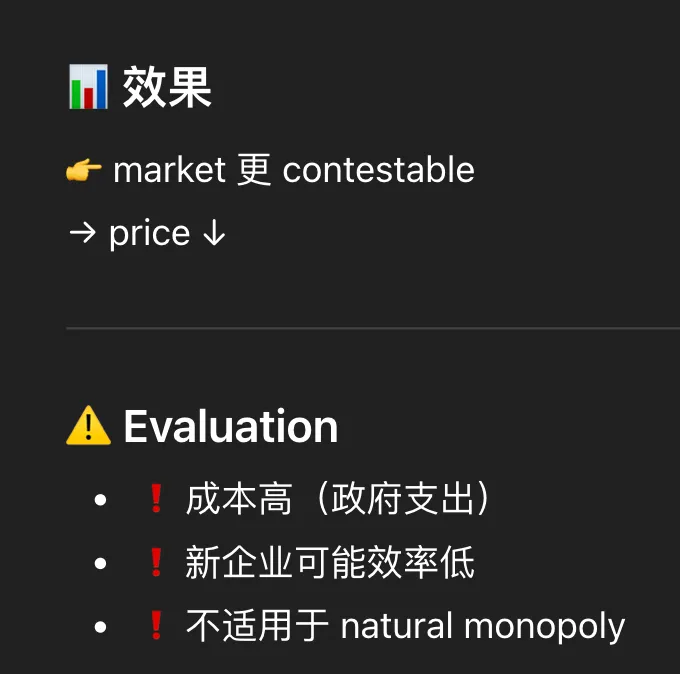
- antitrust laws
- 法律禁止反竞争行为
- collusion
- abuse of dominance
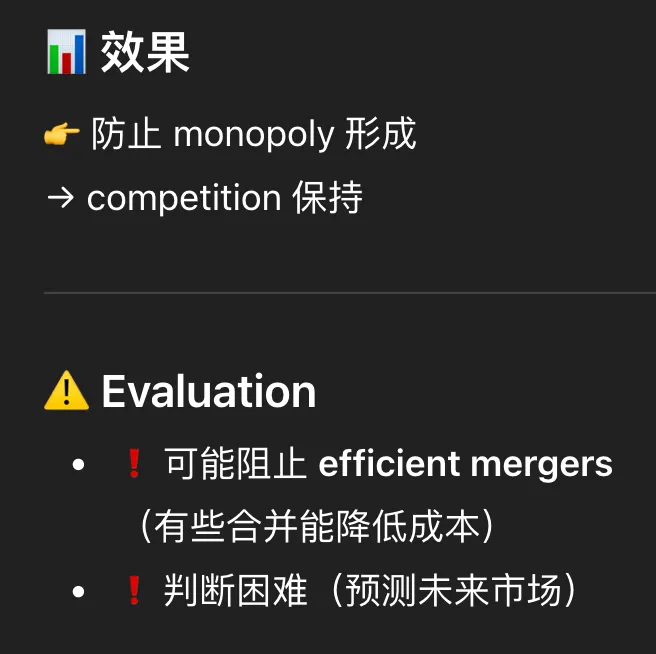
- anti-competitive mergers
-

-
- 法律禁止反竞争行为
- merger control
- 政府审批公司合并
-

-
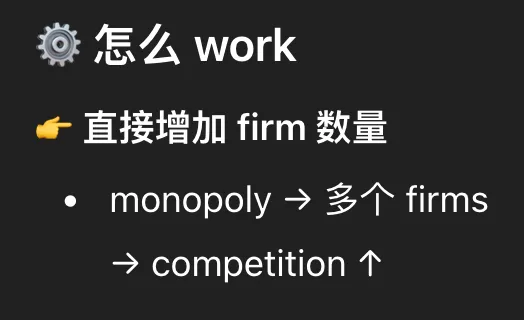
- Break-up of firms
- 把已经很大的公司拆分
-
-
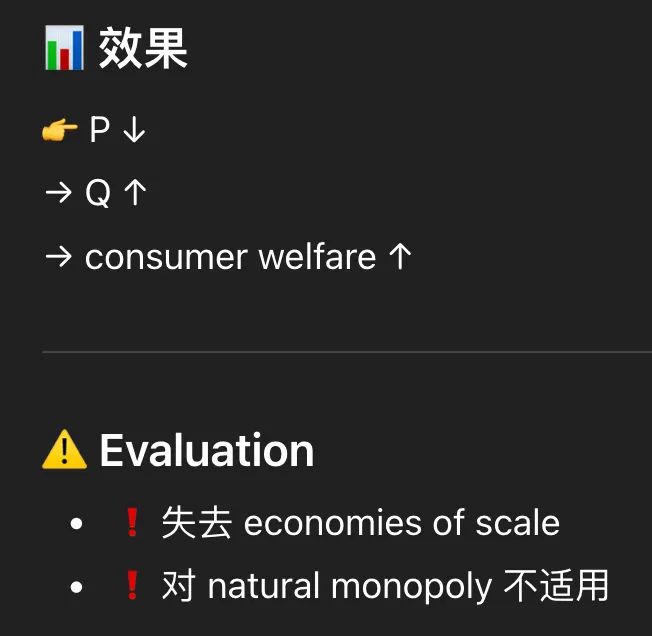
- promote competition(SMEs)
- tax breaks
- subsidies
- deregulation
-

-
- antitrust laws
- Government ownership
- nationalisation
- 政府购买并运营企业
-

-

-

- nationalisation
- Fines & Legal Penalties
- fines
- 对违规企业罚钱
-

-

-

- Leniency programme
- 举报 cartel → 减免处罚
-

-

- While leniency programme can destabilise cartels by reducing trust, they may also lower the perceived risk of collusion, as firms know they can avoid penalties by reporting first
- fines
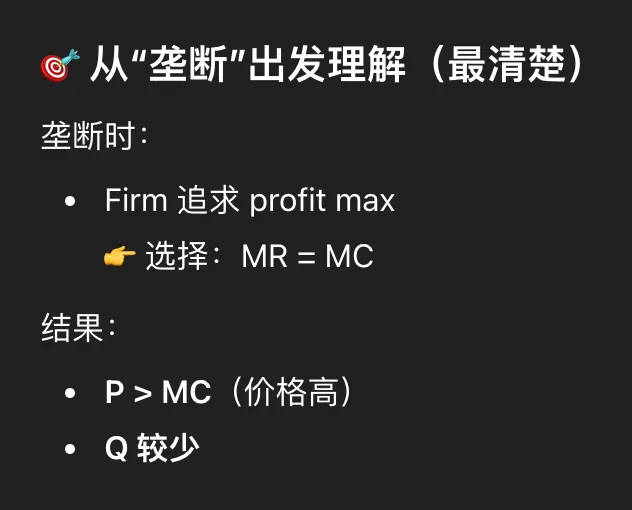
- One key policy is antitrust regulation, which works by prohibiting anti-competitive behaviour such as collusion and abuse of dominance. Governments monitor firm behaviour and intervene through measures such as blocking mergers, imposing price controls or breaking up firms. This increases competition, leading to lower prices and higher output. However, its effectiveness is limited by information failure and the difficulty of detecting collusion.
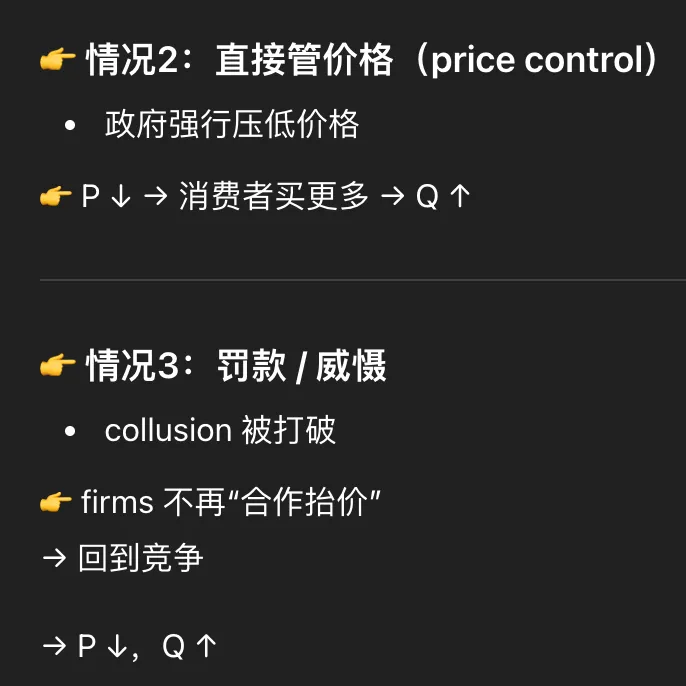
- 为什么这些 policy 会导致 P↓,Q↑?
- These policies increase competition or restrict market power, forcing firms to lower prices and increase output, moving the market closer to allocative efficiency.
-
-

-
- X-inefficiency
- X-inefficiency occurs when firms produce at a higher cost than necessary due to a lack of competitive pressure
-

- poorly motivated workforce, lack of innovation, poor management or avoidance of risk
-

- cartel
- A cartel is a group of firms that collude to act like a monopoly by fixing prices or limiting output
-