macro / ch 9
9.5Shifting aggregate supply curves over the long term
Changes in aggregate supply over the long term
- Aggregate supply shifts in AD-AS models
- an increase in potential output signifies economic growth over the long term
- a decrease signifies negative growth (or a fall in real output)
- Factors that change aggregate supply (shift AS curves) over the long term
- increases in quantities of the factors of production
- LRAS curve and Keynesian AS curve shift to the right.
- economy is capable of producing more real GDP
- vice versa
- improvements in the quality of factors of production (resources)
- improvements in the quality of factors of production shift the LRAS and AS curves to the right
- greater levels of education, skills or health lead to an improvement in the quality of labour resources
- more highly skilled and educated workers or healthier workers can produce more output/GDP than the same number of unskilled or less healthy workers
- improvements in technology
- an improved technology of production means that the factors of production using it can produce more output, and the LRAS and Keynesian AS shift to the right
- workers who work with improved machines and equipment that have been produced as a result of technological innovations will be able to produce more output in the same amount of time
- increases in efficiency
- when an economy increases its efficiency in production, it makes better use of its scarce resources, and can as a result produce a greater quantity of output
- potential output increases, and the LRAS, Keynesian AS shift to the right
- vice versa
- institutional changes
- Institutions affect how efficiently resources are allocated and used
- More efficient resource use → higher productivity and output (LRAS increases)
- vice versa
- reductions in the natural rate of unemployment
- the rate of unemployment when the economy is producing its full employment level of output
- if it decreases, the economy is making better use of its resources, and can therefore produce a larger quantity of output
- potential output increases, LRAS/AS shift to the right
- vice versa
-
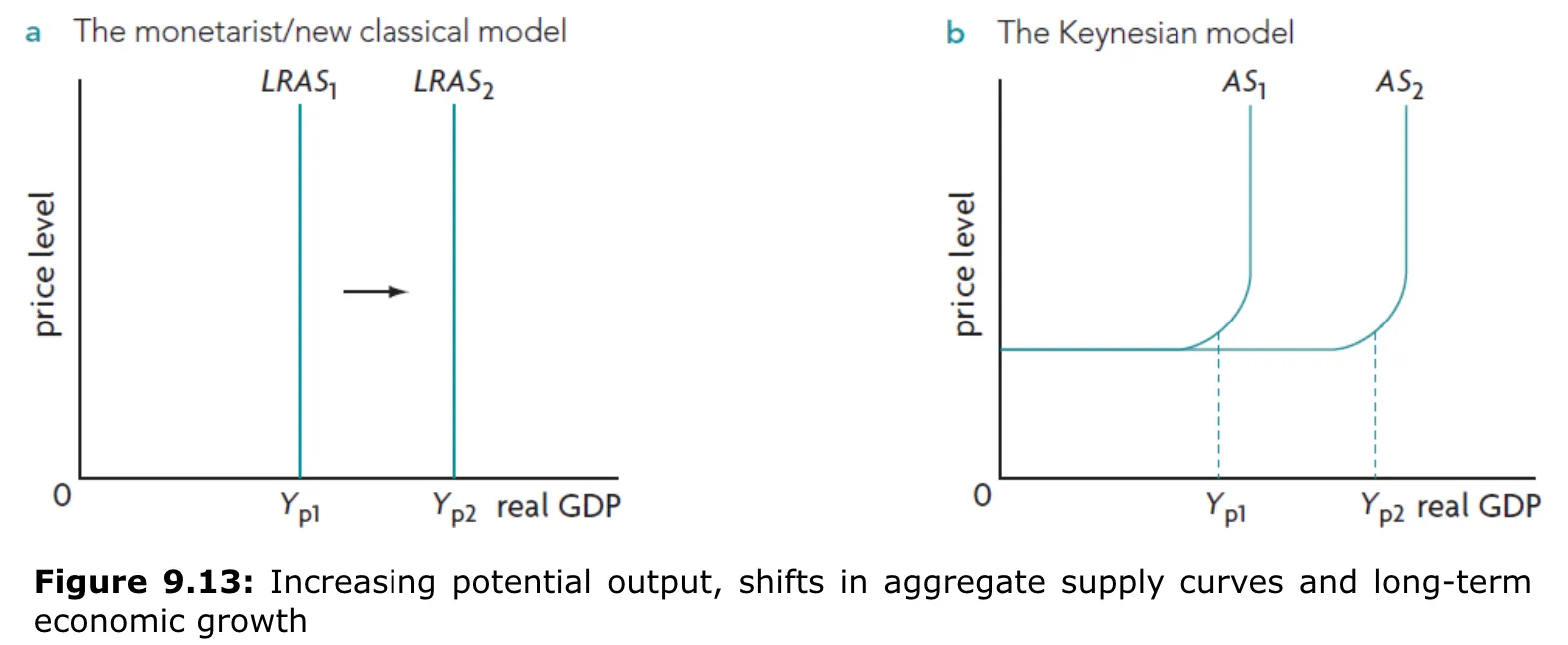
- increases in quantities of the factors of production
- The relationship between the SRAS and LRAS curves in the monetaris/new classical model
- long run relationship
- Economic growth → LRAS shifts right (increase in potential output)
- Over time, SRAS also shifts right
- 👉 Any factor that shifts LRAS will also shift SRAS in the long run
- short run differences
- Some factors affect only SRAS (temporary)
- These do NOT affect LRAS
- Examples of SRAS-only shifts
- Bad weather
- ↓ agricultural output
- SRAS shifts left temporarily
- Returns to original position later
- LRAS unchanged
- Changes in costs of production
- Wages ↑ / ↓
- Oil prices ↑ / ↓
- 👉 Affect SRAS only (short run)
- Bad weather
- Temporary shocks → SRAS shifts only
- Long-term structural changes → SRAS + LRAS both shift
- 📈 Growth & AD connection
- Economic growth → often AD also increases
- Many factors shifting LRAS (e.g. investment) also:
- increase capital
- 👉 shift AD to the right
- long run relationship