micro
Government Intervention in Microeconomics
Price control
- Price controls are a form of government intervention that sets a maximum or minimum price that producers can charge for certain goods or services.
Price ceiling
- A price ceiling is the legal maximum price set by the government for a particular good or service to make goods (such as food and rent) more affordable, especially for low-income consumers.
- The maximum price must be below the equilibrium price, otherwise there’s no function for doing this
-
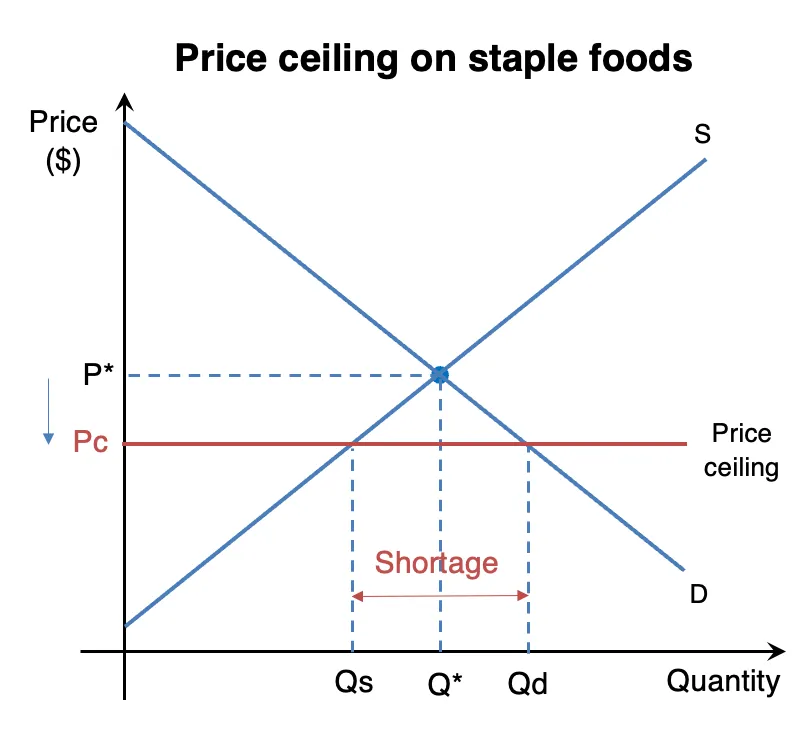
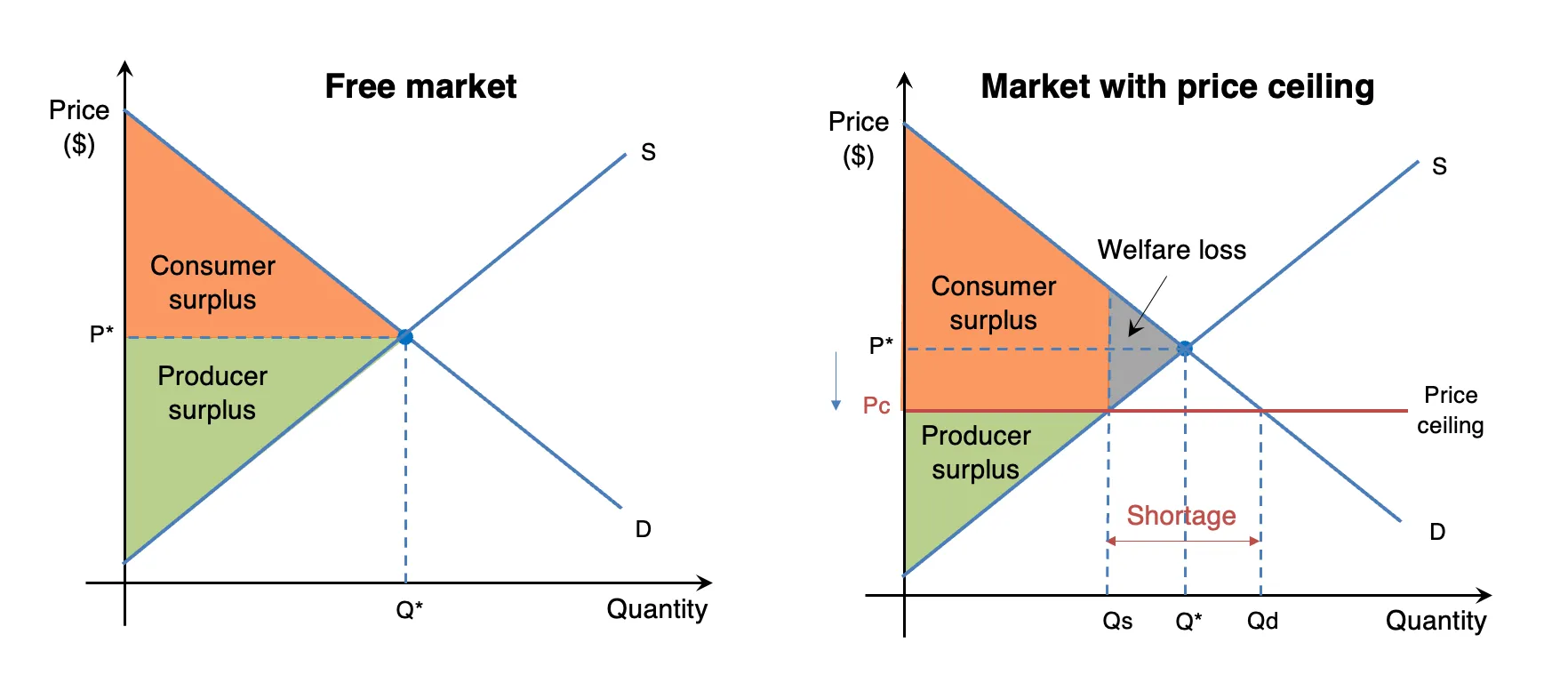
- Pc is the legal maximum price below the equilibrium price set by the government.
- Quantity supplied contracts (from Q* to Qs) because producers see the fall in price
- Quantity demanded expands (from Q* to Qd)
because consumers see the fall in price - A shortage (Qd > Qs) of Qd – Qs arises in the market.
Notice that the exact quantity traded is at Qs, because that’s the only available quantity. It’s the quantity of good producers are willing and able to sell/produce.- The shortage encourages the emergence of black markets.
Some buyers may purchase the good at Pc and resell the good at a higher price (P1) in the black market for a profit. -
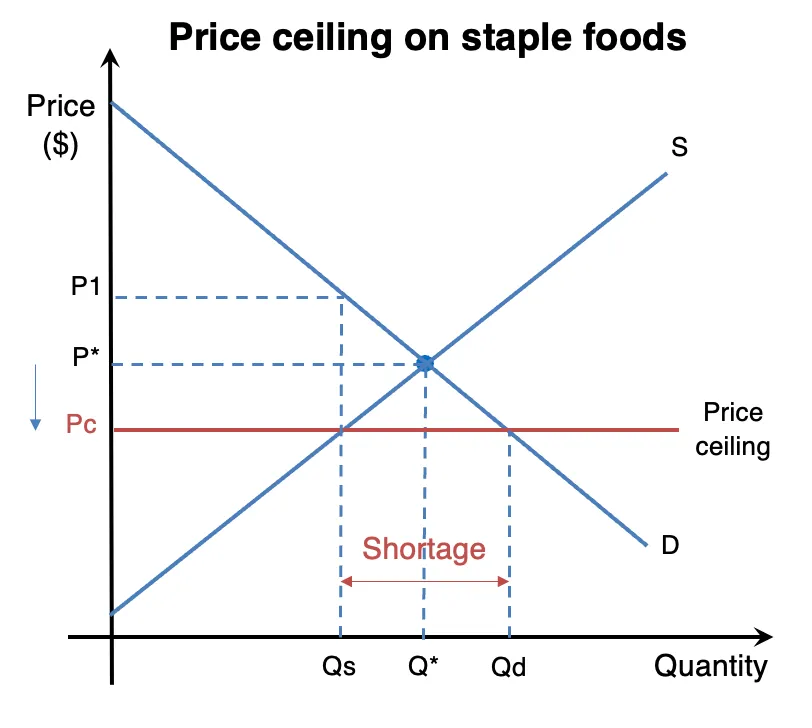
- The shortage encourages the emergence of black markets.
- the welfare loss is indicated by the shaded triangle
-
- stakeholder analysis
- consumers
-
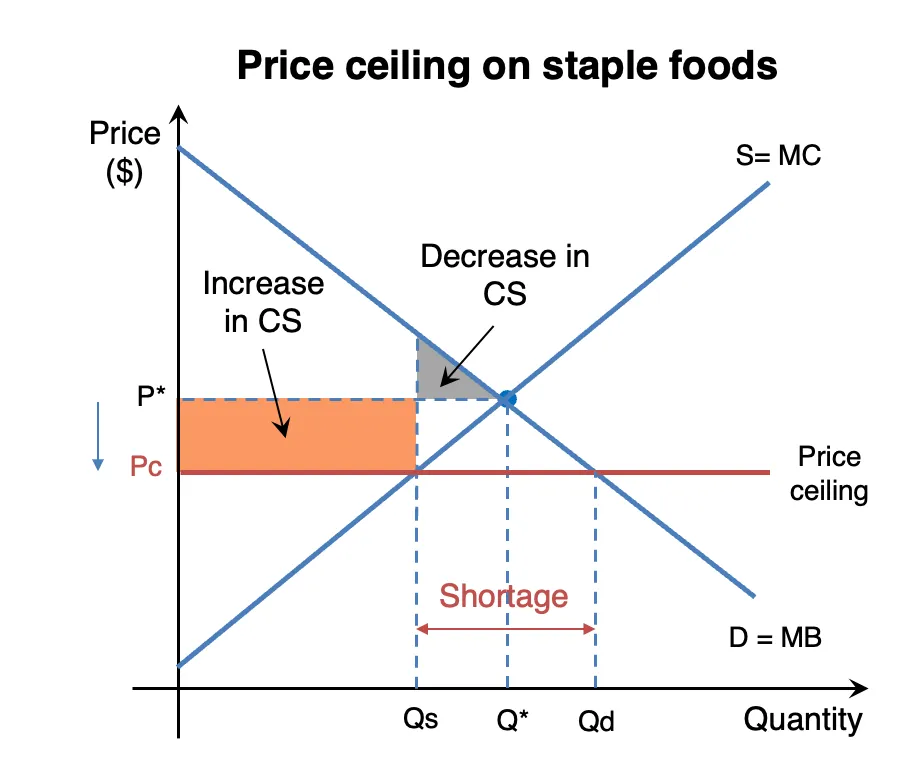
- Pay a lower price (from P* to Pc).
Consume lower quantities (Q* to Qs). - Some consumers who can obtain the good at the lower price are better off. Because they consume/purchase the good at a lower price than previously.
- Some consumers who are unable to obtain the good are worse off.
-
- producers
-
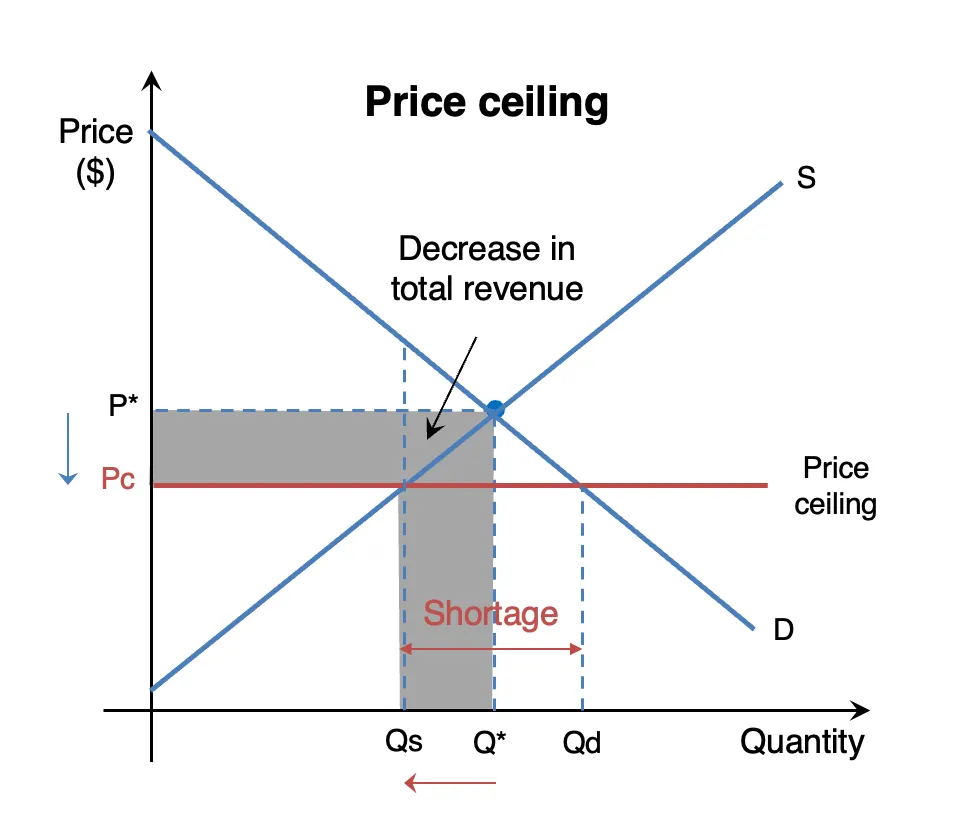
- Sell at a lower price (P* to Pc).
Sell lower quantities (Q* to Qs). - Total revenue decreases (P*Q* to PcQs)
Producer surplus decreases. - Producers are worse off, they sell the product at a lower pice with lower quantity.
-
- workers
- Decrease in output reduces the demand for labour.
- Unemployment may increase
- government
- no direct effect
- the only thing is that government may gain political popularity among the consumers who are better off due to the price ceiling
- market
- shortage
- non-price rationing
- once a shortage arises due to a price ceiling, the price mechanism no longer achieves its rationing function. Some demanders willing and able to buy the good at P_c will go unsatisfied. Non-price rationing measures include:
- waiting in line and the first-come-first-served principle
- those who come first will buy the good
- the distribution of coupons to all interested buyers, so that they can purchase a fixed amount of the good in a given time period
- favouritism
- the sellers can sell the good to their preferred customers
- waiting in line and the first-come-first-served principle
- once a shortage arises due to a price ceiling, the price mechanism no longer achieves its rationing function. Some demanders willing and able to buy the good at P_c will go unsatisfied. Non-price rationing measures include:
- underground/parallel market
- Underground (or parallel) markets involve buying/selling transactions that are unrecorded, and are usually illegal. In the case of price ceilings, they are a special kind of price rationing. They involve buying a good at the maximum legal price, and then illegally reselling it at a price above the legal maximum. Underground markets can arise when there are dissatisfied people who have not succeeded in buying the good because there was not enough of it, and are willing to pay more than the ceiling price to get it. If there were no shortage, the price of the good would be at its equilibrium price, and no one would be interested in paying a higher than equilibrium price for it. Underground markets are inequitable, and frustrate the objective sought by the price ceiling, which is to set a maximum price.
- underallocation of resources to the good and allocative inefficiency
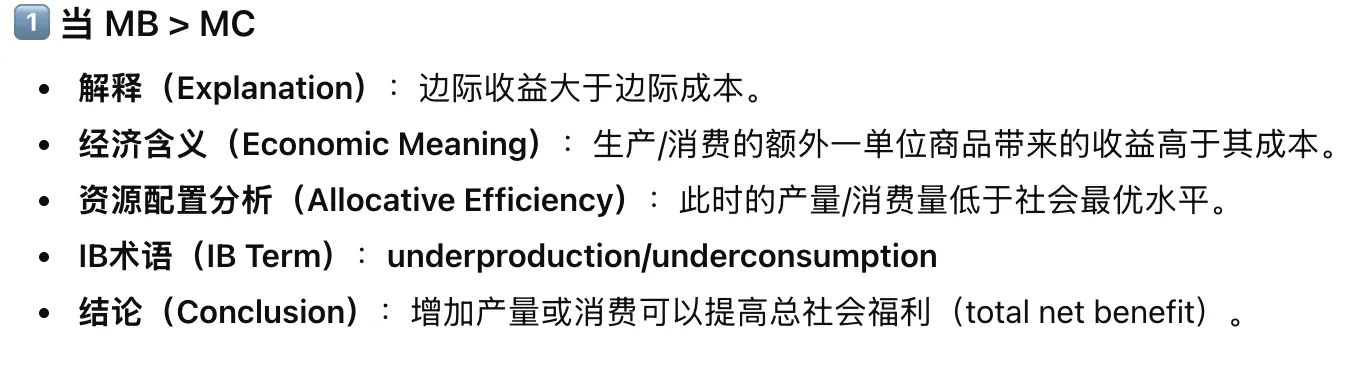
- not enough resources are allocated to the production of the good, resulting in underproduction relative to the social optimum .
- Society is worse off due to underallocation of resources and allocative inefficiency
- consumers
Subsidy
- A subsidy is a transfer payment given by the government, usually to producers in order to (i) reduce the costs of production, (ii) increase output, and (iii) reduce prices.
- why government grants subsidies
- subsidies can be used to increase revenues (hence income) of producers.
- subsidies can make certain goods (necessities) affordable to low income consumers
- lowering the price that is paid by cosumers
- making the good more affordable
- especially for necessities
- subsidy can be used to encourage production and consumption of particular goods and services that are believed to be desirable for consumers
- increasing the quantity of good produced and consumed(shifts the supply curve to the right, also reduce price)
- encourage consumption
- support the growth of particular industries in a country
- increasing the quantity of output produced, support the growth of the industry
- subsidies can be used to encourage exports of particular goods
- lower export price increases the quantity of exports
- subsidies are a method to improve the allocation of resources( reduce allocative inefficiencies) by correcting positive externalities
- improve allocative inefficiency by eliminating or reducing underproduction/underconsumption
- illustrating and analysing impacts of subsidies on market outcomes
-
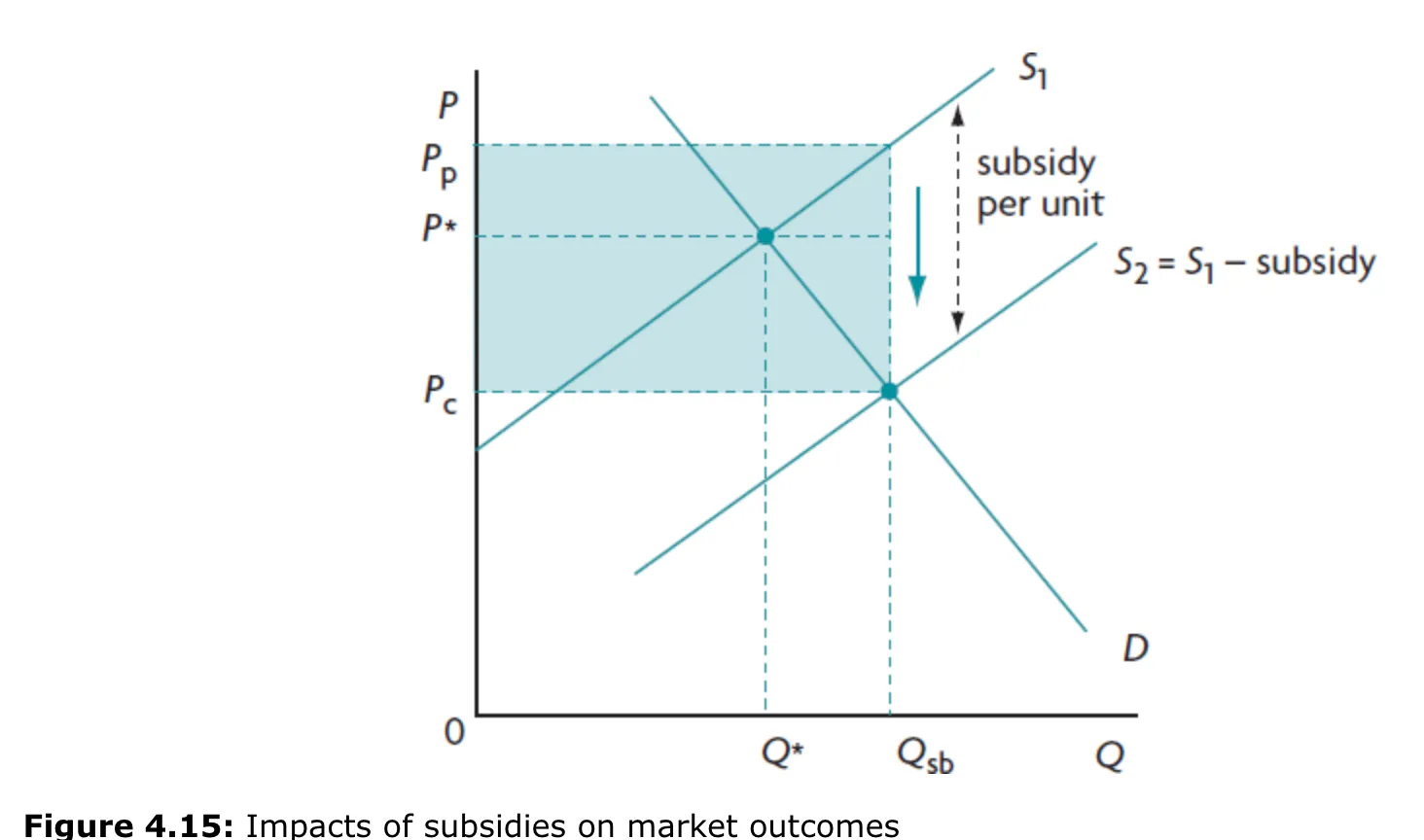
- equilibrium quantity produced and consumed increases from Q* to Qsb
- the equilibrium price falls from P* to Pc; this is the price paid by consumers
- the price received by producers increases from P* to Pp
- the amount of the subsidy is given by (Pp-Pc)*Qsb, or the amount of subsidy per unit multiplied by the number of units sold; this is the entire shaded area, and represents government spending to provide the subsidy
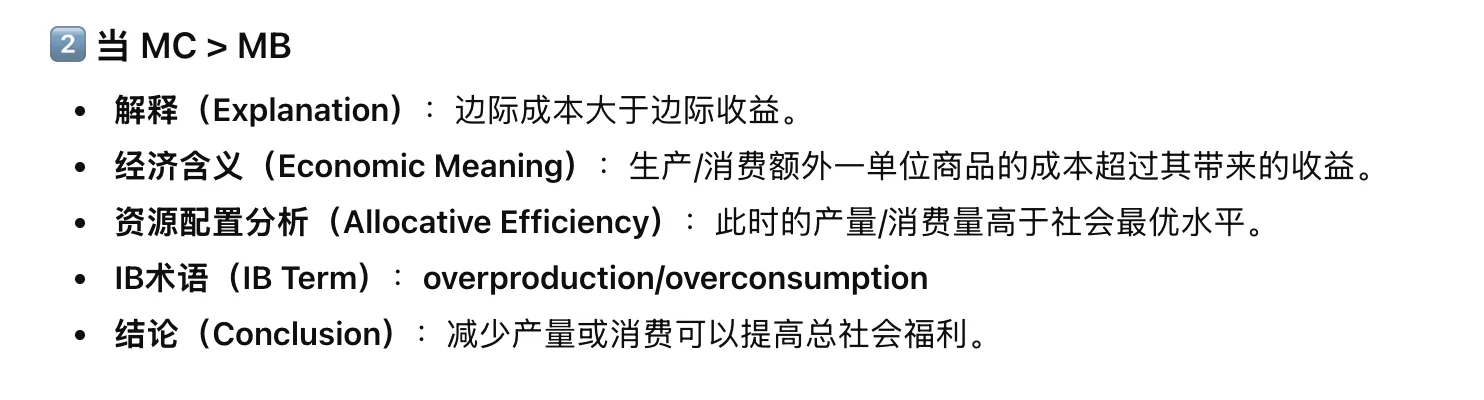
- there is an overallocation of resources to the production of the good: Qsb is greater than the free market quantity, Q*.
- stakeholder analysis
- consumers
- Consumers are affected by the fall in price of the good from P* to Pc (Figure 4.15) and the increase in quantity purchased (from Q* to Qsb).
- Both these changes make them better off.
- producers
- Producers are also better off, because they receive a higher price (Pp> P*) and produce a larger quantity (Qsb > Q*), seen in Figure 4.15.
- The price and quantity effects translate into an increase in revenues.
- Before the granting of the subsidy, firms had revenues of (P*) ✖️ (Q*)
- after the granting of the subsidy, firms had revenues of (Pp) ✖️ (Qsb)
- government
- The government pays the subsidy, which is a burden on its budget.
- To obtain the revenues for the subsidy, the government may have to reduce expenditures elsewhere in the economy, or it may have to raise taxes, or it may have to run a budget deficit (government expenditures greater than tax revenues).
- Whatever the case, the impact on the government’s budget is negative.
- workers
- As output expands from Q* to Qsb, firms are likely to hire more workers to produce the extra output, therefore workers who find new jobs are better off.
- increase employment
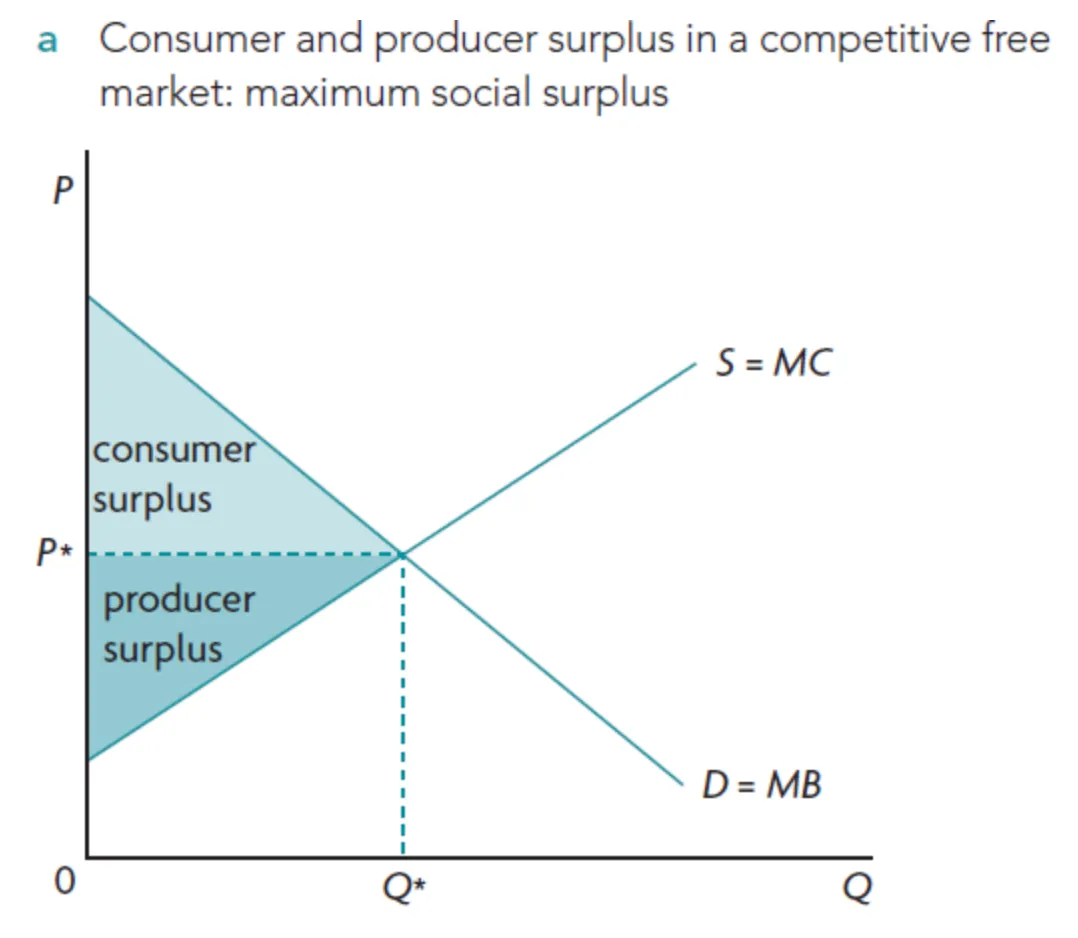
- society as a whole: consumer and producer surplus, and welfare loss
-
-
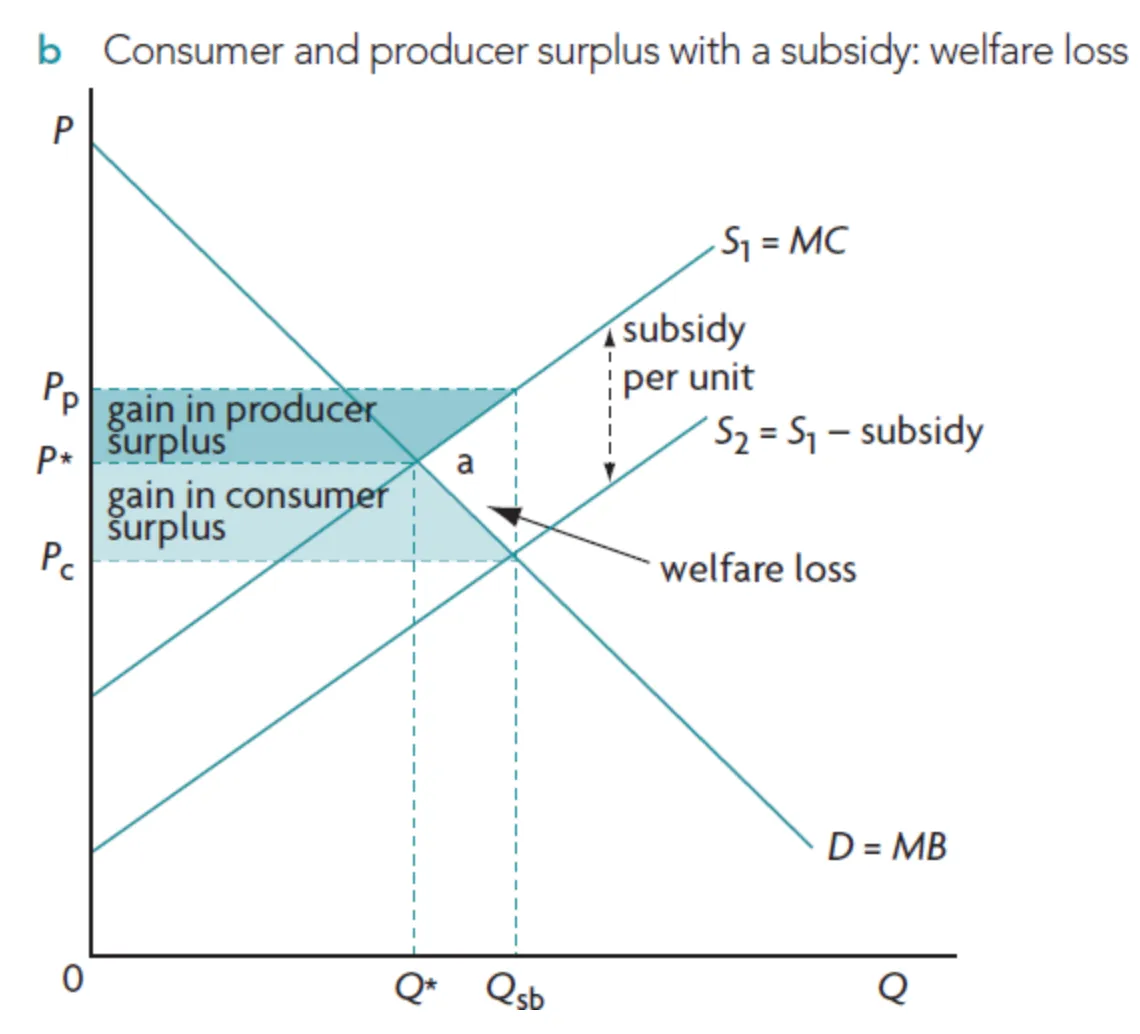
- We can see in Figure 4.16(b) that at Qsb, MB < MC, meaning that the benefit consumers receive from the last unit of the good they buy is less than the marginal cost of producing it.
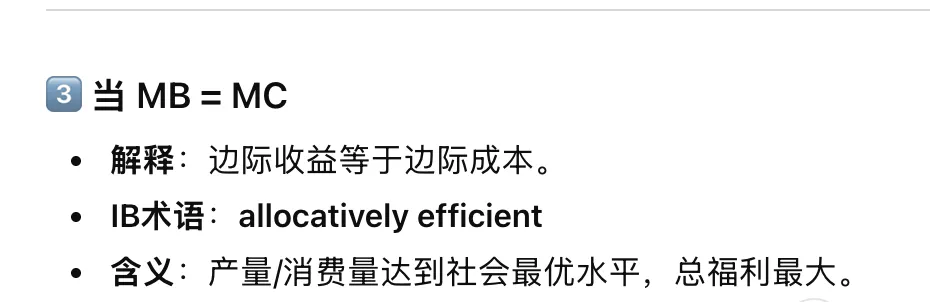
- the granting of a subsidy results in greater consumer and producer surplus; however, society loses due to government spending on the subsidy. Since the loss from government spending is greater than the gain in consumer and producer surplus, welfare loss results, reflecting allocative inefficiency, which in this case is due to overallocation of resources to the production of the good (overproduction). This is also illustrated by MB < MC: too much of the good is being produced and consumed relative to the social optimum.
-
-
- consumers
-
Price floor
- A price floor is the legal minimum price set by the government for a particular good or service, to protect the income of producers and workers, or to discourage consumption.
- The minimum price must be above the equilibrium price, otherwise there’s no function for doing this
-
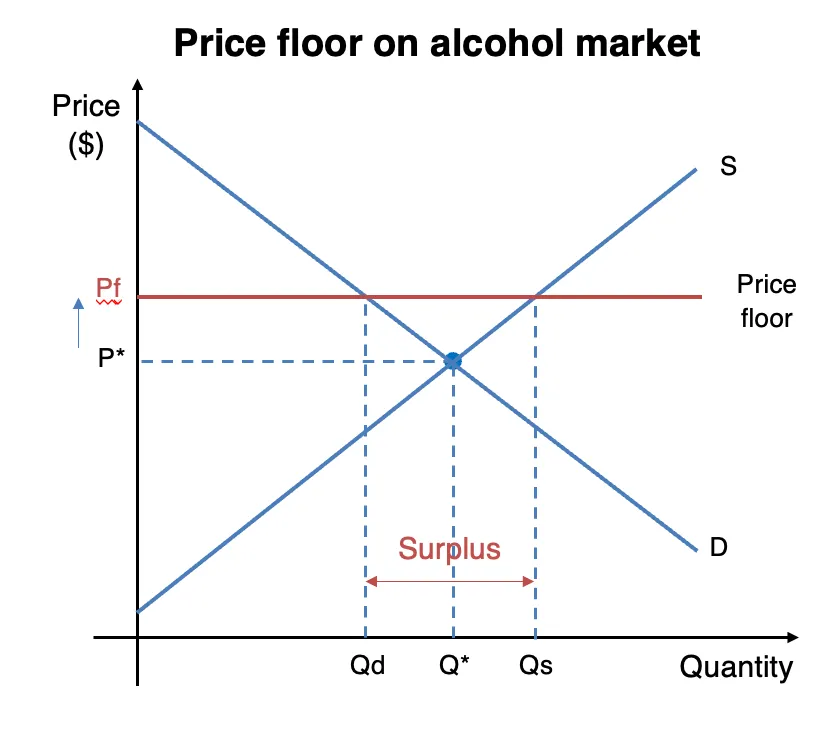
- A price floor (Pf) is set above the equilibrium price (P*).
Quantity supplied expands from Q* to Qs.
Quantity demanded contracts from Q* to Qd.
A surplus of Qs – Qd arises in the market.- This achieves the government objective of reducing alcohol consumption in order to reduce the associated social costs.
- A price floor (Pf) is set above the equilibrium price (P*).
- consequence for market
-
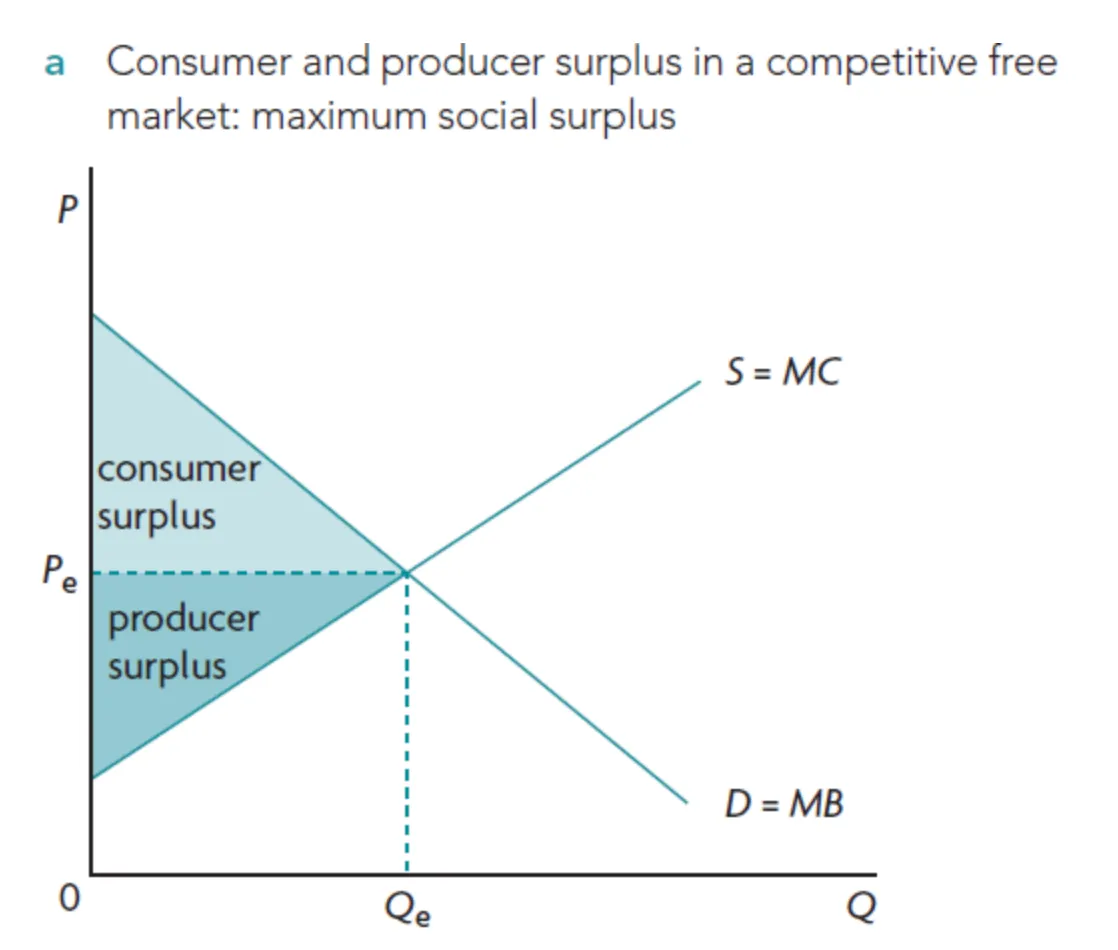
-
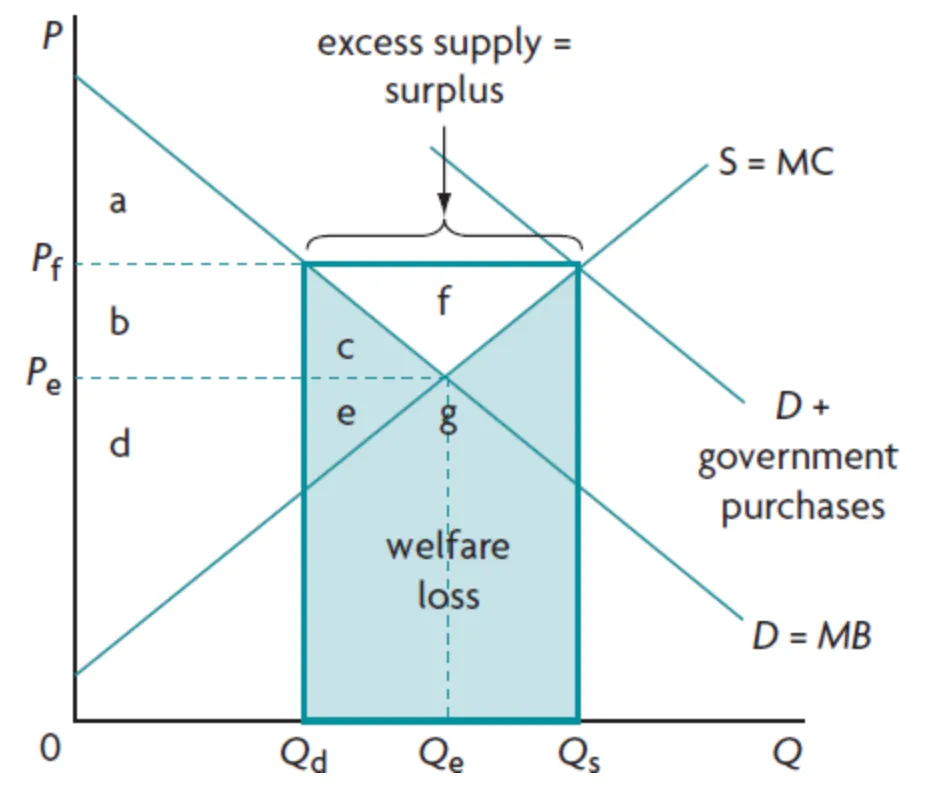
- surplus (Qs > Qd)
- A price floor results in disequilibrium where there is a surplus (excess supply). A common practice is for the government to buy the excess supply, and this causes the demand curve for the product to shift to the right to the new demand curve ‘D plus government purchases’. By buying up the excess supply, the government is able to maintain the price floor at P_f.
- if the government did not buy the surplus, the price would fall back to its equilibrium level. The reason is that farmers would have excess output with no buyers, and so would have to lower the price in order to be able to sell all the surplus.
- government mentions to dispose of surpluses
- one measure is to store it, giving rise to additional costs for storage above the costs of the purchase.
- Another method is to export the surplus (sell it abroad); this often requires granting a subsidy (this is money given to producers to be discussed later in this chapter) to lower the price of the good since foreign countries would not want to buy it at the high price.
- both of them generate additional costs for government
- firm inefficiency
- inefficient firms with high costs of production do not face incentives to cut costs by using more efficient production methods because the high price offers them protection against lower-cost competitors. This leads to inefficiency.
- overallocation of resources to the good and allocative inefficiency
- too many resources are allocated to the production of the good, resulting in a larger than optimum quantity produced.
- the optimal quantity is Qe, but Qs is produced.
-
- stakeholder analysis
- consumers
- Consumers are worse off, as they must now pay a higher price for the good , while they buy a smaller quantity of it.
- This is clear also from their loss of some consumer surplus.
- Consumers are worse off, as they must now pay a higher price for the good , while they buy a smaller quantity of it.
- producers
- Producers gain as they receive a higher price and produce a larger quantity, and since the government buys up the surplus, they increase their revenues from Pe × Qe to Pf × Qs.
- Also, producers become protected against low-cost competition and do not face as strong incentives to become efficient producers; they are therefore less likely to go out of business if they are producing inefficiently (with higher costs).
- workers
- Workers are likely to gain as employment increases on account of greater production of the good.
- government
- When the government buys the excess supply, this is a burden on its budget, resulting in less government funds to spend on other desirable activities in the economy. (hospitals, education, infrastructure)
- The costs to the government are paid for out of taxes (and therefore by taxpayers). In addition, there are further costs of storing the surplus or subsidising it for export (sale to other countries).
- consumers
- application of price floor
- mininum wage
-
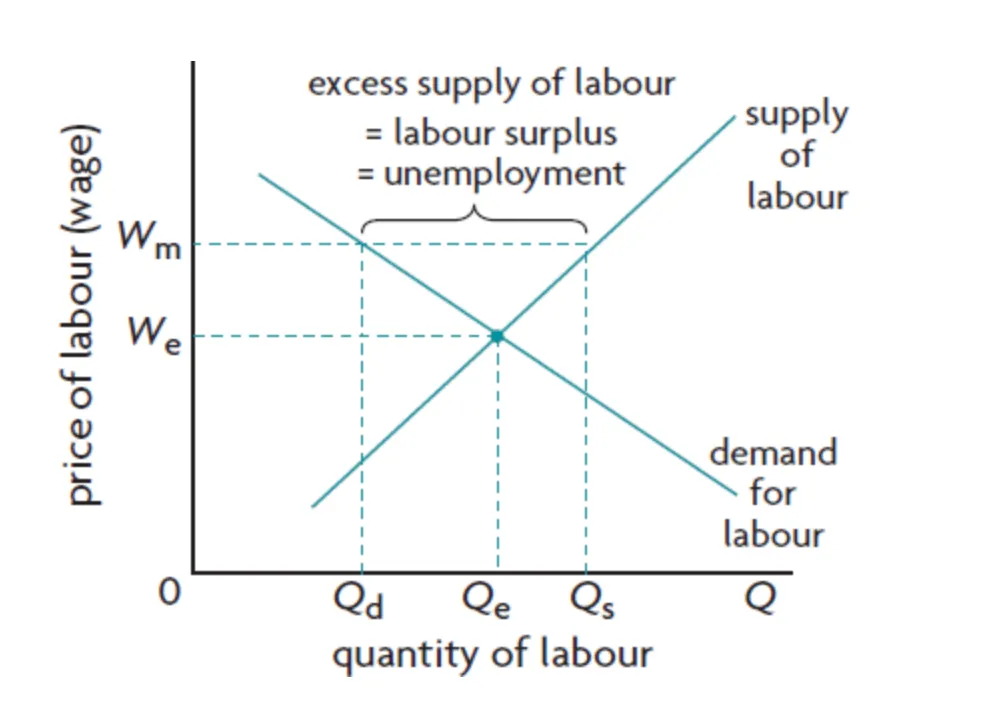
- Many countries around the world have minimum wage laws that determine the minimum price of labour (the wage rate) that an employer (a firm) must pay. The objective is to guarantee an adequate income to low-income workers, who tend to be mostly unskilled.
- The demand for labour curve shows the quantity of labour that firms are willing and able to hire at each wage, and the supply of labour curve shows the quantity of labour that workers supply at each wage.
- consequences
- labour surplus (excess supply) and unemployment
- illegal workers at wages below the minimum wage
-
- misallocation of labour resources
- misallocation in product markets
-
- stakeholder analysis
-
-
- mininum wage


Indirect tax
- indirect tax is a tax imposed on goods/services by the government and paid by producers, to try to reduce the market quantity for a specific goal. (usually safer/healthier society)
- type of indirect tax
- Excise tax
- a type of indirect tax imposed on the expenditure of particular goods and services.
- eg. Sugar, gasoline, and tobacco.
- tax on spending on all (or most) goods and services
- general sale taxes
- values added taxes
- Excise tax
- reason why government imposes indirect tax
- source of government revenue
- government collects tax revenue from the indirect tax
- to generate greater tax revenue
- excise taxes are often imposed on goods with low price elasticity of demand (PED), as the decrease in quantity demanded is proportionally smaller than the increase in price.
- discourage consumption of the goods that are harmful for the individual
- eg. cigarettes, alcohol, gambling
- consumption of these goods may be discouraged through the imposition of indirect tax
- the effect of this depends on the value of PED
- redistribute income
- Some excise taxes are charged on the consumption of luxury goods
- e.g., sports cars and jewellery
- the objective is to tax goods that can be only afford by high-income earners
- payments of a tax on the purchase of these goods reduced after-tax income, thus narrowing differences with the incomes of low-income earners
- Some excise taxes are charged on the consumption of luxury goods
- improve allocation of resources(reduce allocative inefficiencies)
- The provision of certain goods leads to market failure and allocative inefficiency
- Indirect taxes can be used to correct market failures
- eg. cigarettes, alcohol, petrol-based vehicles
- source of government revenue
- the types of indirect, excise tax
- specific taxes
- a fixed amount of tax per unit of the good or service sold
- ad valorem taxes
- a fixed percentage of the price of the good or service
- the amount of tax paid increases as the price of the good or service increases
- a fixed percentage of the price of the good or service
- specific taxes
- illustrating and analysing impacts of an indirect tax on market outcomes
-
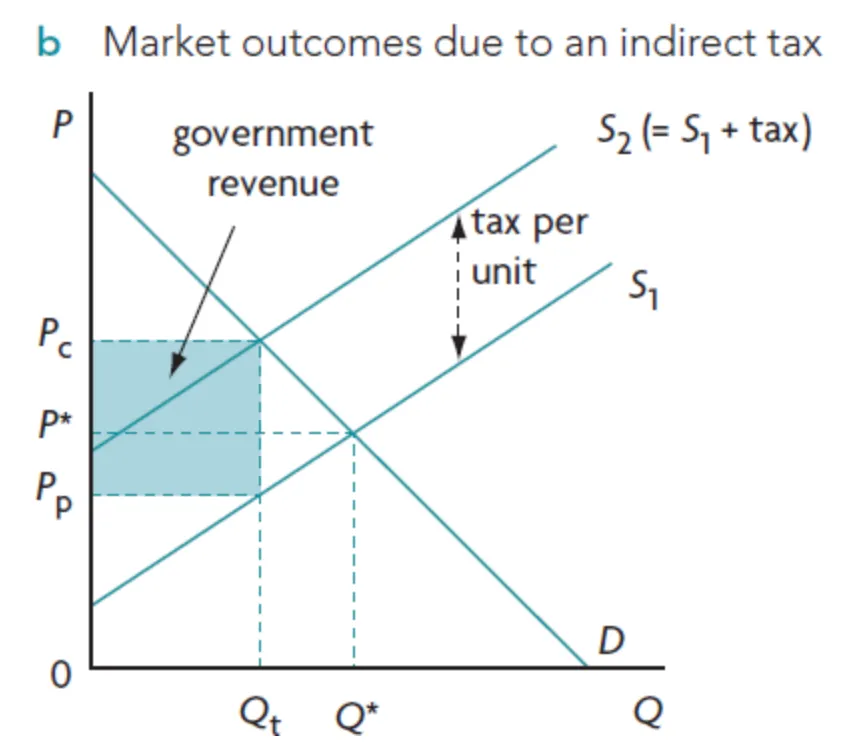
- S1 is the original supply curve, representing the real costs of production; the tax per unit(specific tax) effectively increase producers’ cost of production, shifts the supply curve leftward from S1 to S2.
The key here is the real costs of production does not change, it’s “effectively increasing”, the costs of the factors of production like labor costs(wage), raw material costs, land rent do not change due to the indirect tax. - the market quantity decreases from Q* to Qt
- The Pc is the price that consumers pay; Pp is the actual price that producers receive (based on the original supply curve S1)
- Pc is the new market price
- (Pc-Pp) * Qt is the tax revenue generated for the government, represented by the blue shaded area
- S1 is the original supply curve, representing the real costs of production; the tax per unit(specific tax) effectively increase producers’ cost of production, shifts the supply curve leftward from S1 to S2.
- stakeholder analysis
- consumers
- Consumers are affected in two ways:
- by the increase in the price of the good (from P* to Pc) and by the decrease in the quantity they buy (from Q* to Qt). Both these changes make them worse off, as they are now receiving less of the good and paying more for it(with higher price).
- producers
- Producers are affected in two ways:
- by the fall in the price they receive (from P* to Pp), and by the fall in the quantity of output they sell (from Q* to Qt). These effects translate into a fall in their revenues, from P* * Q* before the tax to Pp * Qt. Firms are therefore worse off as a result of the tax.
- government
- The government is the only stakeholder that gains, as it now has revenue equal to (Pc - Pp) * Qt. This is positive for the government budget, tax revenue is generated.
- workers
- A lower amount of output, from Q* to Qt, means that fewer workers are needed to produce it
- therefore, the tax may lead to some unemployment. Workers are worse of if they become unemployed.
- society as a whole: consumer and producers surplus and welfare loss
-
before tax
-
after tax
-
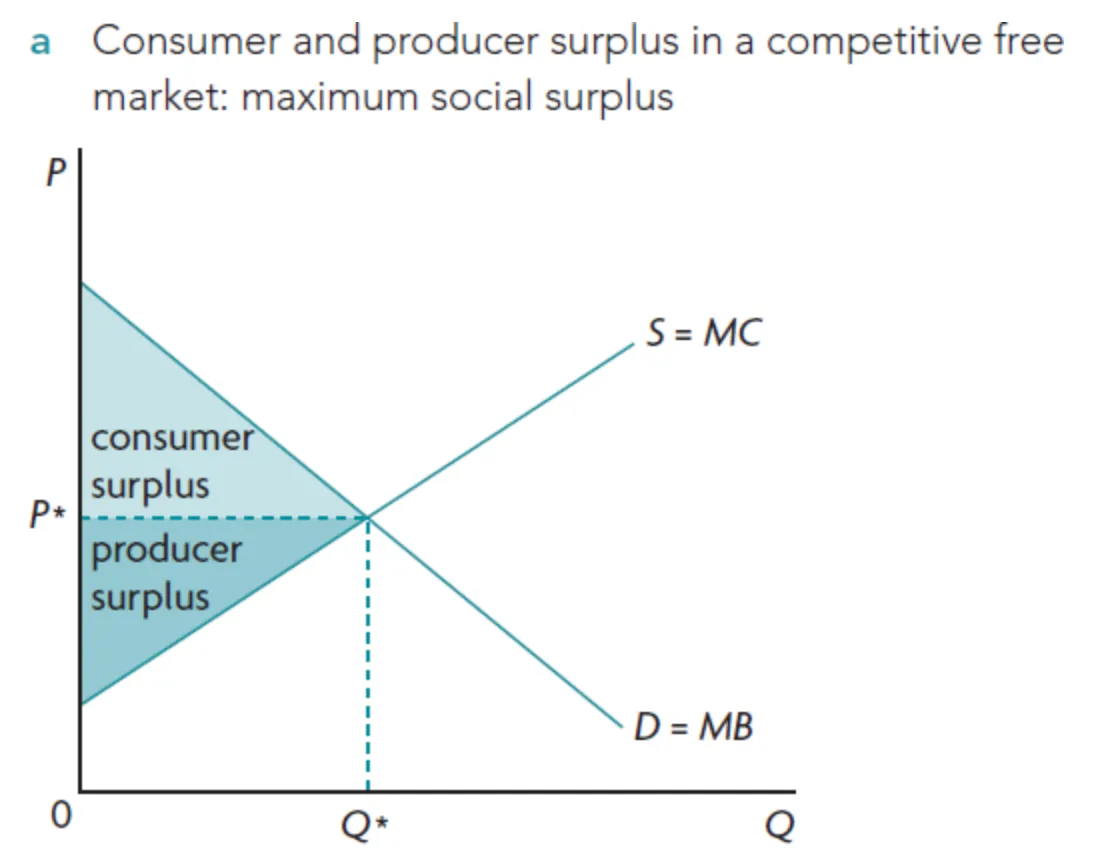
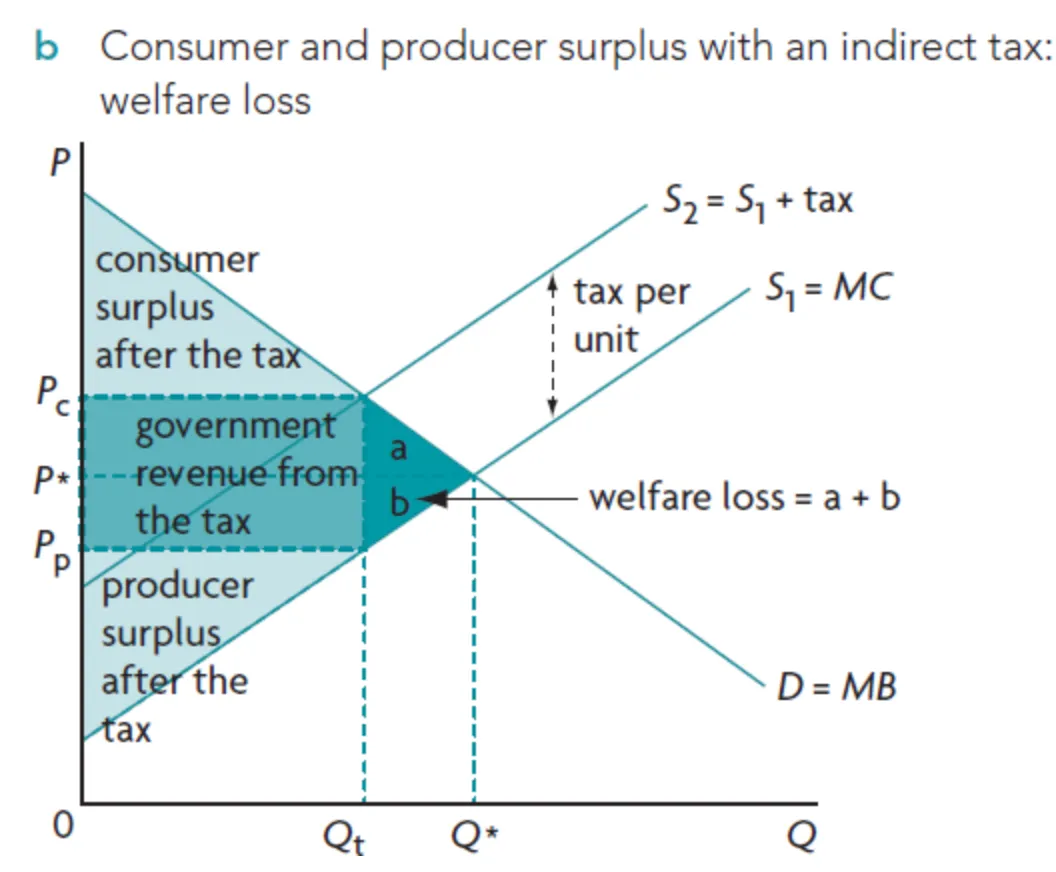
The imposition of an indirect tax results in reduced consumer and producer surplus, part of which is transformed into government revenue, and part of which is a welfare loss. The welfare loss in this case is the result of underallocation of resources to the production of the good (underproduction). This is also indicated by MB>MC: too little of the good is produced and consumed relative to the socially optimum.
-
-
- consumers
-