micro
Market failure and socially undesirable outcomes I & II
Market Failure
- occurs due to an inefficient allocation of resources. The signaling, incentive, and
rationing functions of the price mechanism may not always lead to a socially optimal outcome
Positive Externalities
- Postitve externalities are the external benefits imposed to third parties through economic activities of comsumption or production.
- Merit good exclusively refers to goods associated with positive externalities of consumption.
Due to the external benefits imposed to a third party, the marginal social benefit (MSB) of a merit good is larger than the marginal private benefit (MPB).
- Merit good exclusively refers to goods associated with positive externalities of consumption.
- Positive externalities of consumption
- A positive externality of consumption occurs when the consumption of a particular good by consumers creates external benefits for third parties. Third parties are individuals who are not directly involved in the economic activity.
-
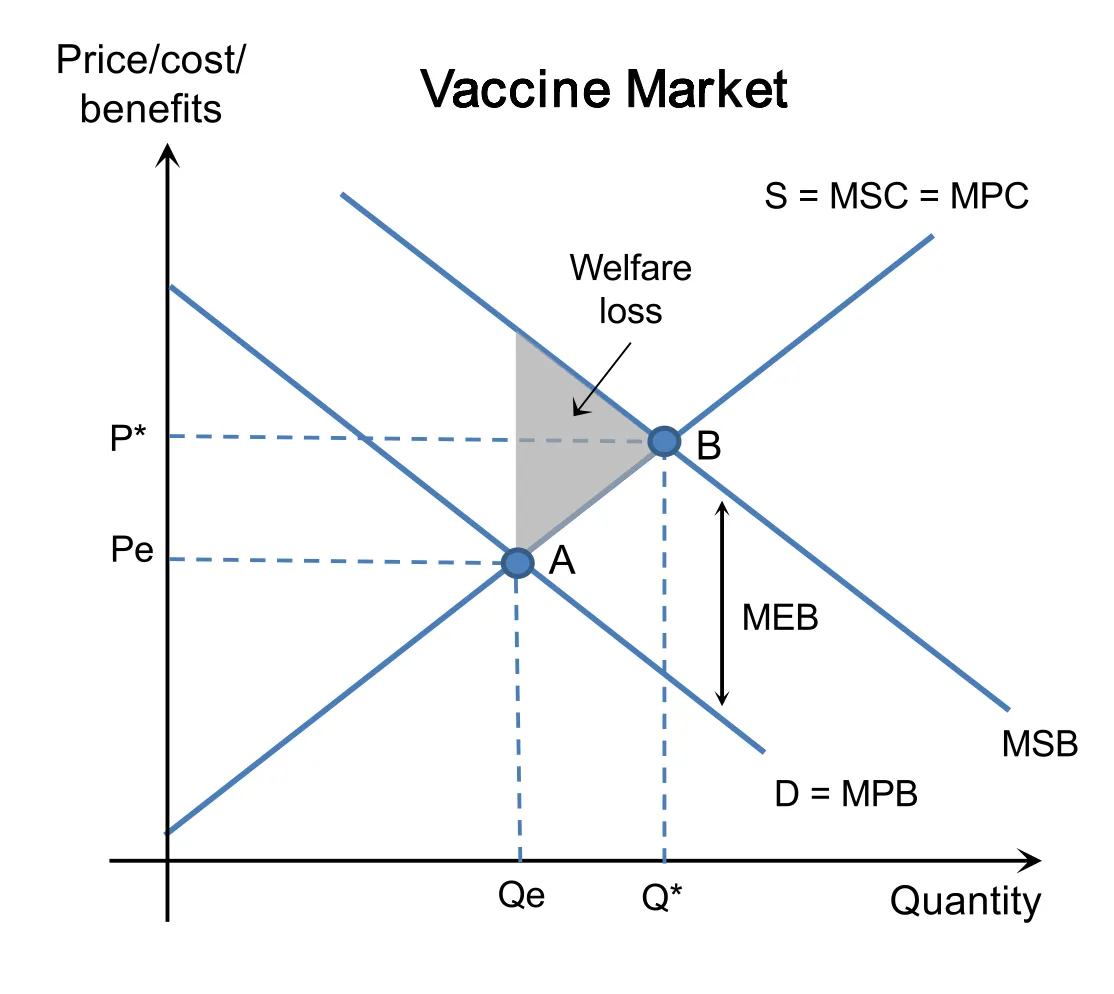
- Under-allocation of resources(underconsumption)
- the MSB is larger then MPB(the external benefits imposed on third parties enlarge the benefits for the whole society)
- the current equiblibrium quantity is smaller than the socially optimal quantity
-
- A positive externality of consumption occurs when the consumption of a particular good by consumers creates external benefits for third parties. Third parties are individuals who are not directly involved in the economic activity.
- Positive externalities of production
- A positive externality of production occurs when the production of a particular good by producers creates external benefits for third parties. Third parties are individuals who are not directly involved in the economic activity.
-
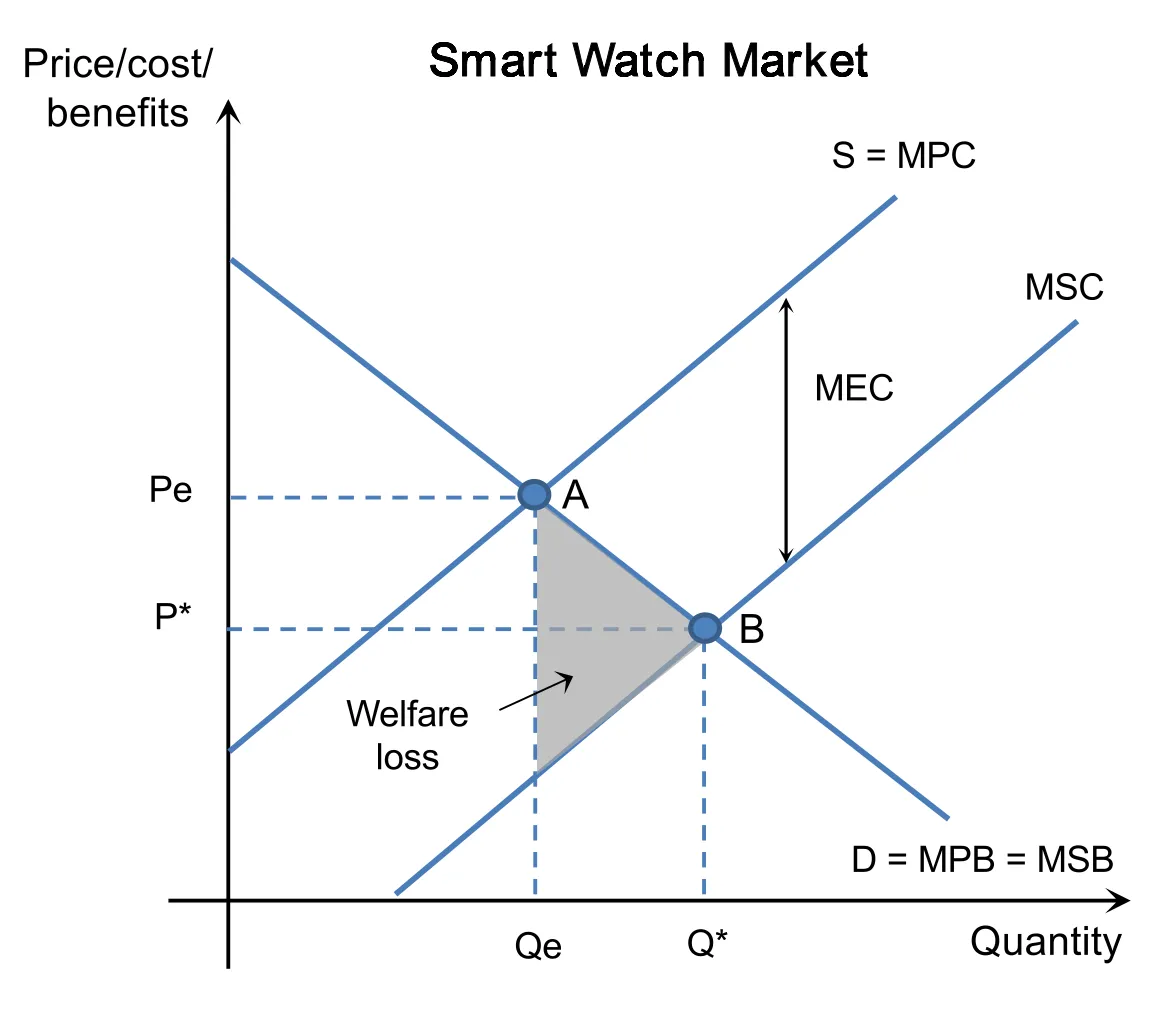
- Underallocation of resources(underproduction)
- MSC is lower than MPC(the external benefits offset part of the costs)
- the current equilibrium quantity is lower than the socially optimal quantity
-
- A positive externality of production occurs when the production of a particular good by producers creates external benefits for third parties. Third parties are individuals who are not directly involved in the economic activity.
Negative Externalities
- Negative externalities are the external costs imposed to third parties through economic activities of consumption or production. Third parties are group of people or individuals who are not directly involved in the production or consumption.
- Demerit goods are goods associated with negative externalities of consumption.
Because consumption imposes external costs on third parties, the marginal social benefit (MSB) of a demerit good is less than the marginal private benefit (MPB), leading to overconsumption in a free market.
- Demerit goods are goods associated with negative externalities of consumption.
- Negative externalities of consumption
- A negative externalities of consumption occurs when the consumption of goods by consumers creates external costs to the third parties. Third parties are individuals who are not directly involved in the economic activity.
-
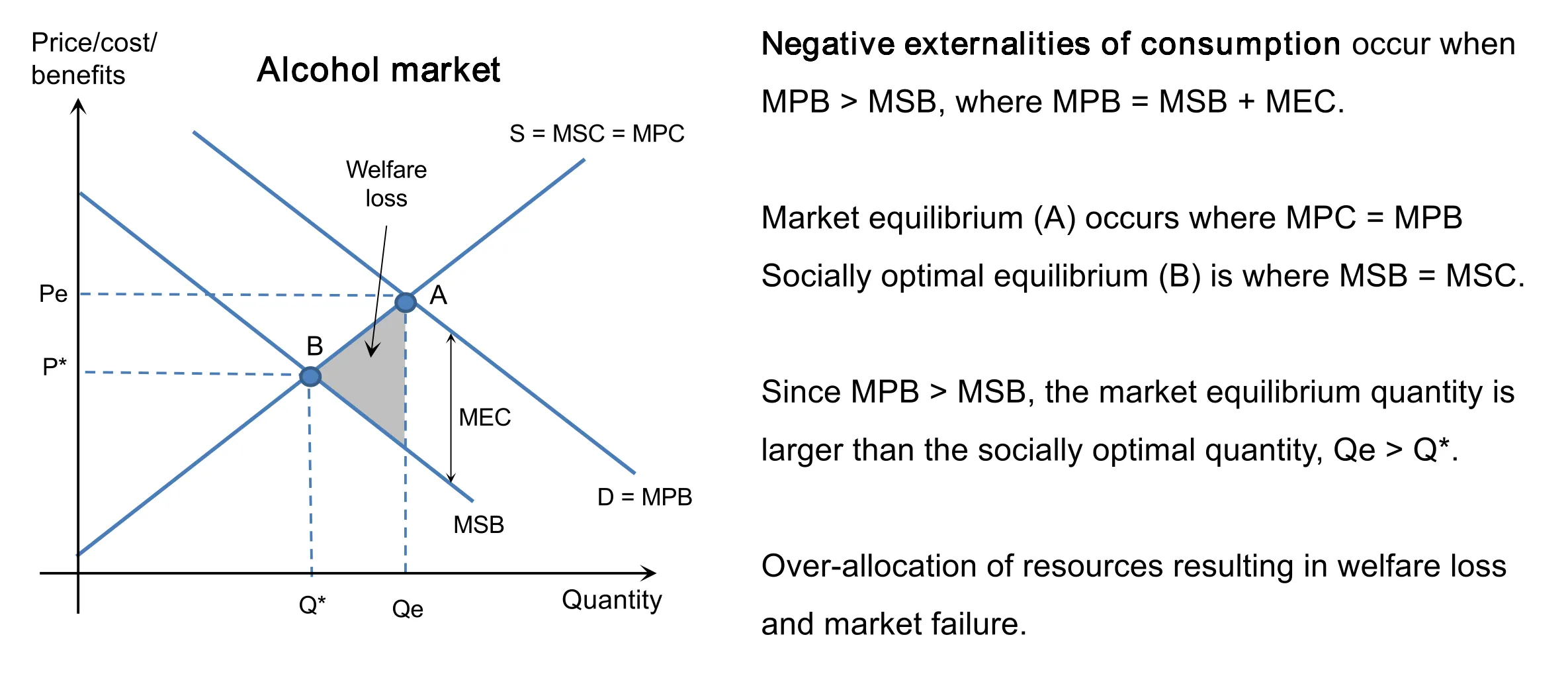
- The consumption of alcohol imposes external costs on third parties. The costs offset part of the benefits. So the MSB is lower than MPB. The current market equilibrium quantity is larger than the socially optimal quantity, indicating a overallocation of resources (overconsumption of alcohol) in the free market.
-
- A negative externalities of consumption occurs when the consumption of goods by consumers creates external costs to the third parties. Third parties are individuals who are not directly involved in the economic activity.
- Negative externalities of production
- A negative externalities of production occurs when the production of goods by producers creates external costs to the third parties. Third parties are individuals who are not directly involved in the economic activity.
-
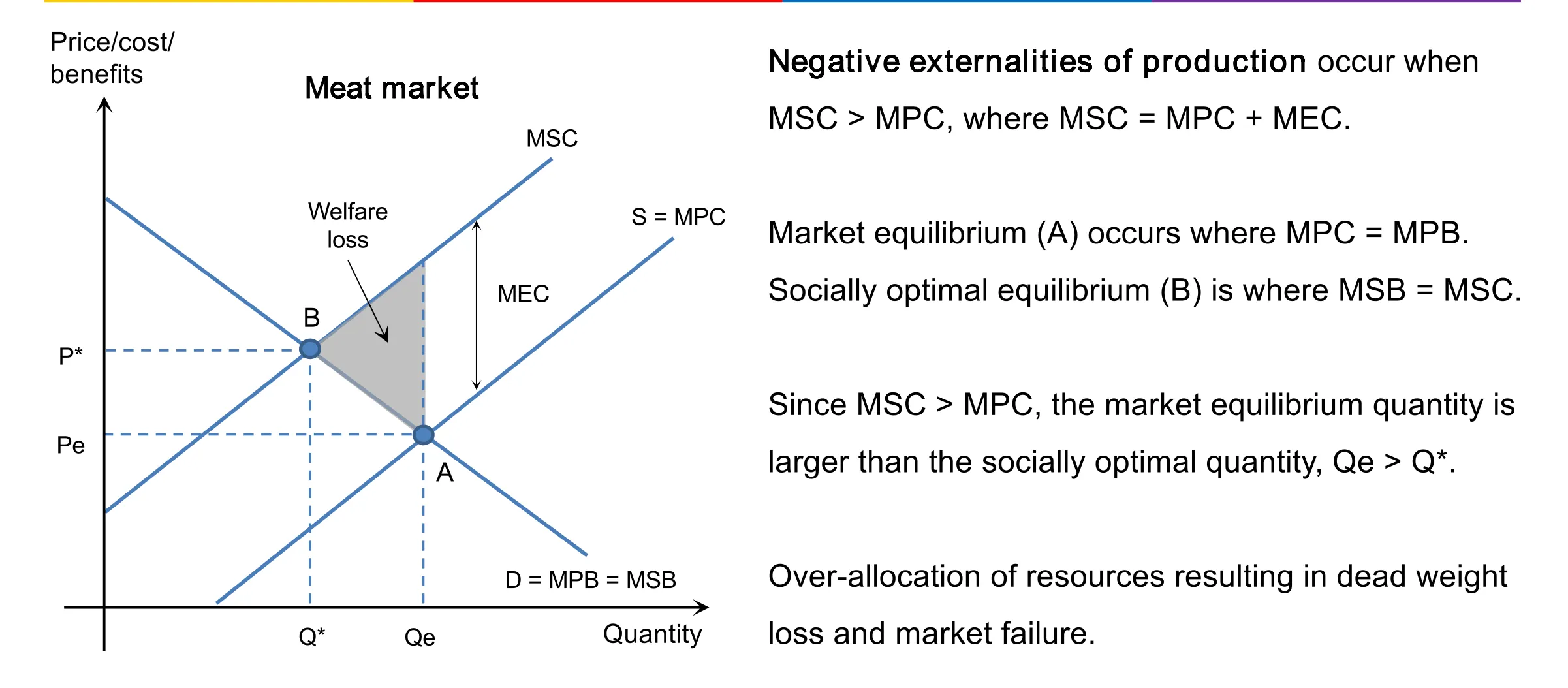
- The production of alcohol imposes external costs on third parties. The EC enlarges the social costs for the whole society. So the MSC is bigger than MPC. The current market equilibrium quantity is larger than the socially optimal quantity, indicating a overallocation of resources (overproduction of alcohol) in the free market.
-
- A negative externalities of production occurs when the production of goods by producers creates external costs to the third parties. Third parties are individuals who are not directly involved in the economic activity.
Government intervention to correct positive externalities
- Positive Externalities
- Government usually intervene the market by increasing the allocation of resources to correct the market failure
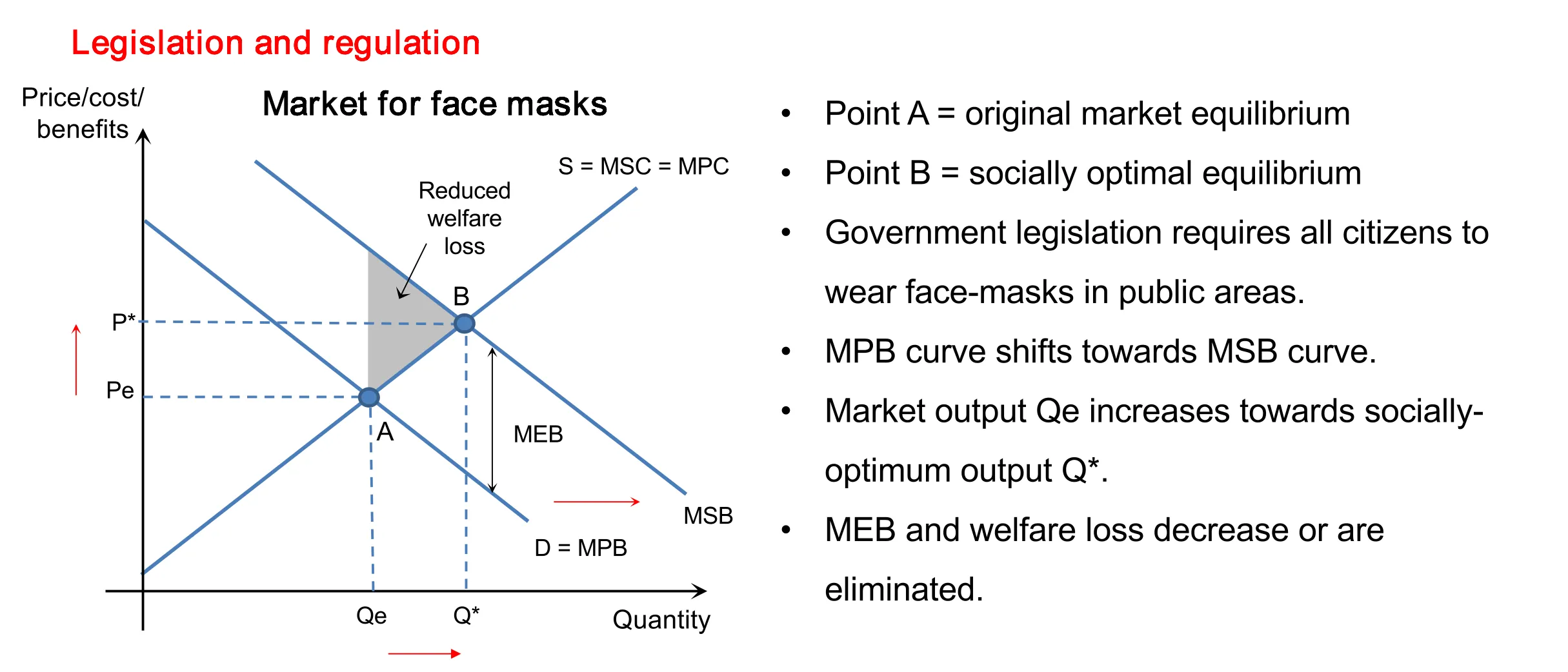
- Legislation and regulation
- Laws enforced by the government to ensure certain behaviour from consumers and producers.
- Compulsory mask-wearing in public areas
- Compulsory education for all students up to a certain age
- Legal requirement for children to receive vaccination against certain diseases
-
- Advantages
- Effective in correcting externalities from a command-and-control approach(compulsorily)
- Can directly increase consumption or production
- Disadvantages
- Monitoring and enforcing costs incurred(遭受) by government
- Political pushback: Restricts consumer and producer freedom
- People may choose to break the rules if penalties are not significant
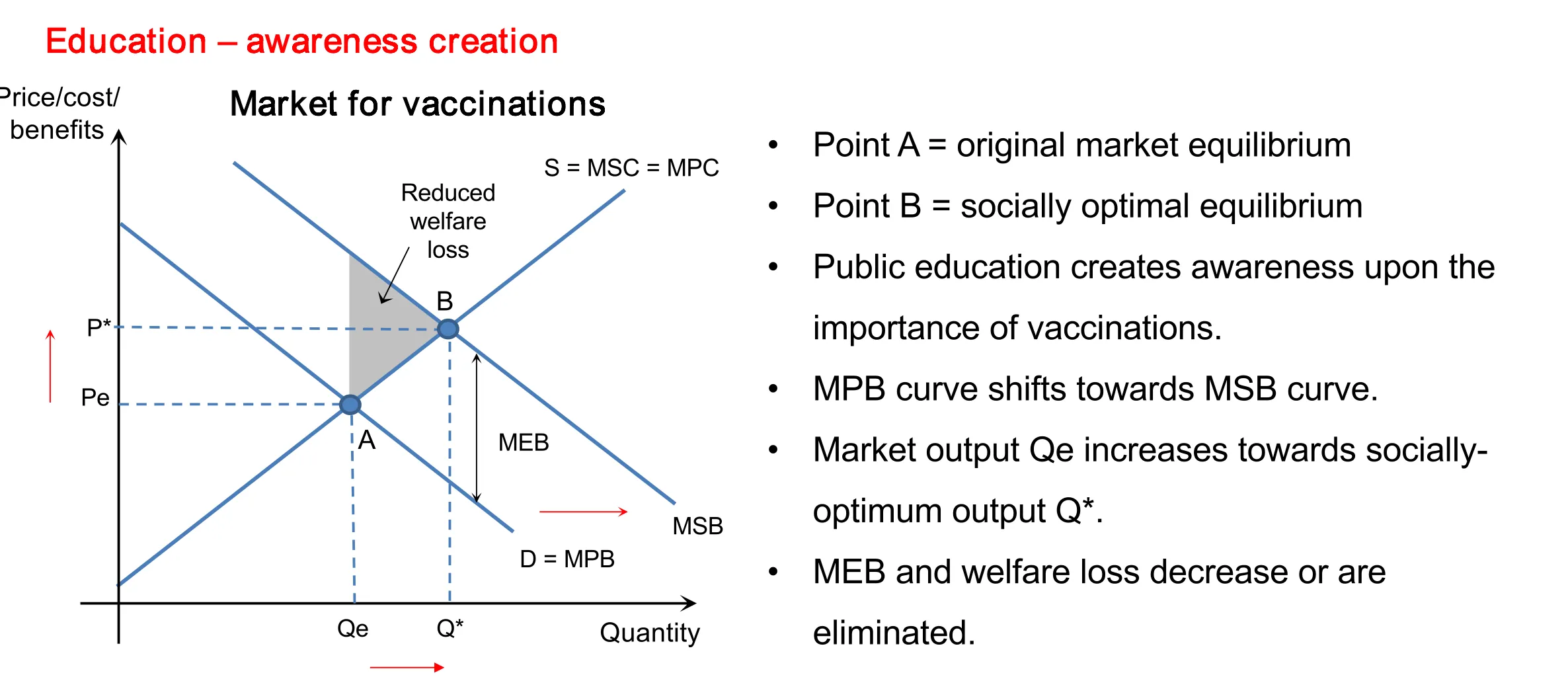
- Education and awareness creation
- Governments may educate the public about the benefits of merit goods through advertisements, campaigns, and schools to encourage consumption.
-
- Advantages
- Effective education and awanress creation may change consumers’ behavior for the long term
- Preserves freedom of choice
- Addresses the root of the problem
- Limitations
- Slow to see the effect: Requires time for the message to be accepted and behaviour to change
- May be relatively less effective, because educational campaigns only encourage people to change their behaviour
- Opportunity cost of government spending
- Education and awareness creation requires government spending on research, materials, media campaigns, and administrative resources, all of which involve opportunity costs
- This budget can be spent on other areas like education, healthcare service, hospitals or infrastructures
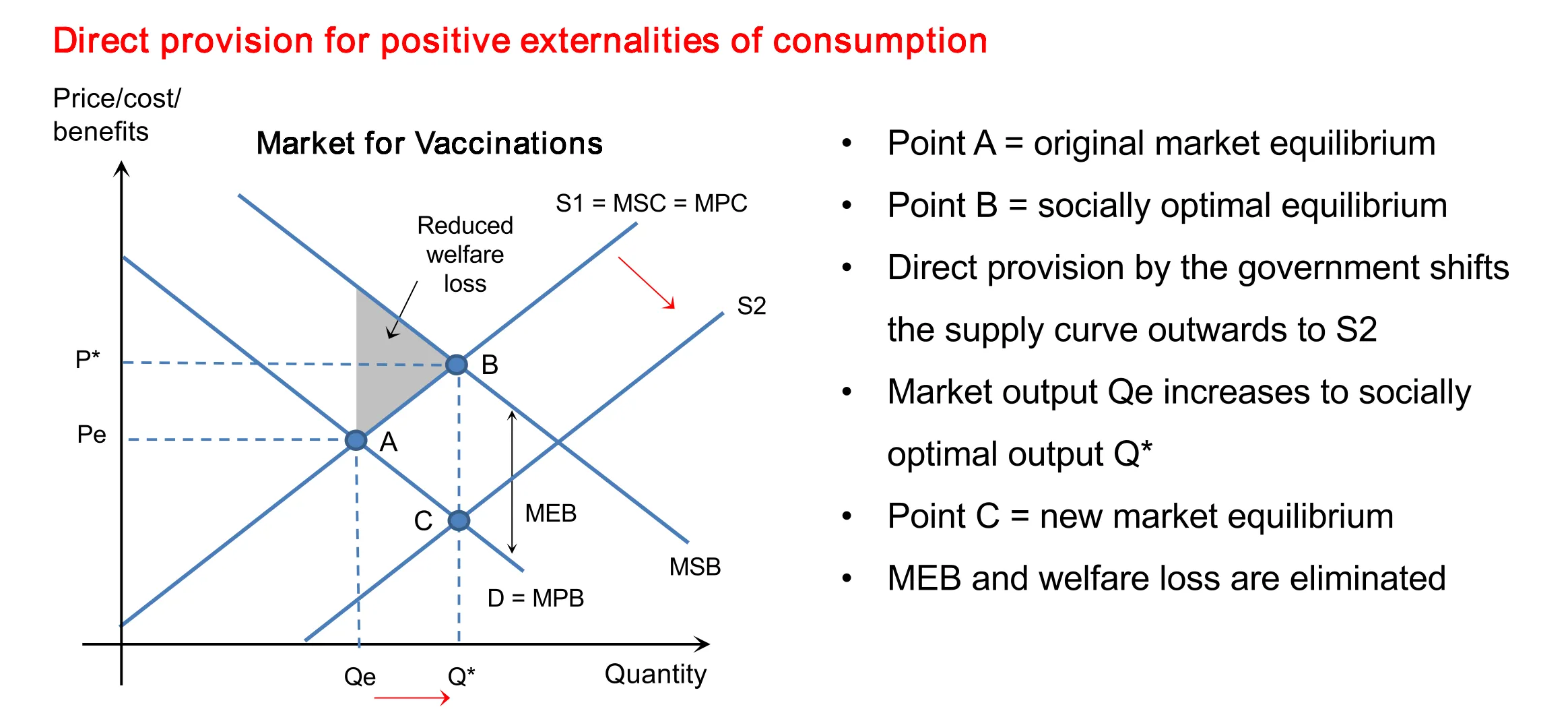
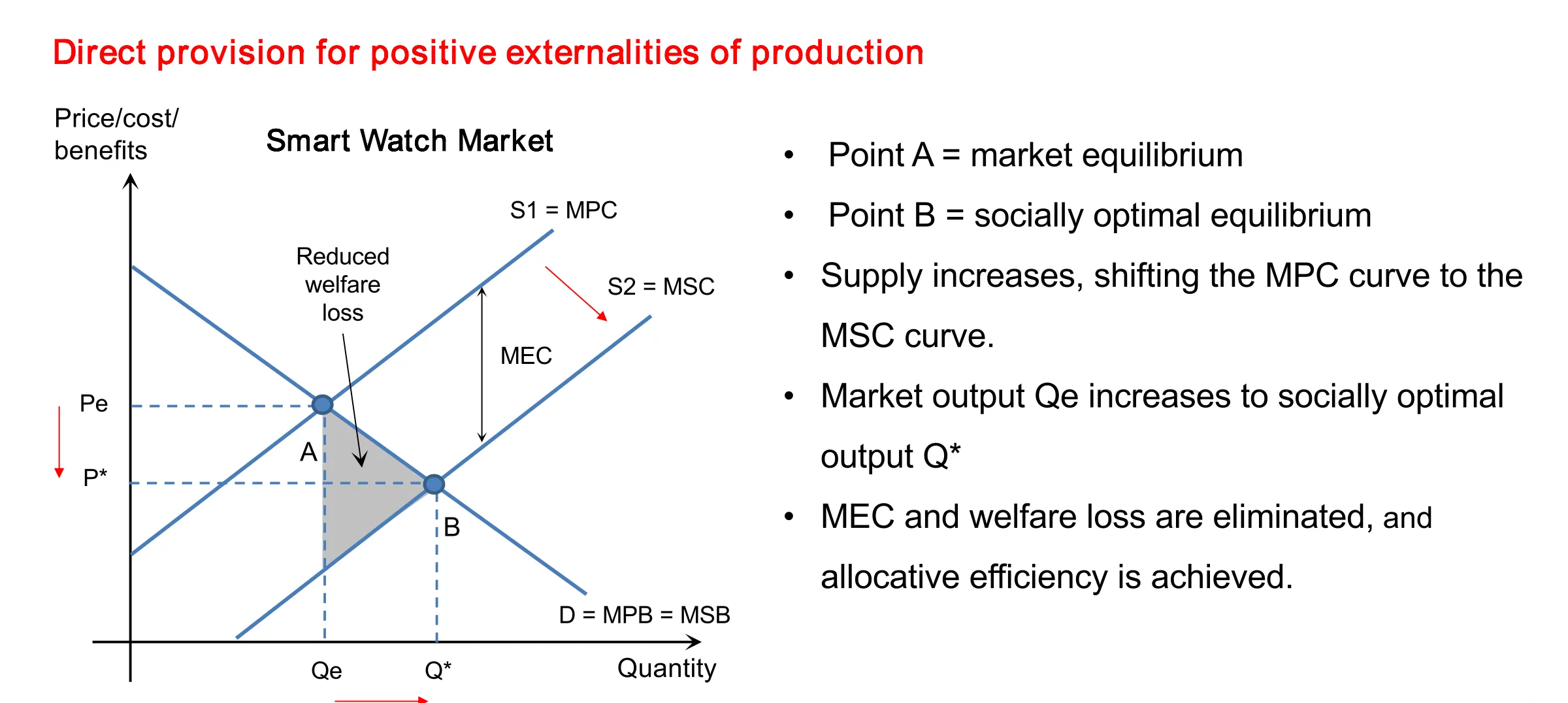
- Direct provision
- Governments may directly provide goods and services in the public sector associated with positive externalities such as education, healthcare, and infrastructure.
- they enter the market as a “huge” producer
-
-
- Advantages
- Ensures sufficient provision at the socially optimal level
- High certainty and predictability(more easier to control)
- Limitations
- Opportunity cost – Direct provision requires government spending, which always involves
foregone benefits of alternative uses. Such as invest on healthcare services and development. - Economic inefficiency – Goods and services may be provided free of charge or at a very low
cost, potentially resulting in overconsumption such use of A&E (accident and emergency)
services for common illnesses.- 当政府直接提供某些商品或服务,并且收费非常低甚至免费时,消费者几乎不需要考虑使用成本,因为对他们来说价格接近 0。
结果可能会导致 过度使用(overconsumption):
典型后果:资源被浪费
举例:
急诊(A&E)服务
有些人因为小病去急诊,占用资源
真正急重症患者可能因此等待更久
社会承担的成本增加,但市场价格没有反映这一额外成本(使用过度,external costs imposed on third parties)
- 当政府直接提供某些商品或服务,并且收费非常低甚至免费时,消费者几乎不需要考虑使用成本,因为对他们来说价格接近 0。
- Inequality – If the goods provided are in shortage, the government may need to prioritize certain groups e.g., healthcare services for the elderly.
- 例如accident and emergency是短缺的,政府需要给老人优先安排这些healthcare service。但是这对于社会中的其他人来说就是不公平的,有些人得不到及时的服务,welfare减少。
- Opportunity cost – Direct provision requires government spending, which always involves
- Subsidies
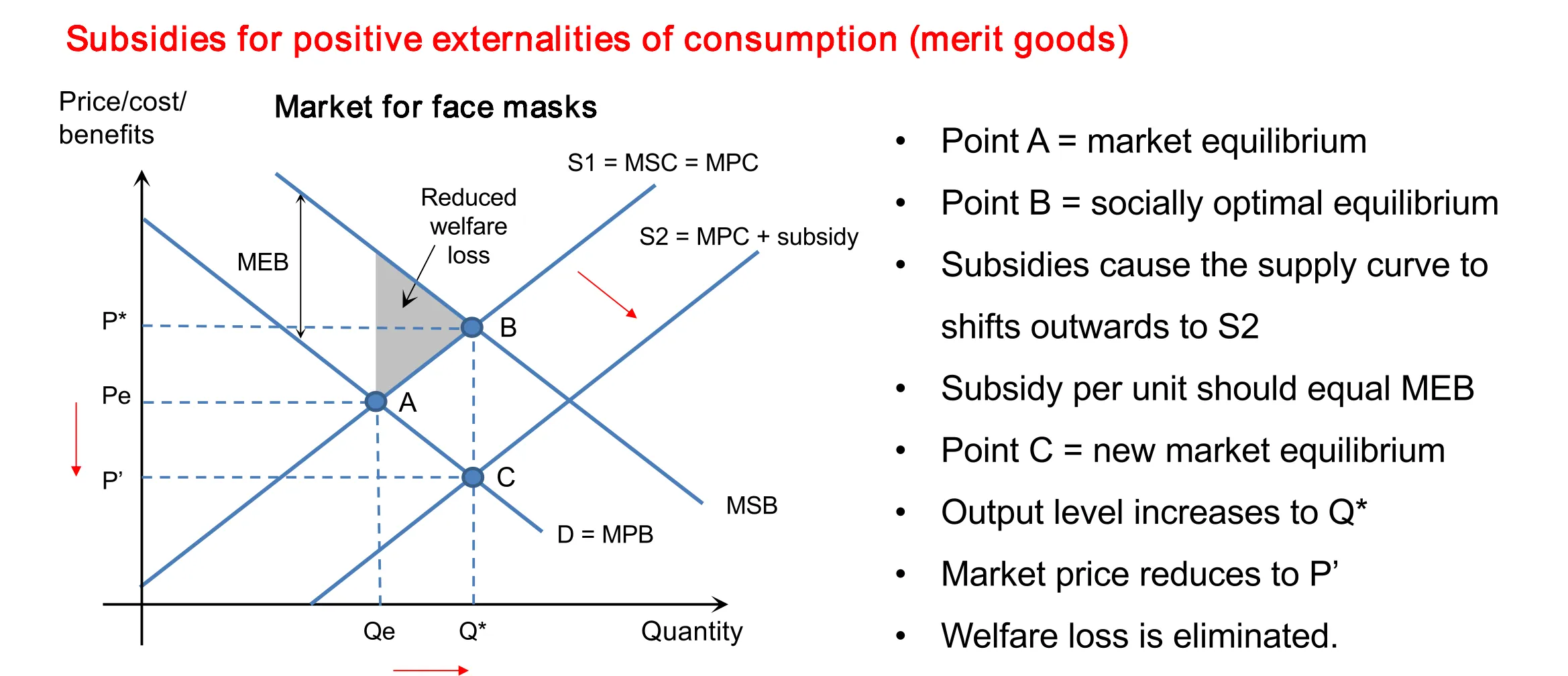
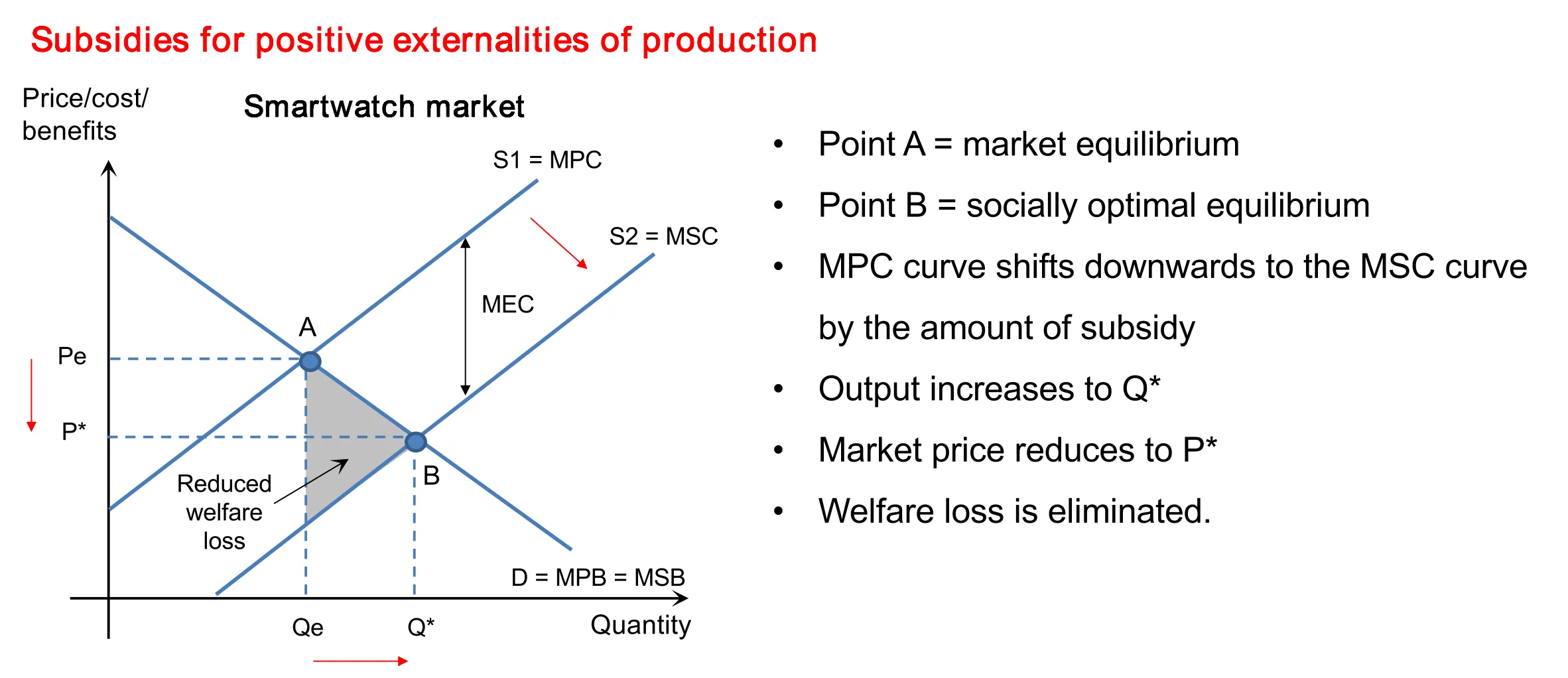
- A subsidy is a transfer payment given by the government, usually for producers in order to reduce the costs of production effectively, increase output, and reduce prices.
- Governments may also provide subsidies to producers to reduce the cost of production to
encourage consumption and production. Thus correct the positive externalities.
- Governments may also provide subsidies to producers to reduce the cost of production to
- Examples:
•Subsidies on vaccines
•Subsidies on clean drinking water in public spaces
•State-subsidized schools
•Subsidies for renewable energy -
-
- Advantages
- Incentivizes production and consumption
- Reduces the price of the good, increasing its affordability to lower income groups
- Disadvantages
- Imperfect market information – difficult to accurately calculate the level of subsidy and
externalities in order to achieve the socially-optimum output. - Opportunity cost – Subsidies require extra government spending, which always involves foregone benefits of alternative uses
- Effectiveness is dependent on PED – larger subsidies required for price inelastic products.
- Imperfect market information – difficult to accurately calculate the level of subsidy and
- A subsidy is a transfer payment given by the government, usually for producers in order to reduce the costs of production effectively, increase output, and reduce prices.
Government intervention to correct negative externalities
- Governments usually intervene in such markets by decreasing the allocation of resources to
correct the market failure. - Indirect(Pigouvian) tax
-
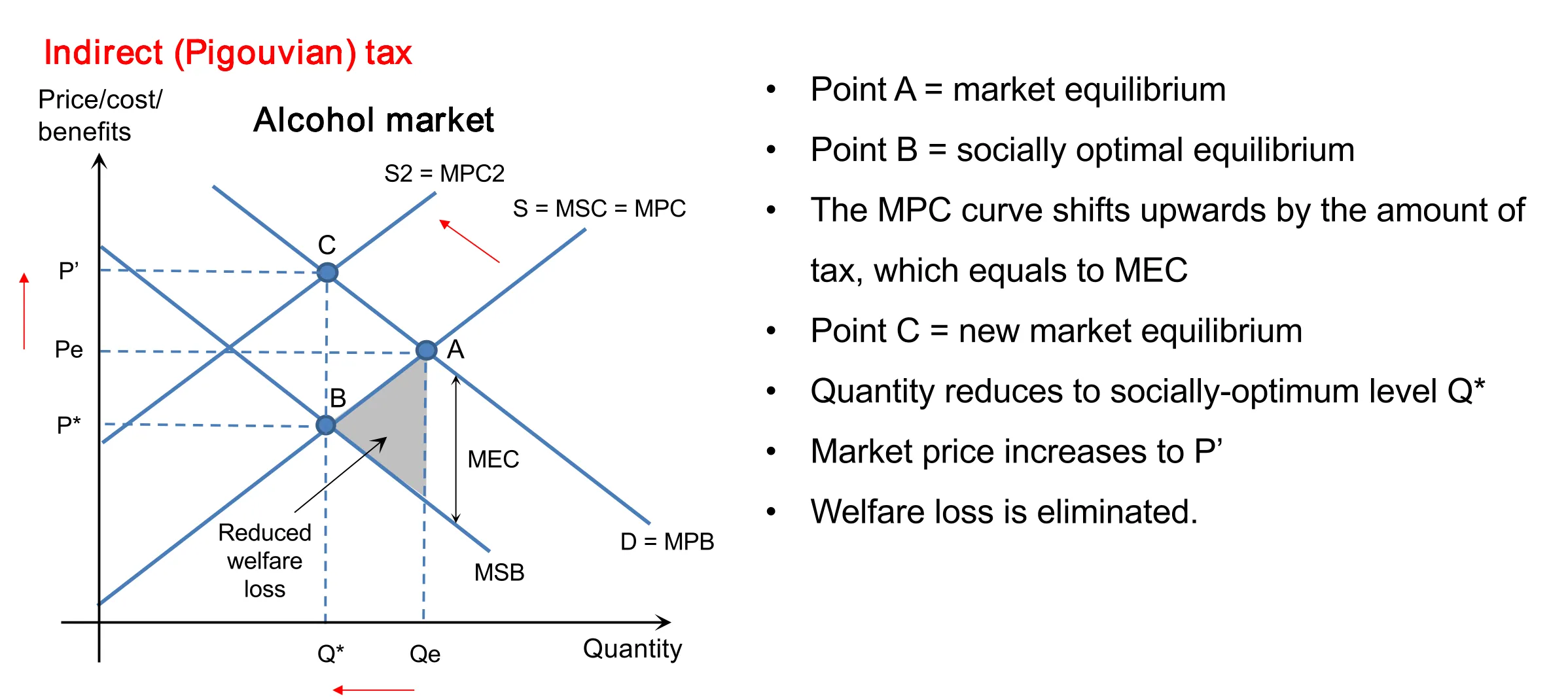
An indirect tax is placed on the expenditure of goods or services, paid by producers to the
government. This helps to internalize the external costs within the market participants i.e.,
consumers and producers pay towards the external costs.- Internalize: To internalize a negative externality means to make producers or consumers take into account the external costs generated by their actions in their decision-making, thereby reducing overproduction or overconsumption to the socially optimal level.
-
negative consumption externality
-
Advantages
- The price increase discourage consumption
- The higher costs discourage production
- Tax revenue is generated for the government, can be used in places like education or hospital
-
Disadvantages
- Regressive – low-income groups pay a higher portion of their income for the tax
- The amount of tax wealthy people and vulnerable people pay for the same good is the same, so it harms the vulnerable individuals more (they spend a large proportion of income on tax)
- Relatively ineffective for good with inelastic PED
- Imperfect market information means the size of the tax is unlikely equal to the external cost.
- Emergence of parallel markets – smuggling activities for demerit goods.
- addictive for example cigarette -> black & underground market
- Regressive – low-income groups pay a higher portion of their income for the tax
-
- legislation and regulation
-
Laws enforced by the government to ensure certain behaviour from consumers and producers.
-
Examples:
•Smoking banned indoors and in public areas.
•Age restrictions for gambling and drinking.
•Limit the level of pollutant emissions.
•Require firms to install emission-reducing technologies. -
negative consumption externality
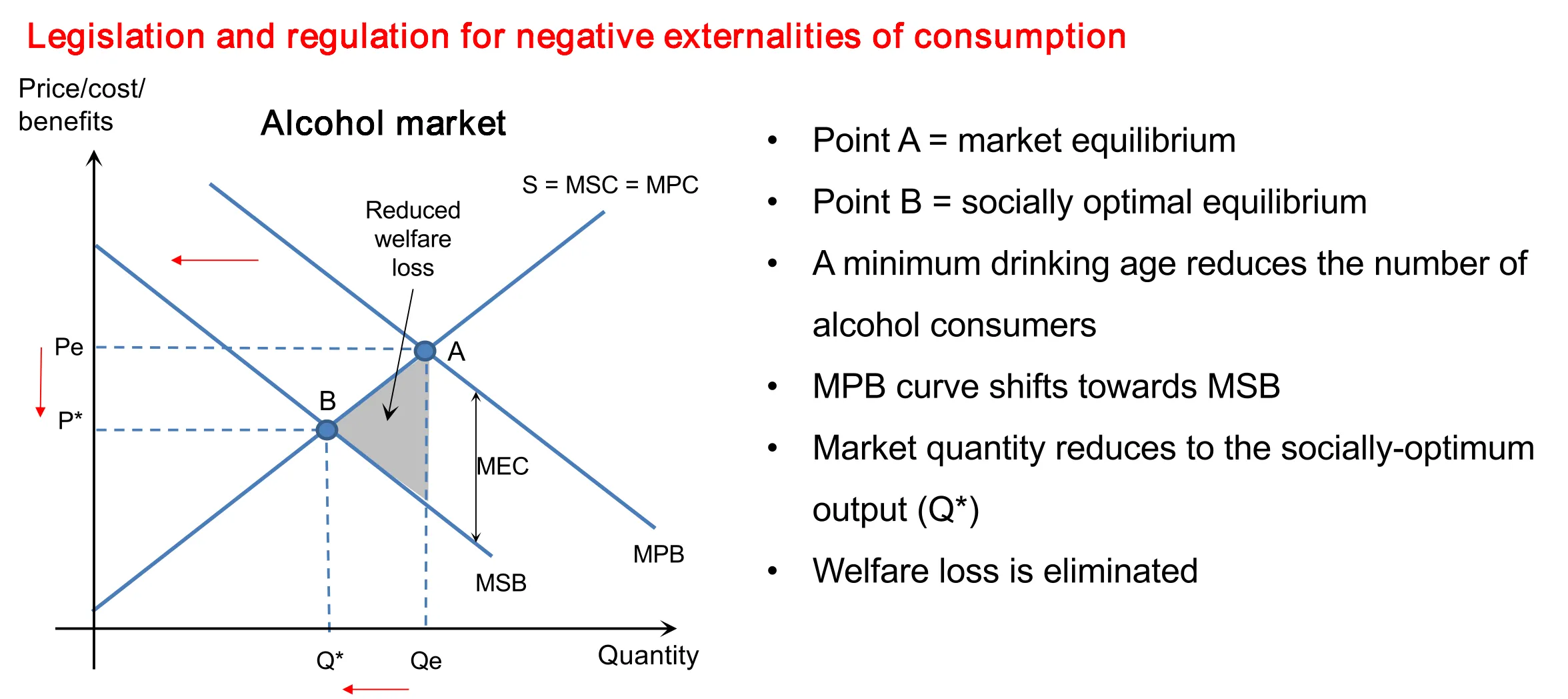
-
negative production externality
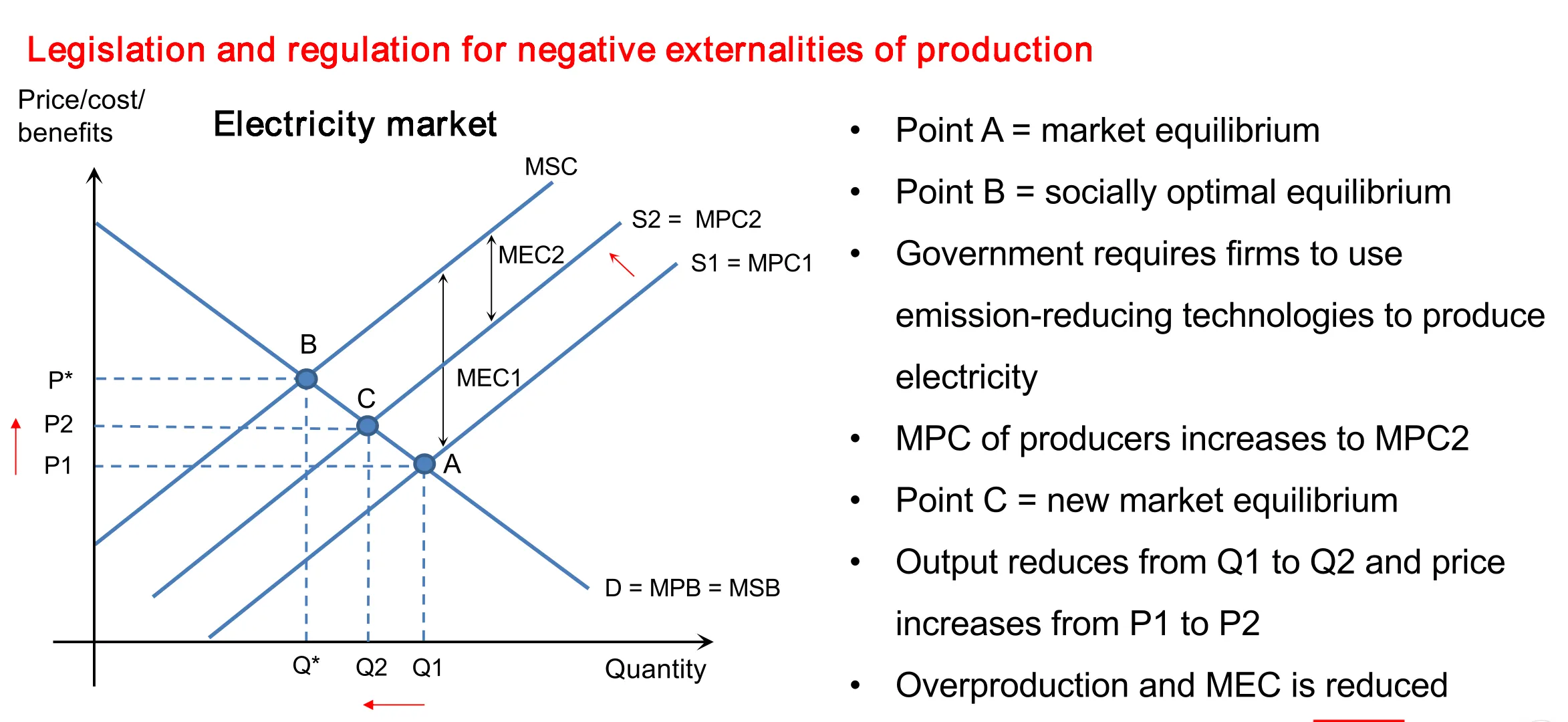
-
Advantages
- Effective in reducing externalities from a command-and-control approach
-
Disadvantages
- Monitoring and enforcing costs incurred by the government
- Political pushback: For example, if government forces electricity producers to use emission-reducing technologies. This will increase their costs of production because producers are forced to invest on technology.
- People may choose to break the rules if penalties are not high enough
-
- Education - awareness creation
-
The government may also discourage the consumption of demerit goods through education and awareness campaigns so that the public is more aware of the negative effects of the good.
-
Examples:
•Anti-drug campaigns
•Warning ads on cigarette packaging
•School-based education on climate change, and negative effects of smoking, and drinking. -
negative consumption externality
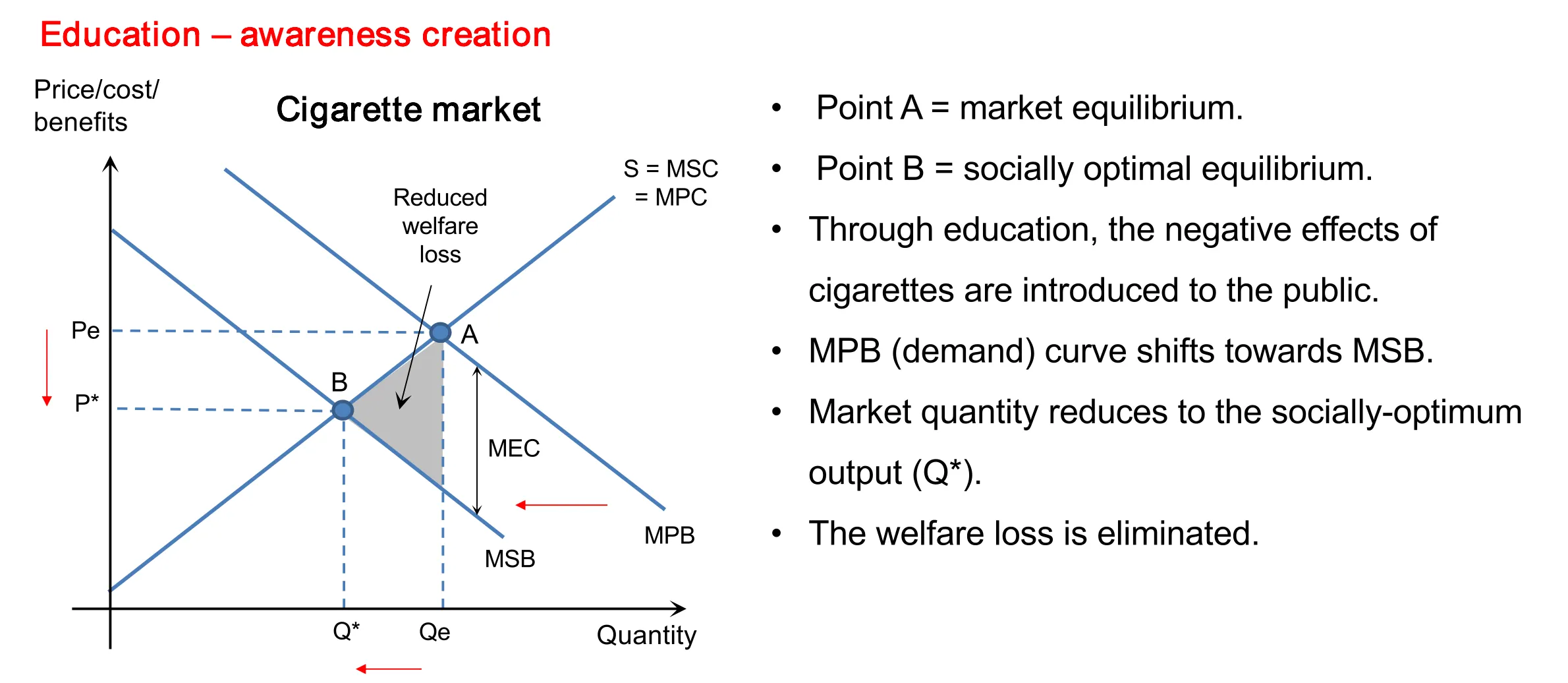
-
Advantages
- Effective education and awareness creation may change consumers’ behavior for the long term
- Preserves freedom of choice
- Addresses the root of the problem
-
Limitations
- Slow to see the effect: Requires time for the message to be accepted and behaviour to change
- May be relatively less effective, because educational campaigns only encourage people to change their behaviour
- Opportunity cost of government spending
- Education and awareness creation requires government spending on research, advertisement materials, media campaigns, and administrative resources, all of which involve opportunity costs
- This budget can be spent on other areas like education, healthcare service, hospitals or infrastructures
-
- Collective self-governance
- Collective self-governance refers to the voluntary communal actions that combat negative externalities. Successful campaigns may change social norms and cultural behaviours.
- Advantages
- Low costs for government
- Less political pushback
- Long term effectiveness because it may change social norms and cultural behaviours
- Limitations
- Uncertain effectiveness(because it’s voluntary communal actions)
- Slow to take effect
- free rider problem
- hard to combat severe externalities like cigarette addiction
- Carbon taxes
-
Carbon taxes are imposed on producers for carbon emissions from production activities with the aim of minimizing environmental pollution.
-
negative production externality: during the production of electricity, producers are required to pay the carbon tax, this effectively increases their production cost and shifts the MPC curve upward to MSC
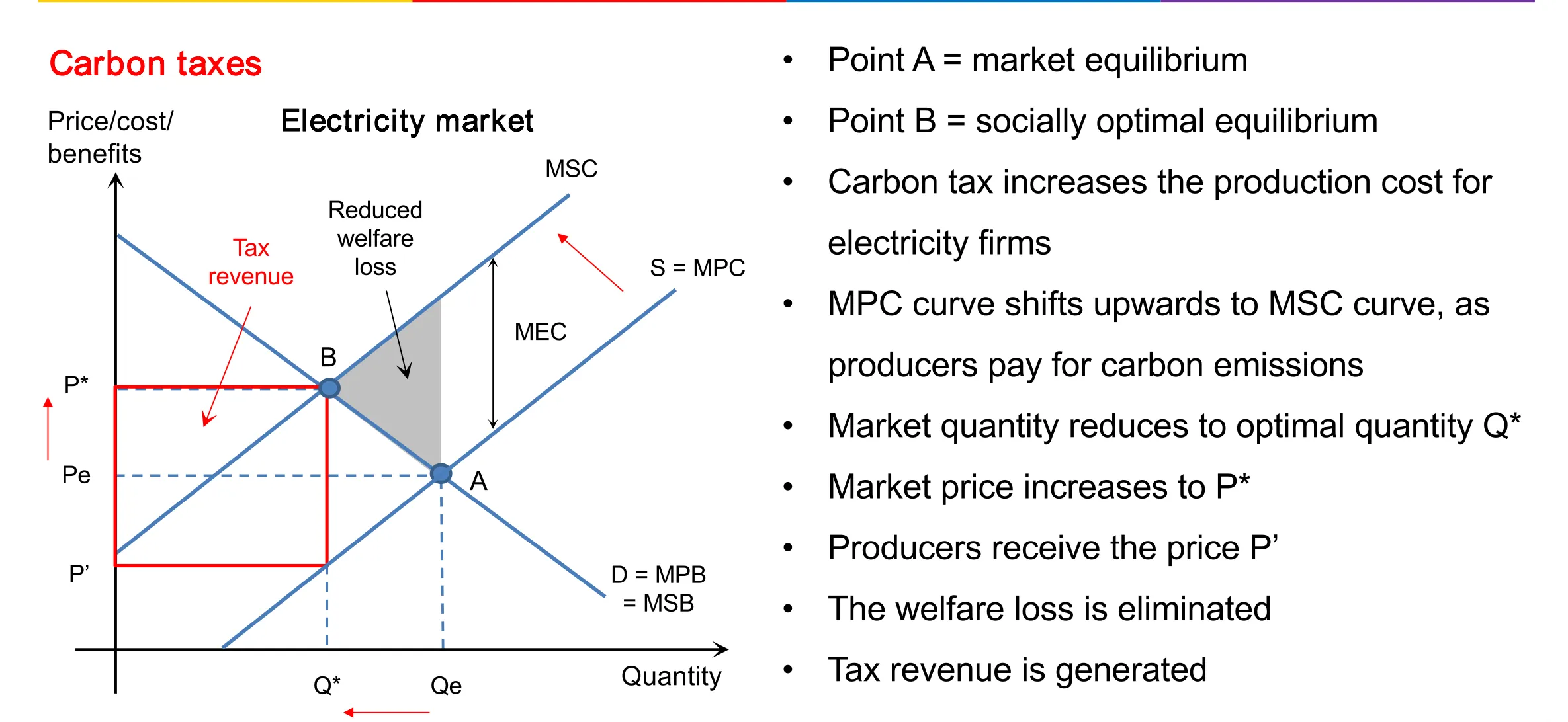
-
Advantages
- Long term benefits – create incentives for firms to use cleaner technologies in production
- Internalize externality – producers and consumers pay for the environmental costs
- Tax revenue generated
- Easily implemented and the effect will be created quickly
-
Disadvantages
- Regressive – low-income groups pay a higher portion of their income for the tax
- For example electricity is necessity, so consumes must purchase it. Higher prices caused by carbon taxes may disproportionately affect low-income consumers, making the tax regressive.
- Ineffective for products with inelastic PED
- the consumption won’t decrease too much(to the socially optimum level), even when prices rise
- Imperfect market information – difficult to accurately calculate the level of externalities and carbon tax in order to achieve the socially-optimum output.
- Regressive – low-income groups pay a higher portion of their income for the tax
-
- Tradable permits
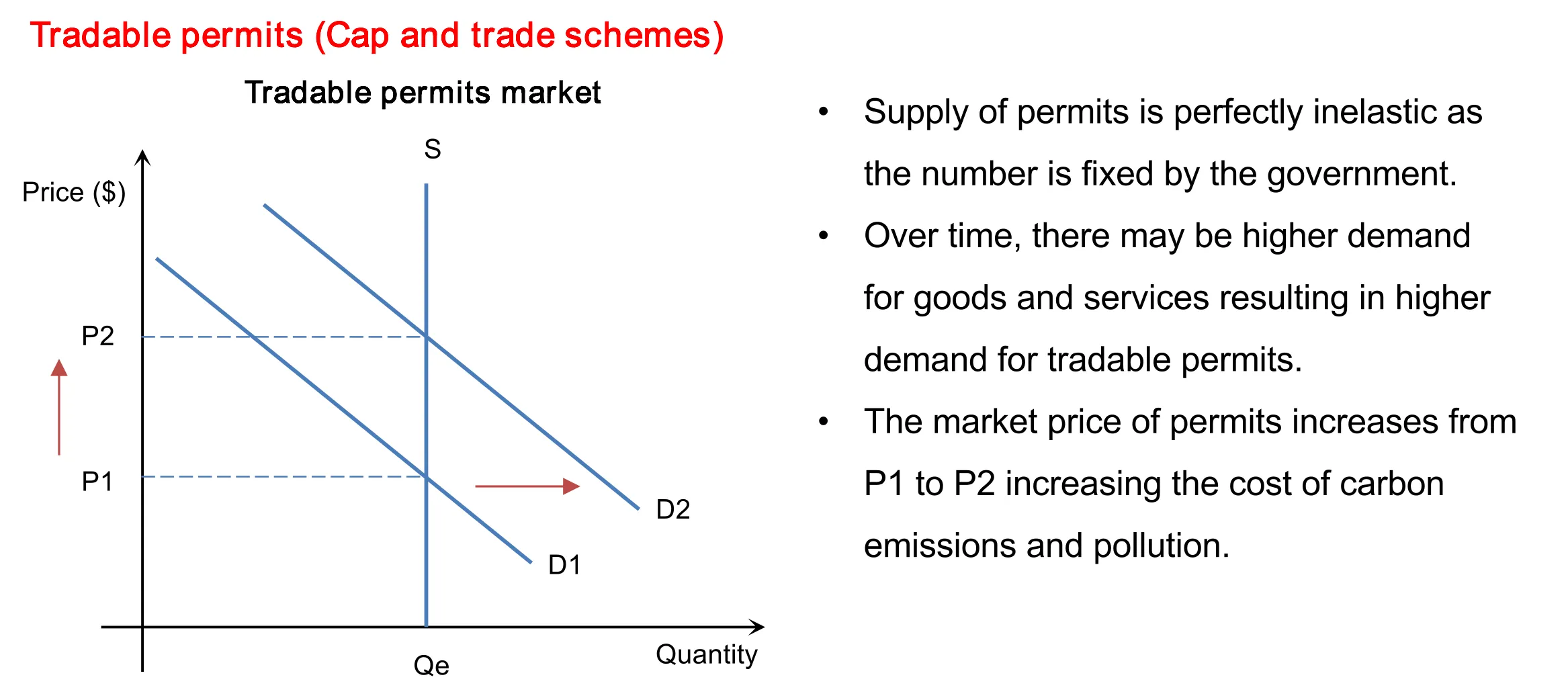
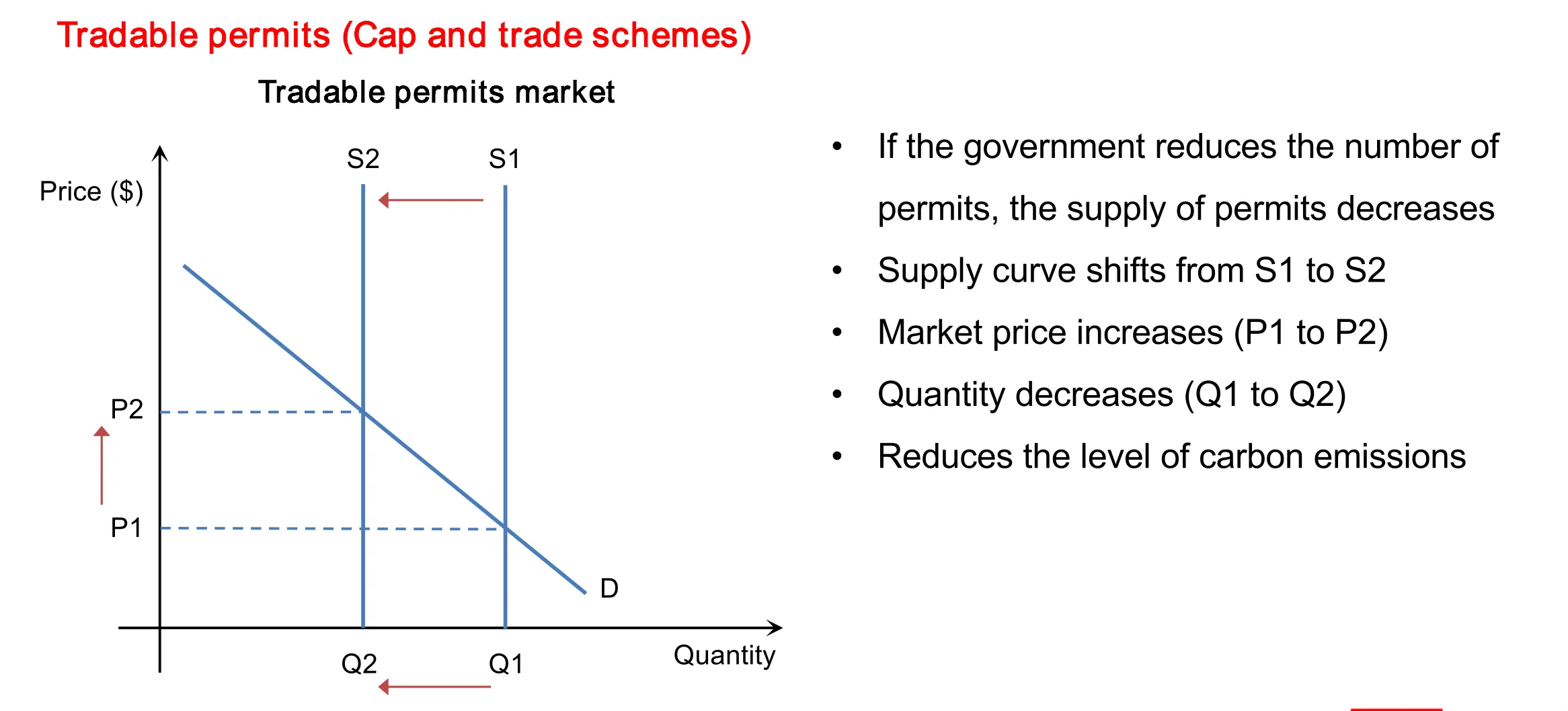
- Tradable permits are government-issued licenses that allow firms to emit a specified amount of pollution, which can be bought and sold in a cap-and-trade system where the government sets an overall limit on emissions.
- 在 cap-and-trade(总量管制与交易)制度下,
政府先设定一个 污染排放总量上限(cap),
再发放与该上限等量的排污许可证,
每张许可证允许排放一定数量的污染,
企业之间可以自由买卖这些许可证(trade)。
- 在 cap-and-trade(总量管制与交易)制度下,
- Tradable permits can be freely traded between firms.
•The more pollutants producers create, the more permits they will need to purchase.
•More environmentally-friendly producers may sell their excess permits to gain revenues.
•In the long run, this creates incentives for firms to switch to cleaner production technologies. -
-
- Advantages
- Limits carbon emissions to a predetermined level.
- Greater incentives for firms to switch to cleaner technologies in the future.
- Internalize externality – consumers and producers pay for external costs.
- Flexibility for firms – firms may choose to switch to clean technologies or pay for permits
- Disadvantages
- Potential job losses due to increased production costs.
- Multinational companies may shift production to other countries to avoid permit constraints.
- Demands for permits are highly price inelastic
- Difficult to determine the socially optimal level of pollutants and permits allowed per year.
- Tradable permits are government-issued licenses that allow firms to emit a specified amount of pollution, which can be bought and sold in a cap-and-trade system where the government sets an overall limit on emissions.
- International agreements
- Nations often develop international agreements to combat negative externalities of production.
- Barriers preventing the success of international agreements:
•Countries are more concerned with their economic interests instead of environmental costs.
•The reluctance of some major countries to join the agreements limits the effectiveness
•High-income countries may exploit low-income countries.
Common Access Resources
- Common access resources are rivalrous and non-excludable resources such as clean air, fish
stocks, and trees. Without government intervention, these resources are likely to be overused. - Non-excludable
- It is impossible to prevent non-payers from benefitting from the resource. The non-excludability nature of common access resources means that they are over-used.
- Rivalrous
- The consumption of a resource reduces the amount available for others to use. Common access resources are rivalrous due to scarcity.
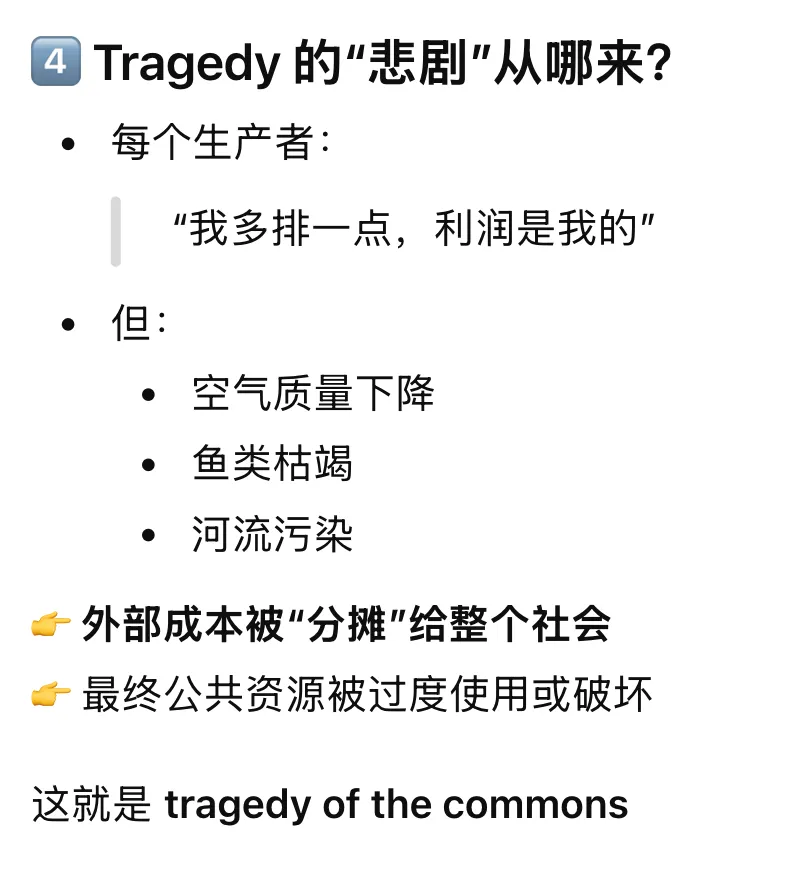
- Tradegy Of The Commons
- The tragedy of the commons is a situation where degradation, depletion or destruction of a common access resource is caused by rivalry and over-consumption.
- Tragedy of the commons example:
•Firms face the temptation to catch as many fish as possible to maximize profits.
•Eventually, fish stocks become depleted over time.
•Firms have reduced or no fish left in the long term.
•Tragedy of the commons occurs due to overfishing. - Due to the non-excludable and rivalrous nature of common access resources, producers will likely over-produce products using such resources. This results in threats to sustainability such as deforestation, air pollution, soil erosion, congestion, overfishing etc.
Common access resources are related to negative externalities of production, where the external cost refers to the threats to
sustainability. -